
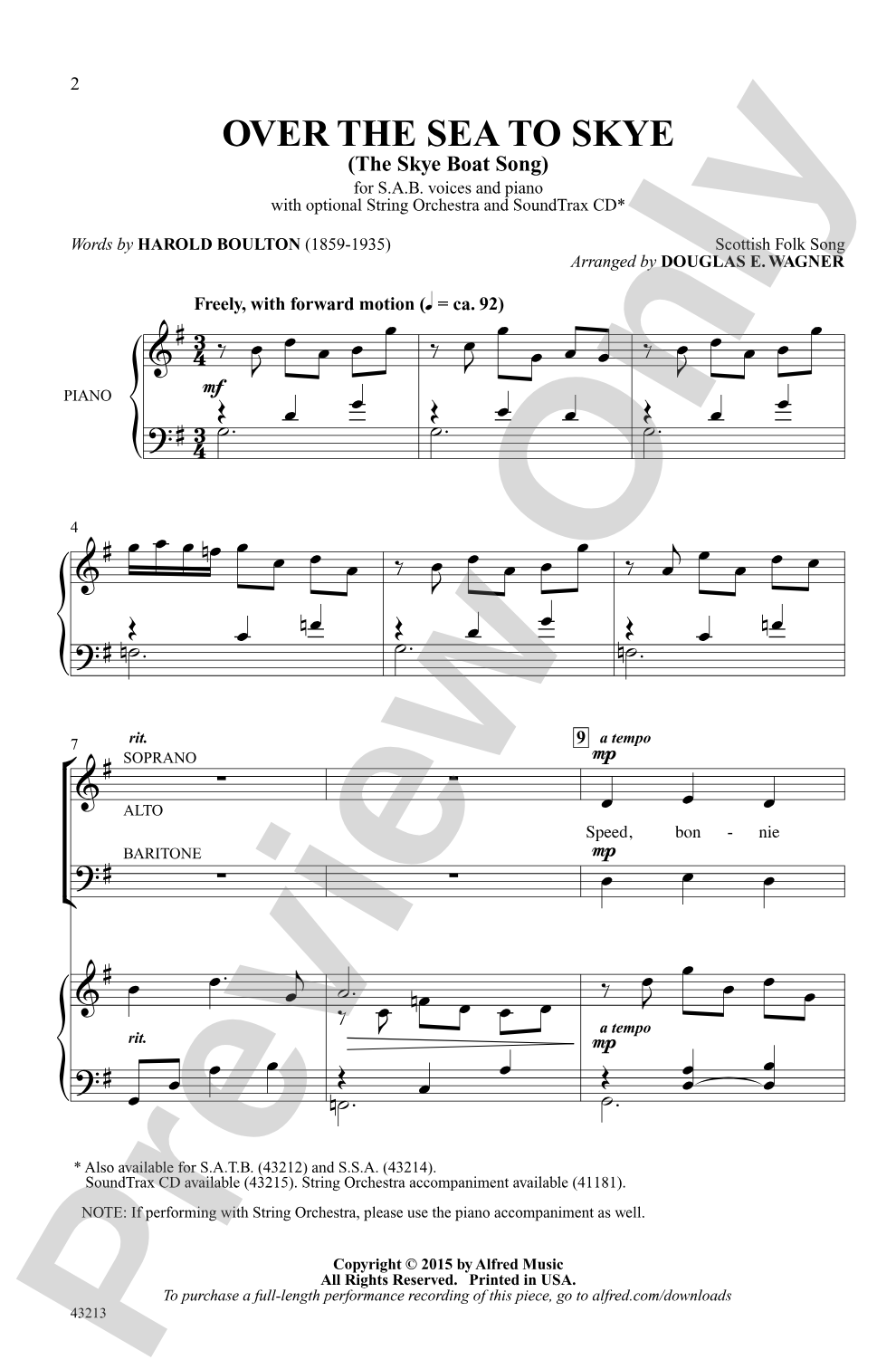
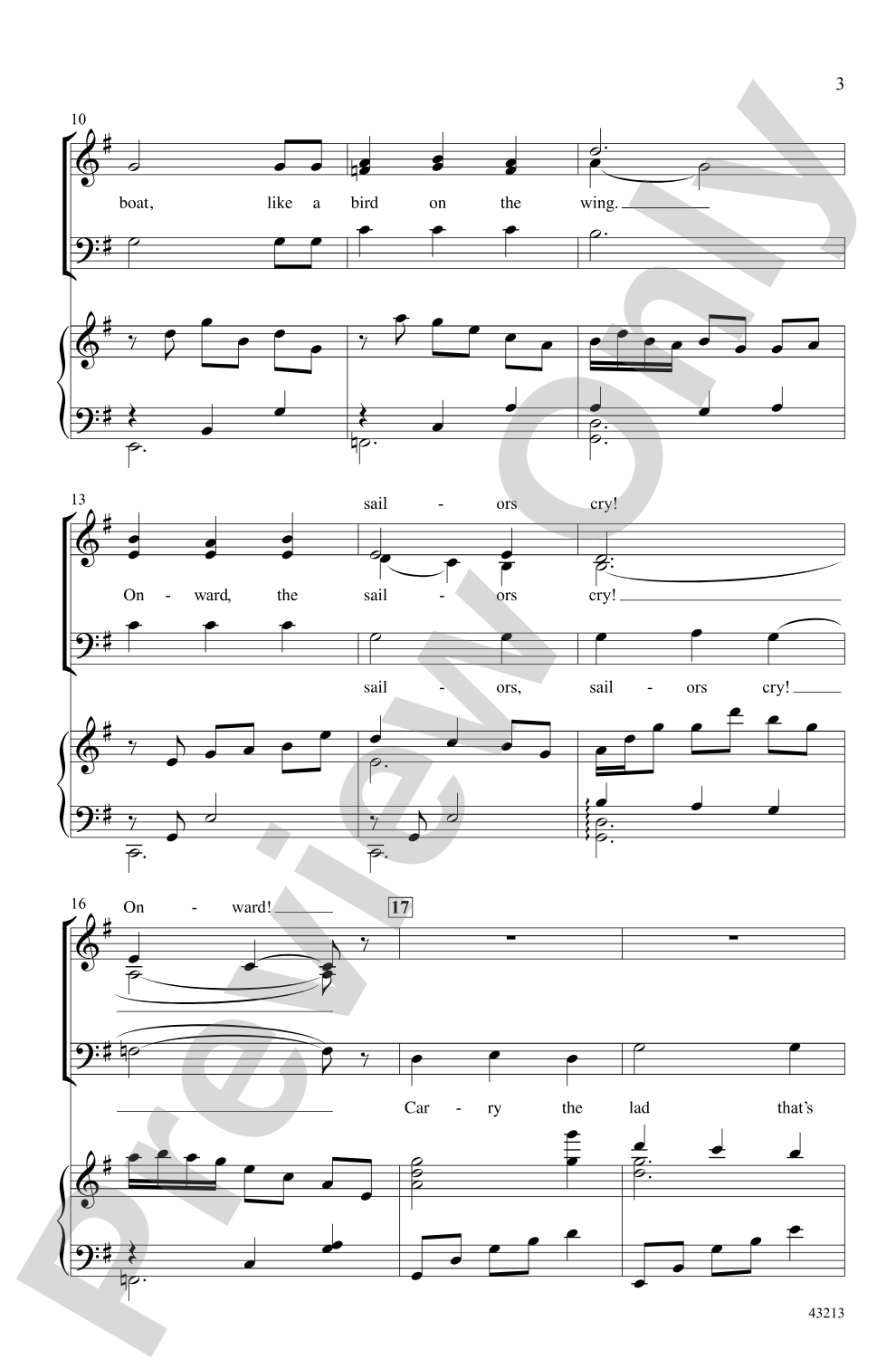

Over the Sea to Skye: SAB Choral Octavo
(The Skye Boat Song)
Scottish Folk Song, words by Harold Boulton / arr. Douglas E. Wagner
Item: 00-PO-0003208
$1.90
Minimum order quantity: 20 copies
Pickup currently not available
Related Items
Over the Sea to Skye: SoundTrax Digital Audio Download |
$27.99
|
View | |
Over the Sea to Skye: SATB Choral Octavo |
$1.90
|
View | |
Over the Sea to Skye: SSA Choral Octavo |
$1.90
|
View | |
Over the Sea to Skye: SATB Choral Octavo |
$1.90
|
View | |
Over the Sea to Skye: SAB Choral Octavo |
$1.90
|
View | |
Over the Sea to Skye: SSA Choral Octavo |
$1.90
|
View | |
Over the Sea to Skye: Choral Octavo SoundTrax CD |
$27.99
|
View |
Description
Like waves of an ocean carrying a boat, the lilting triple-meter of this ageless Scottish folk tune supports warm choral tones. Lush and embracing, it's a lovely ballad for concert or contest. To make it extra special, perform with the optional string orchestra accompaniment.


Over the Sea to Skye: SAB Choral Octavo isn't in MakeMusic Cloud just yet...but it could be. Let us know you'd like to see it, and you'll help shape what comes next. In the meantime, start a free trial and dive into thousands of interactive titles your students can play along with today.
Request This Title
Tell us you want it.
Start Your Free Trial
Explore everything that's ready to play right now.
Sample Audio
1
Audio File
--:--
0:00
0:00
Sample Video
No sample videos found.
Additional Details
Series:
Alfred Choral Designs
Publisher:
Alfred Music
Page Count:
8
SKU:
00-PO-0003208
Instrumentation:
Opt. String Orchestra
More about this title
About the Arranger: Douglas E. Wagner

Douglas E. Wagner brings three decades of high school music direction into his work as a composer and arranger. A Butler University graduate with degrees in music, Wagner has published more than 3,500 titles across virtually every ensemble type: choir, band, orchestra, handbells, organ, piano, and voice. His music circulates globally, with performances documented in concert halls, broadcasts, and festivals across multiple continents.
Since 1973, Wagner has built an extraordinary catalog that reflects deep understanding of what works in the rehearsal room and on the concert stage. With over seventeen million copies of his music in circulation, he stands among the most frequently performed composers in American music education.
Why we love this
Wagner's arrangement captures the emotional warmth of this Scottish standard while making it genuinely singable for three-part mixed voices. The lilting triple meter becomes an asset rather than a challenge, allowing singers to float the melody with natural phrasing. The optional string orchestra parts elevate the arrangement from a concert staple into something contest-ready without requiring a full orchestra to be effective.
What to expect
The arrangement evokes a gentle, maritime quality; the triple meter creates a rocking, almost lullaby-like sensation that suggests the ocean itself cradling the boat. Warm harmonies and a straightforward melodic arc make the piece feel both timeless and intimate, inviting singers and listeners alike into a moment of quiet reflection.
Who it's for
This arrangement suits choirs at the middle school through early high school level, as well as community and church choirs seeking accessible folk material with depth. Directors programming festival or contest entries will find a piece that sits comfortably in three-part mixed voicing while still offering musical sophistication and emotional resonance.
How to get the most out of it
- Let the triple meter breathe naturally; resist over-conducting the pulse and instead shape phrases across measures to echo the wavelike motion described in the text.
- Balance the SAB texture so that the soprano melody remains audible without forcing; the warm character depends on blended rather than prominent upper voices.
- If performing with the string accompaniment, plan rehearsals to let singers hear the optional parts early so they can relate their parts to the fuller texture they'll experience in performance.
How to use it
Program this as a contrast piece in a concert featuring mixed tempos and moods, or as a standalone ballad for festival or contest where its lyrical quality and solid three-part writing will stand out. It also serves well as a concert closer when you want to leave the audience with something gentle and memorable rather than a high-energy finale.
Skills your students will build
- Singing in 3/4 meter with natural phrasing
- Blending vocal parts in SAB voicing
- Interpreting folk melody with stylistic awareness
- Responding to optional instrumental accompaniment and balancing choir sound within a larger ensemble texture