
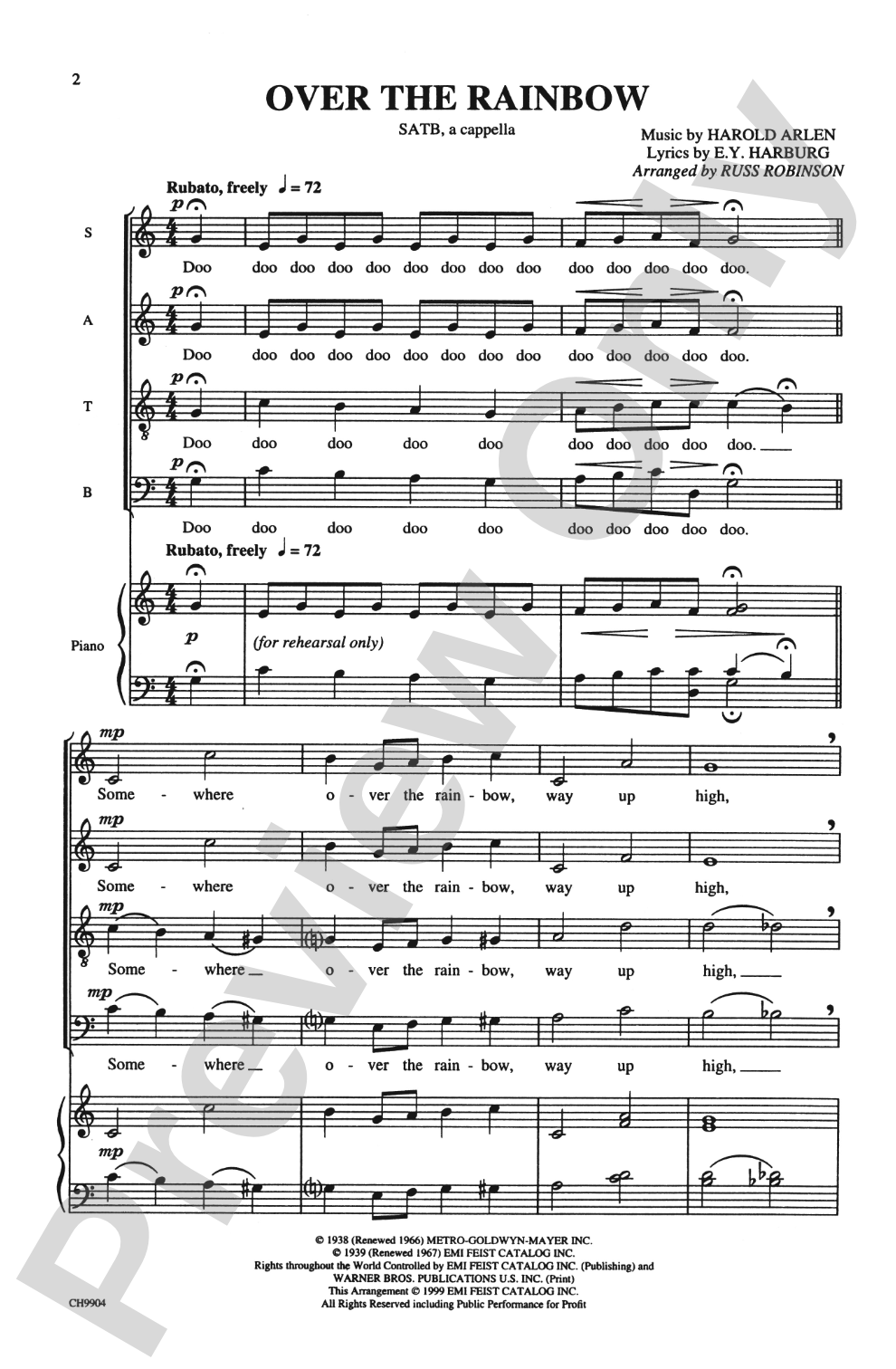
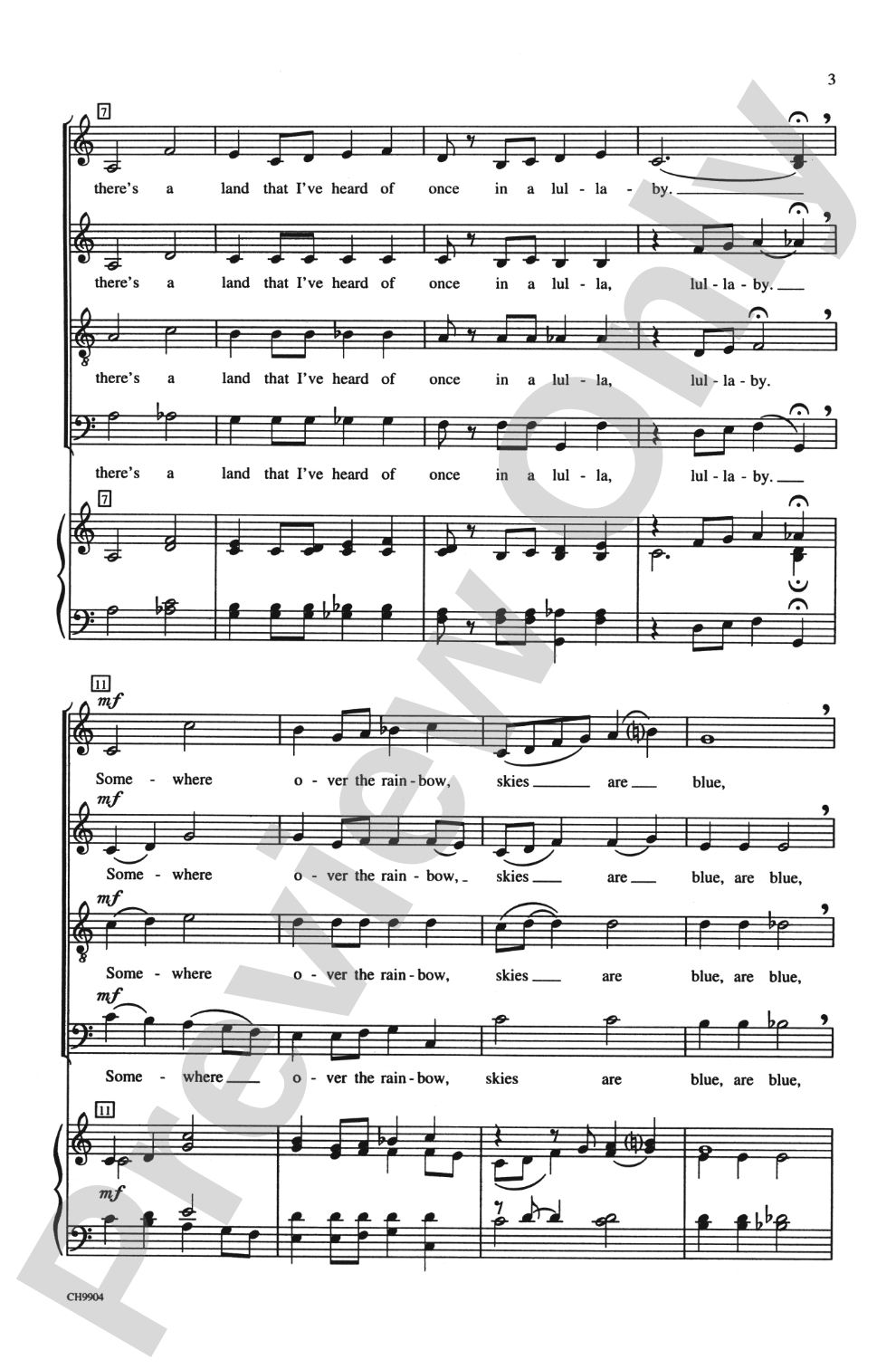

Over the Rainbow: SATB, a cappella Choral Octavo
From the Musical The Wizard of Oz
Music by Harold Arlen, lyric by E. Y. Harburg / arr. Russell Robinson
Item: 00-PO-0002523
$2.10
Minimum order quantity: 20 copies
One moment…
Description
Russ Robinson brings us a very singable a cappella setting of this all-time classic from "The Wizard of Oz." The 1998 theatrical release of the movie created a whole new wave of interest in this wonderful music.


Over the Rainbow: SATB, a cappella Choral Octavo isn't in MakeMusic Cloud just yet...but it could be. Let us know you'd like to see it, and you'll help shape what comes next. In the meantime, start a free trial and dive into thousands of interactive titles your students can play along with today.
Request This Title
Tell us you want it.
Start Your Free Trial
Explore everything that's ready to play right now.
Sample Audio
No sample audio found.
Sample Video
No sample videos found.
Additional Details
Publisher:
Alfred Music
Page Count:
8
SKU:
00-PO-0002523
More about this title
About the Composer: Harold Arlen
Harold Arlen (1905-1986) composed some of the most enduring American popular songs of the twentieth century, with a gift for memorable melodies and sophisticated harmonic language. His work for film and stage defined the Golden Age of Hollywood songwriting, and his ability to craft music that bridges classical training and popular appeal made him a model for generations of composers. "Over the Rainbow" stands as perhaps his most iconic creation, a song that transcends its theatrical origins to become part of the American songbook.
Why we love this
Robinson's a cappella voicing respects the emotional arc of Arlen's original melody while giving your singers something genuinely singable and dramatically coherent without instrumental support. The arrangement works equally well in a contest setting or as a showstopper on a regular concert program, and the eight-page length sits in that sweet spot of substantial without overwhelming rehearsal time. Most importantly, every singer in the ensemble gets to carry real musical weight.
What to expect
The music carries the wistfulness and hope of the original, with moments of genuine vulnerability in the lower register and a sense of yearning that builds toward something transcendent. Robinson's voicing honors Arlen's melodic gift while creating harmonic color that shifts the piece somewhere between nostalgic and timeless.
Who it's for
This arrangement suits SATB choirs of intermediate to advanced ability who are comfortable with a cappella singing and ready to handle the harmonic and rhythmic independence of four-part writing without accompaniment. It works for high school, college, and community choirs looking to program a piece that will connect with audiences while also offering genuine musicianship challenges.
How to get the most out of it
- Shape the line from the opening notes through the ascending phrase and into the relative minor section; resist the urge to reset energy at phrase boundaries. This song lives in its long, continuous arc.
- Balance the inner voices carefully in the lower register during the verses. The harmonic underpinning needs to sit forward enough to support sopranos and altos but not so much that it overwhelms the texture.
- Work the dynamics with intention. "Over the Rainbow" asks for emotional restraint in places where singers instinctively want to belt, and that restraint is what creates the space for genuine impact at the climax.
- Establish rock-solid intonation in the a cappella passages by singing vowel-unified unisons within each voice part during rehearsal, then gradually layer in the harmonic complexity.
How to use it
Program this alongside contemporary choral work or juxtaposed with standard hymn arrangements to highlight its sophistication; audiences recognize the melody immediately, but the a cappella setting reveals layers they may not have heard before. It also works beautifully as a closer to a pop or standards concert program, or as the emotional centerpiece of a thematic concert about hope, dreams, or resilience.
Skills your students will build
- Sustaining intonation without instrumental reference across multiple phrases
- Blending four independent voice parts while maintaining clear harmonic function
- Shaping long melodic lines through dynamic control and phrasing
- Singing in a lighter, more introspective register than typical pop or jazz arrangements
- Navigating harmonic progressions with chromatic voice leading