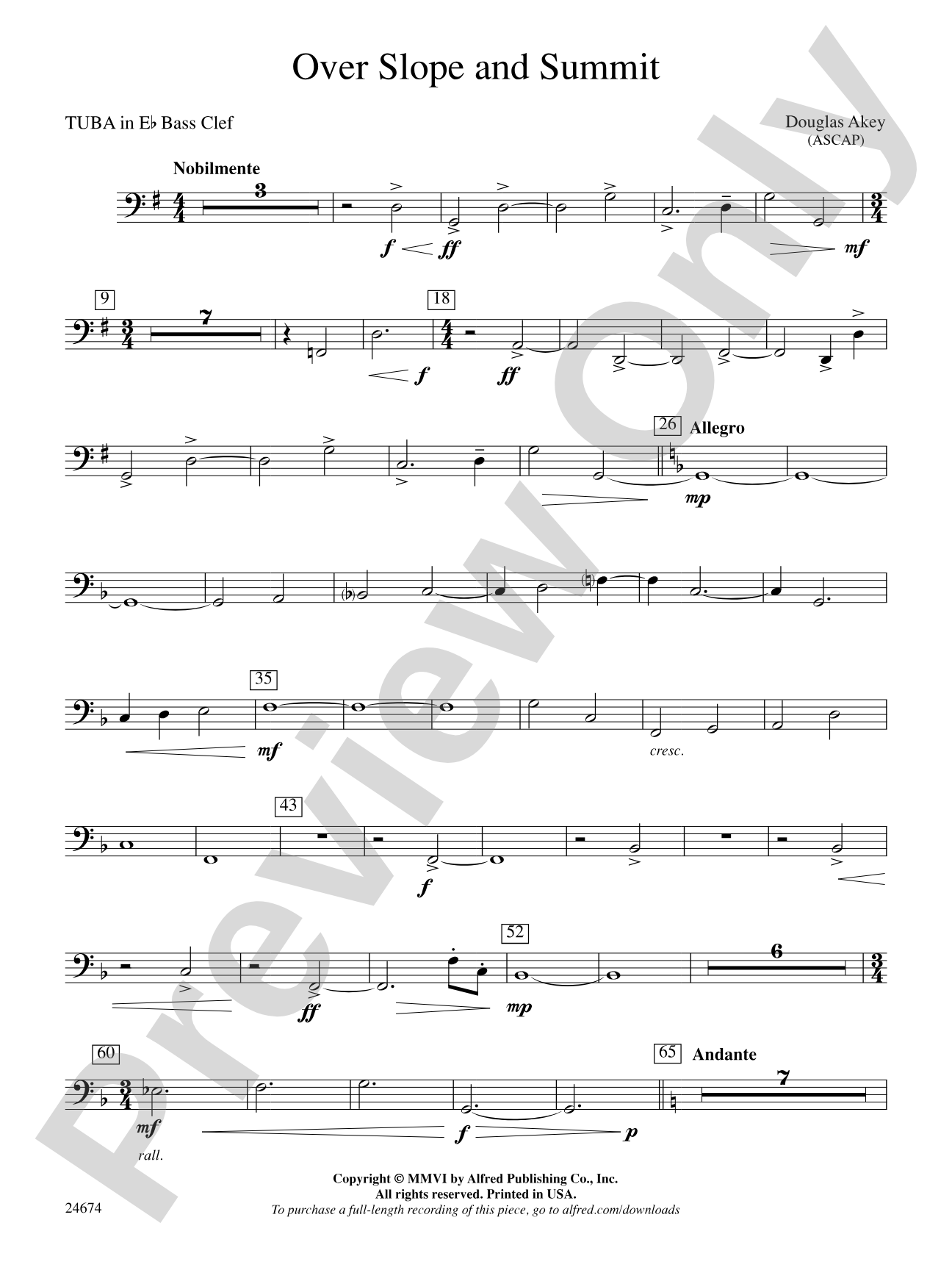
Over Slope and Summit: (wp) E-flat Tuba B.C. Sheet Music Preview

Over Slope and Summit: (wp) E-flat Tuba B.C.

By Douglas Akey

Grade: 4 (Medium Difficult)

Item: 00-PC-0000842_wpTBEBC

Digital Download
$3.00
Description
Over Slope and Summit was written for the Mountain View High School Wind Ensemble (Loveland, CO) and its director, Peter Toews. Alpine fanfares and soaring melodies create a musical painting of the five peaks of the Rocky Mountains that are visible from the school's campus.

Don't just read it, hear it, play along with it, and watch your students grow with it. In MakeMusic Cloud, Over Slope and Summit: (wp) E-flat Tuba B.C. comes alive with professional accompaniment, adjustable tempo, and built-in practice tools that turn solo practice into real progress.

Sample Audio
0:00
0:00
Sample Video
Additional Details
Series: Alfred Concert Band
Publisher: Alfred Music
SKU: 00-PC-0000842_wpTBEBC

More about this title

About the Composer: Douglas Akey

Douglas Akey

Douglas Akey earned his bachelor's degree in Instrumental Music and master's degree in Solo Performance from Arizona State University, where he studied on a performance scholarship. For nearly four decades, he has served as Director of Bands and Music Department Chairperson at Hendrix Junior High School in Chandler, Arizona, building a program recognized across the state and nation.

Akey's compositions have become fixtures on state contest lists and appear in repertoires worldwide. His contributions to music education have earned him the Stanbury Award from the American School Band Directors Association and recognition as a National Federation of Secondary Schools Music Educator of the Year.

Why we love this

Akey writes with genuine affection for the Colorado landscape, and that specificity lifts the piece beyond generic nature painting. The Alpine fanfare gestures feel earned rather than decorative, and the soaring melodic writing gives your ensemble something genuinely expressive to sink their teeth into at Grade 4 difficulty. Programming this after contest season gives students a chance to play concert music rooted in real geography and real community.

What to expect

Alpine peaks emerge from mist. Horns call across valleys while the ensemble swells in response. The music breathes with the same unhurried grandeur as the Rocky Mountain landscape, painting a sonic picture that feels both intimate and vast.

Who it's for

Band directors looking for Grade 4 concert music that connects to place and community. This works equally well for ensembles building a music appreciation program and for groups wanting accessible repertoire with genuine artistic depth.

How to get the most out of it

  • Balance the opening fanfares so the brass punctuation supports rather than overwhelms the melodic lines. This clarity will help the sweeping sections land with greater impact.
  • Shape the soaring melodies with long-term phrase architecture rather than note-to-note phrasing. Think in four and eight-bar units to build the sense of peaks and valleys the program intends.
  • Bring out harmonic color shifts in the accompaniment figures. Akey uses them to suggest movement through the landscape, not just to fill texture.
  • Let the ensemble breathe at natural resting points. Resisting the urge to rush through transitions between sections keeps the mountainous journey audible and unhurried.

How to use it

This is ideal for a spring concert celebrating regional culture or natural heritage. Use it alongside folk-inspired pieces or other geo-specific work to build a thematic program. The piece also serves as an excellent winter or late-season choice when you want to build musicality without the technical fireworks of contest literature.

Skills your students will build

  • Sustaining long melodic lines with consistent tone and vibrato control
  • Balancing principal and secondary parts to create transparent texture
  • Shaping contours in fanfare figures to suggest narrative arc
  • Reading and executing dynamic and expression markings that evoke landscape imagery
  • Responding to large-form phrasing across multiple systems

You May Also Like