
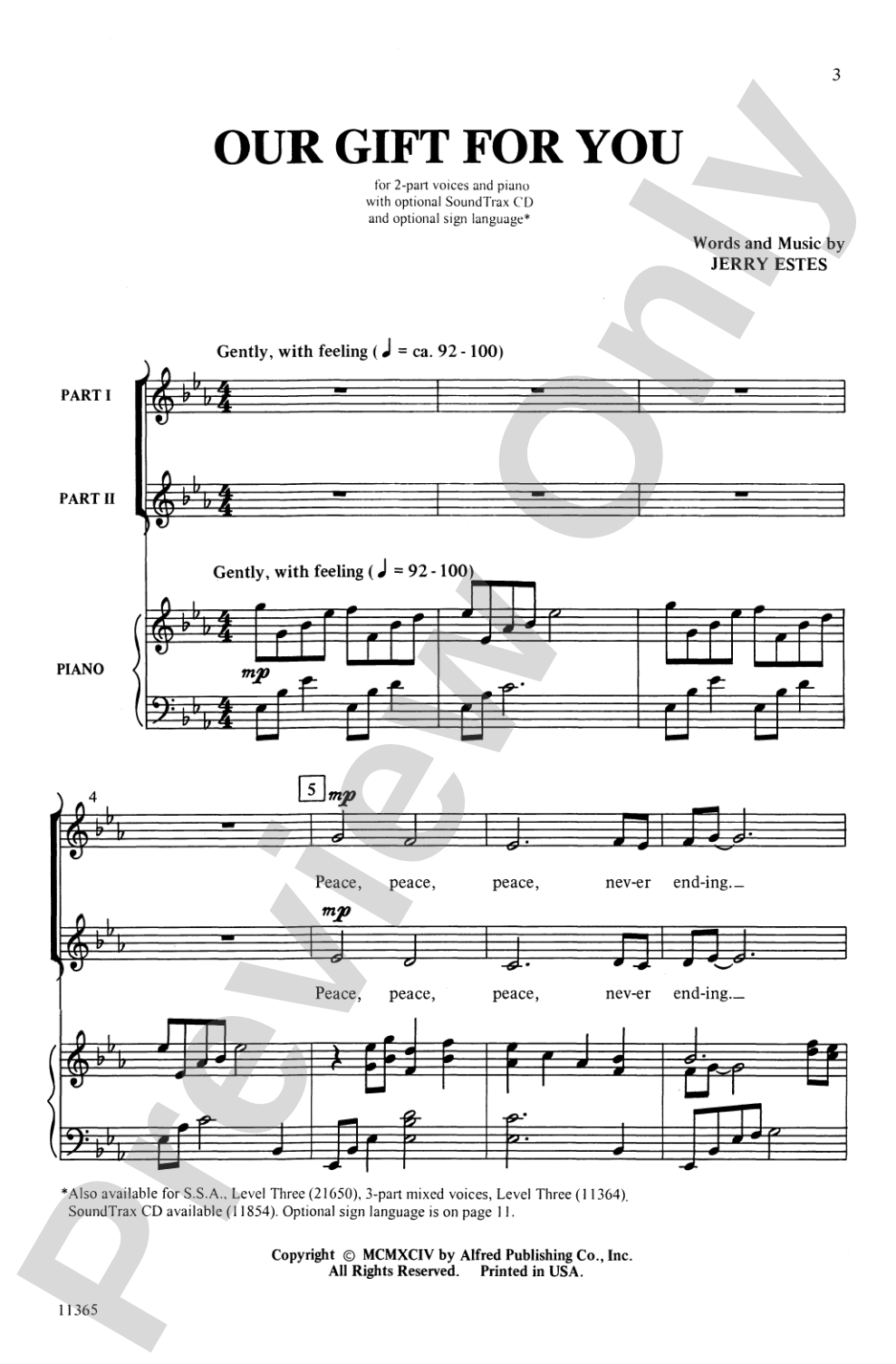

Our Gift for You: 2-Part (with Opt. Sign Language) Choral Octavo
Music by Jerry Estes
Item: 00-PO-0002055
$2.25
Minimum order quantity: 20 copies
Pickup currently not available
Related Items
Our Gift for You: 3-Part Mixed (with Opt. Sign Language) Choral Octavo |
$2.25
|
View | |
Our Gift for You: SSA Choral Octavo |
$2.25
|
View | |
Our Gift for You: SSA Choral Octavo |
$2.25
|
View | |
Our Gift for You: 2-Part (with Opt. Sign Language) Choral Octavo |
$2.25
|
View | |
Our Gift for You: Choral Octavo SoundTrax CD |
$27.99
|
View |
Description
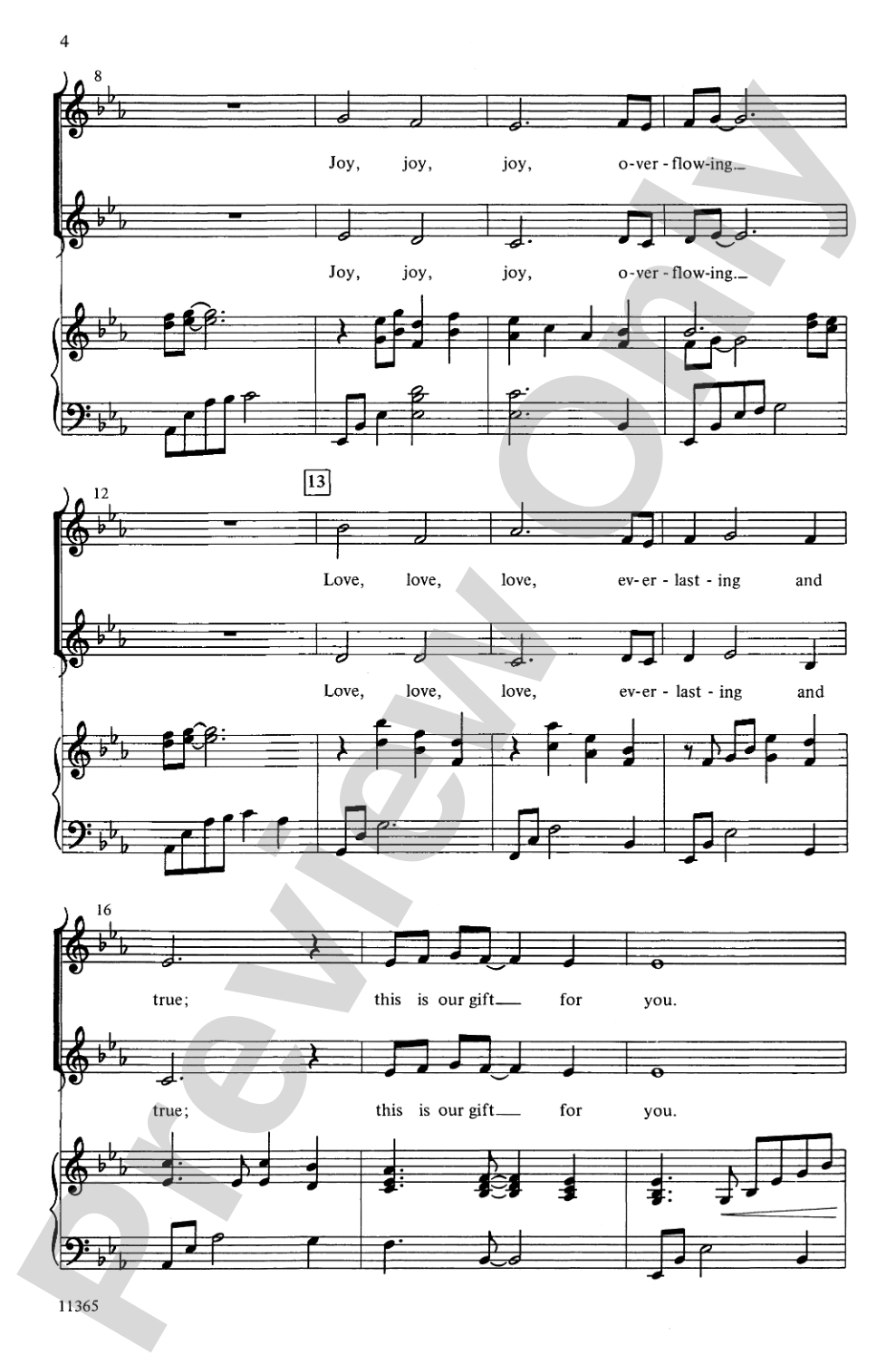
What a wonderful choice for your 2-part or 3-part choirs. Long, held notes with simple harmonic movement make OUR GIFT FOR YOU ideal for developing a good choral blend. And the text--in which the singers' "gift" is peace, love, and joy--is universal. Optional sign language symbols (for the chorus) are included in the publication. Although it's a "general" piece suitable for performance year' round, we think it's appropriate for Christmas, too. Featured on "On with the Show!" video, 00-21799.


Our Gift for You: 2-Part (with Opt. Sign Language) Choral Octavo isn't in MakeMusic Cloud just yet...but it could be. Let us know you'd like to see it, and you'll help shape what comes next. In the meantime, start a free trial and dive into thousands of interactive titles your students can play along with today.
Request This Title
Tell us you want it.
Start Your Free Trial
Explore everything that's ready to play right now.
Sample Audio
1
Audio File
--:--
0:00
0:00
Sample Video
No sample videos found.
Additional Details
Series:
Alfred Archive Edition: Alfred Choral Designs
Publisher:
Alfred Music
Page Count:
12
SKU:
00-PO-0002055
More about this title
About the Composer: Jerry Estes

Jerry Estes brings classroom experience directly into his compositional work. A vocal music educator at Wydown Middle School, where he teaches grades 6-8, Estes holds a B.M.E. in vocal emphasis from Southwest Baptist University and an M.M. from Southern Illinois University. His professional involvement with MENC and ASCAP reflects his commitment to both music education and the composing craft.
Esses' choral writing prioritizes accessibility without sacrificing musical integrity. His pieces emerge from direct knowledge of what young singers need: manageable ranges, clear harmonic structures, and texts that resonate beyond a single performance season.
Why we love this
This piece delivers exactly what developing choirs need: sustained harmonic writing that trains ears to listen inward and match vowels across parts. The optional sign language integration reflects genuine inclusion rather than an afterthought, giving you a real pedagogical tool for visual learners and a staging option that deepens performance meaning.
What to expect
Serene and affirming. The long, held notes create space for singers to focus on tone quality and listen carefully to those around them. The message of peace, love, and joy settles quietly into the room rather than announcing itself, making this piece feel both reflective and genuinely uplifting.
Who it's for
Middle school and high school 2-part or 3-part choirs looking for repertoire that builds fundamental skills in blend and sustained singing. This works equally well for general music ensembles, treble choirs, or mixed choirs arranged in two parts.
How to get the most out of it
- Begin by singing the piece unaccompanied to establish blend habits before adding the recorded accompaniment. This forces the choir to listen to each other rather than rely on instrumental support.
- Address the longer sustained notes by working with individual phrases for breath placement; mark your scores clearly so singers know they have permission to breathe and reset without losing the line.
- If using sign language, integrate it into rehearsals early rather than as a final touch. Movement should feel integral to the piece, not superimposed.
- Work the two parts independently at first, especially in sections where they move in different rhythmic patterns. Once each part is secure, blend them slowly to hear how the harmonies settle.
How to use it
Program this during winter concert season or throughout the year as a moment of stillness in a concert that might otherwise move quickly. It pairs well alongside more rhythmically active pieces, and its thematic focus on universal values makes it suitable for peace-centered programs, graduation ceremonies, or any concert that benefits from a centered, contemplative moment.
Skills your students will build
- Sustaining tone across long note values without pitch drift
- Listening across parts to achieve blend and tuning balance
- Coordinated breath management in legit singing
- Integration of movement and staging with vocal production
- Reading 2-part voicing and harmonic function