
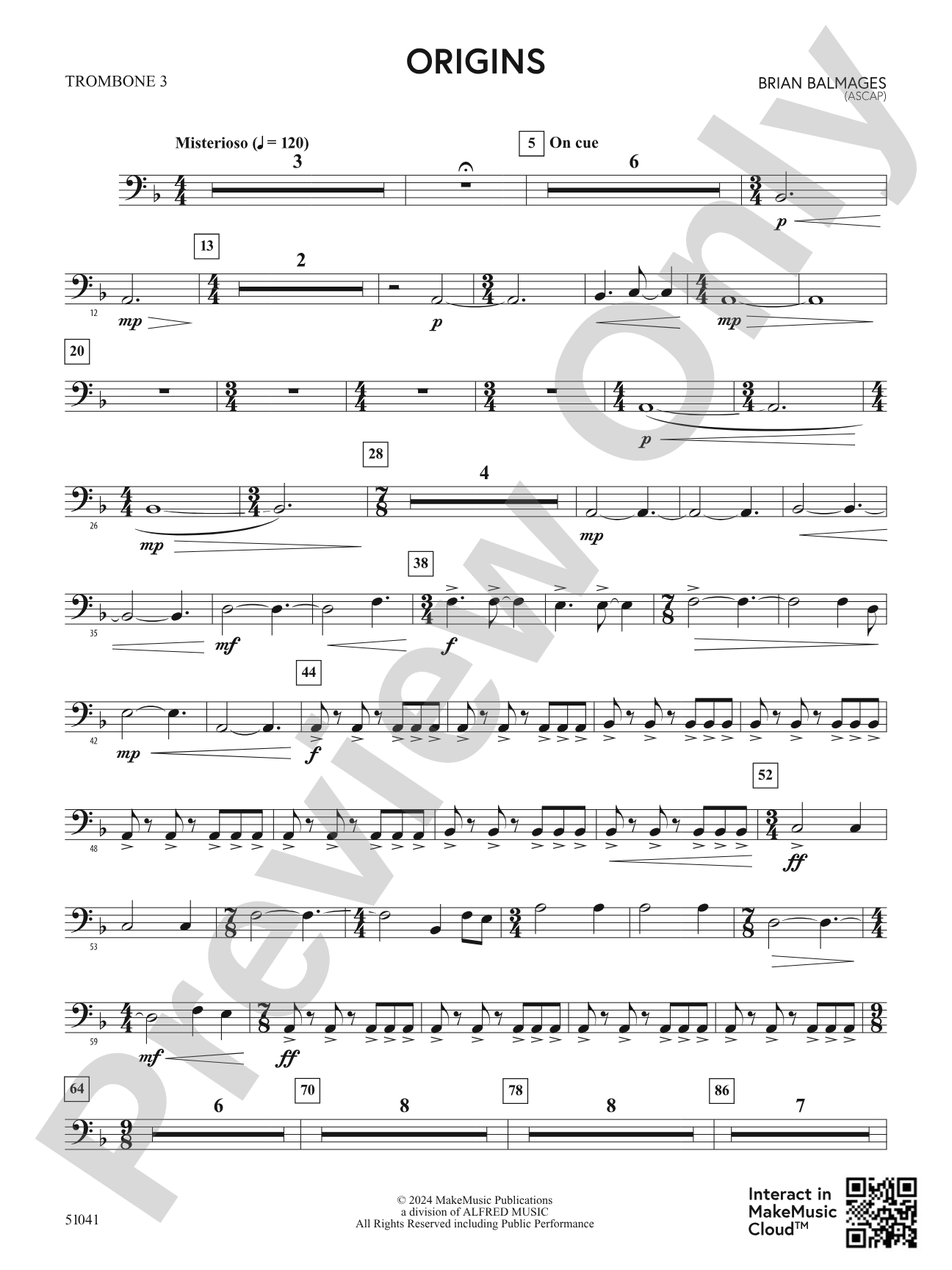

Origins: 3rd Trombone
By Brian Balmages
Grade: 4
Item: 00-PC-0019243_TN3
$5.99
Pickup currently not available
Description
This cinematic-inspired work by Brian Balmages will bring down the house in grand fashion! In addition to the powerful melodic lines, colorful orchestration, and pulsating rhythms, Origins has optional parts for didgeridoo and wordless choir. Not just a piece, but an experience! (5:45)
00-PO-0007316 - SATB
00-PO-0007315 - SSAA
00-PO-0007317 - TTBB


00-PO-0007316 - SATB
00-PO-0007315 - SSAA
00-PO-0007317 - TTBB
Don't just read it, hear it, play along with it, and watch your students grow with it. In MakeMusic Cloud, Origins: 3rd Trombone comes alive with professional accompaniment, adjustable tempo, and built-in practice tools that turn solo practice into real progress.
Open in the Player
Jump straight in and assign it today.
Start Your Free Trial
Open this title and explore the full library in minutes.
Sample Audio
1
Audio File
--:--
0:00
0:00
Sample Video
Additional Details
Series:
MakeMusic Symphony Orchestra
Publisher:
MakeMusic Publications
SKU:
00-PC-0019243_TN3
More about this title
About the Composer: Brian Balmages

Brian Balmages has established himself as a composer and conductor working across orchestral, band, and chamber music with equal authority. His works have reached audiences worldwide, from Carnegie Hall and the Kennedy Center to the Sydney Opera House, performed by ensembles spanning professional orchestras to elementary school groups. He holds the A. Austin Harding Award from the American School Band Directors Association, won the 2020 NBA William D. Revelli Composition Contest for Love and Light, and serves as an elected member of the American Bandmasters Association.
Balmages received the inaugural James Madison University Distinguished Alumni Award from the School of Visual and Performing Arts and was commissioned by the University of Miami to compose music for the inauguration of the institution's sixth president. His music was performed during the 2013 Presidential Inaugural Prayer Service. As a guest conductor, he maintains regular appearances at all-state and regional ensembles, university and professional orchestras, and major conferences including the Midwest Clinic, Western International Band Clinic, and numerous state ASTA conferences. He currently serves as Director of MakeMusic Publications and Digital Education for Alfred and MakeMusic.
Why we love this
Origins delivers exactly what Grade 4 orchestras need: a full-bodied, accessible work that sounds far more sophisticated than its technical demands suggest. The optional didgeridoo and wordless choir parts transform a solid symphonic piece into a genuine theatrical event, giving your ensemble multiple ways to scale the experience based on your resources and concert goals.
What to expect
Origins sweeps listeners into a cinematic journey driven by powerful melodic lines and rich, layered orchestration. The pulsating rhythms create forward momentum that builds toward moments of genuine grandeur, while the optional wordless voices and didgeridoo infuse an earthy, primal quality that justifies the work's title.
Who it's for
Grade 4 orchestras ready to tackle a piece with genuine dramatic arc and orchestration that engages every section. This is ideal for groups seeking a concert centerpiece that showcases musicianship while remaining within technical reach, especially those interested in exploring programmatic storytelling.
How to get the most out of it
- Balance the wordless choir as a textural layer rather than a melodic voice; it should blend into the orchestration rather than compete with the primary themes.
- Work the didgeridoo player into rehearsals early if you're including that part; it requires time to integrate the rhythmic and tonal color into the ensemble sound.
- Allow the pulsating rhythms to drive forward naturally; resist over-conducting during the rhythmic sections and let the percussion section breathe with the written patterns.
- Build dynamic contrast throughout the five-minute-plus duration by shaping phrases deliberately; the cinematic scope demands clear architectural planning from measure to measure.
How to use it
Program Origins as the finale of a concert where it can command full focus and attention; the five-minute-plus duration and dramatic arc demand the closing slot or a featured position. It works equally well as a centerpiece at festivals or contests, where the combination of technical accessibility and theatrical impact will engage both adjudicators and audiences.
Skills your students will build
- Balancing multiple textural layers (melodic lines, rhythmic accompaniment, optional choral and wind instrument colors)
- Sustaining ensemble cohesion through varied meter and rhythmic patterns
- Reading and executing pulsating rhythmic figures with precision and ensemble unity
- Responding to large-scale dynamic and structural arcs in programmatic music
- Coordinating optional instrumental and vocal parts within a full orchestra texture