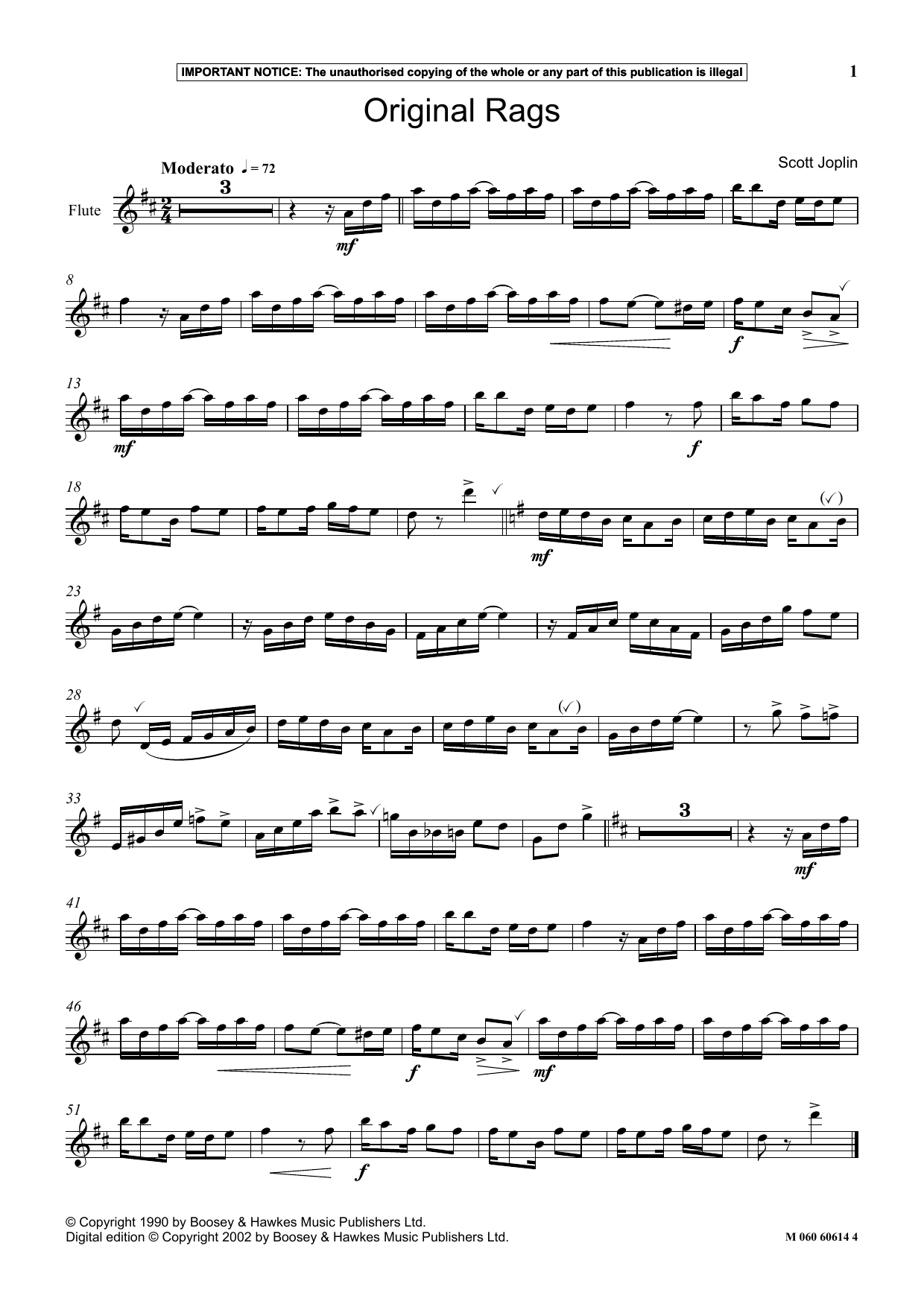
Original Rags Sheet Music Preview

Original Rags: Instrumental Solo

As performed by Scott Joplin

Item: 35-DS00239057

Digital Download
$3.99
One moment…
Description

Discover MakeMusic Cloud: thousands of interactive titles your students can play along with today.

Sample Audio
No sample audio found.
Sample Video
Additional Details
Publisher: Hal Leonard
Page Count: 3
SKU: 35-DS00239057

More about this title

About the Artist: Scott Joplin

Scott Joplin (1868–1917) stands as the defining composer of American ragtime, a genre that fundamentally reshaped how musicians understood syncopation, form, and rhythmic sophistication. His carefully crafted rags elevated the style from popular entertainment to serious compositional art, combining European structural principles with African American rhythmic innovation in ways that influenced jazz, stride piano, and twentieth century classical music.

Joplin's legacy in music education extends far beyond his most famous works. His rags demand technical precision, rhythmic independence between hands, and deep listening to harmonic progression. Teaching his compositions gives students direct access to a uniquely American musical tradition and builds the kind of coordinated independence that serves any advanced pianist.

Why we love this

This piece sits in that rare space where genuine musical sophistication meets engaging rhythm. Performers must navigate syncopated melody lines while maintaining steady accompanimental patterns, which builds the kind of rhythmic autonomy that transfers directly to jazz, contemporary music, and complex solo repertoire. PRFSOL rewards careful practice without feeling like an etude.

What to expect

Propulsive energy balanced with compositional elegance. Joplin's ragtime doesn't shimmy aimlessly; every syncopation serves the melodic line, creating momentum that feels inevitable rather than playful. The piece sits somewhere between a march and a dance, precise but never stiff.

Who it's for

Intermediate to advanced pianists ready to tackle syncopation beyond simple off-beat rhythms. Students studying American music history, jazz history, or twentieth century musical roots will find this essential. Teachers building toward ragtime as a gateway into jazz and contemporary styles.

How to get the most out of it

  • Separate the hands physically during early learning. Practice the left hand pattern in isolation until it becomes reflexive; syncopated melodies demand mental space to land cleanly.
  • Lean into the written rhythms without rushing. Ragtime sits in a particular pocket between march-like precision and jazz swing; respecting Joplin's notation creates the architecture that makes syncopation sparkle.
  • Shape the melody with subtle dynamic contour. The right hand carries the character; allow phrases to breathe and peaks to emerge so the accompaniment recedes into support.
  • Maintain evenness in the ragtime stride or accompaniment figure. Any wobble in the foundation destabilizes the syncopated line above it.

How to use it

Pair this with other Scott Joplin rags to contextualize his voice within the genre, or program it alongside early jazz pieces to trace the musical conversations happening in that era. It also works as a solo recital moment for intermediate pianists who want to claim an American classic without the technical demands of concert grands like The Entertainer.

Skills your students will build

  • Reading and executing syncopation between left and right hands
  • Maintaining rhythmic independence while playing contrasting figures simultaneously
  • Shaping melody across syncopated accompaniment patterns
  • Interpreting early twentieth century American compositional idiom
  • Building technical coordination for stride piano and ragtime style

You May Also Like