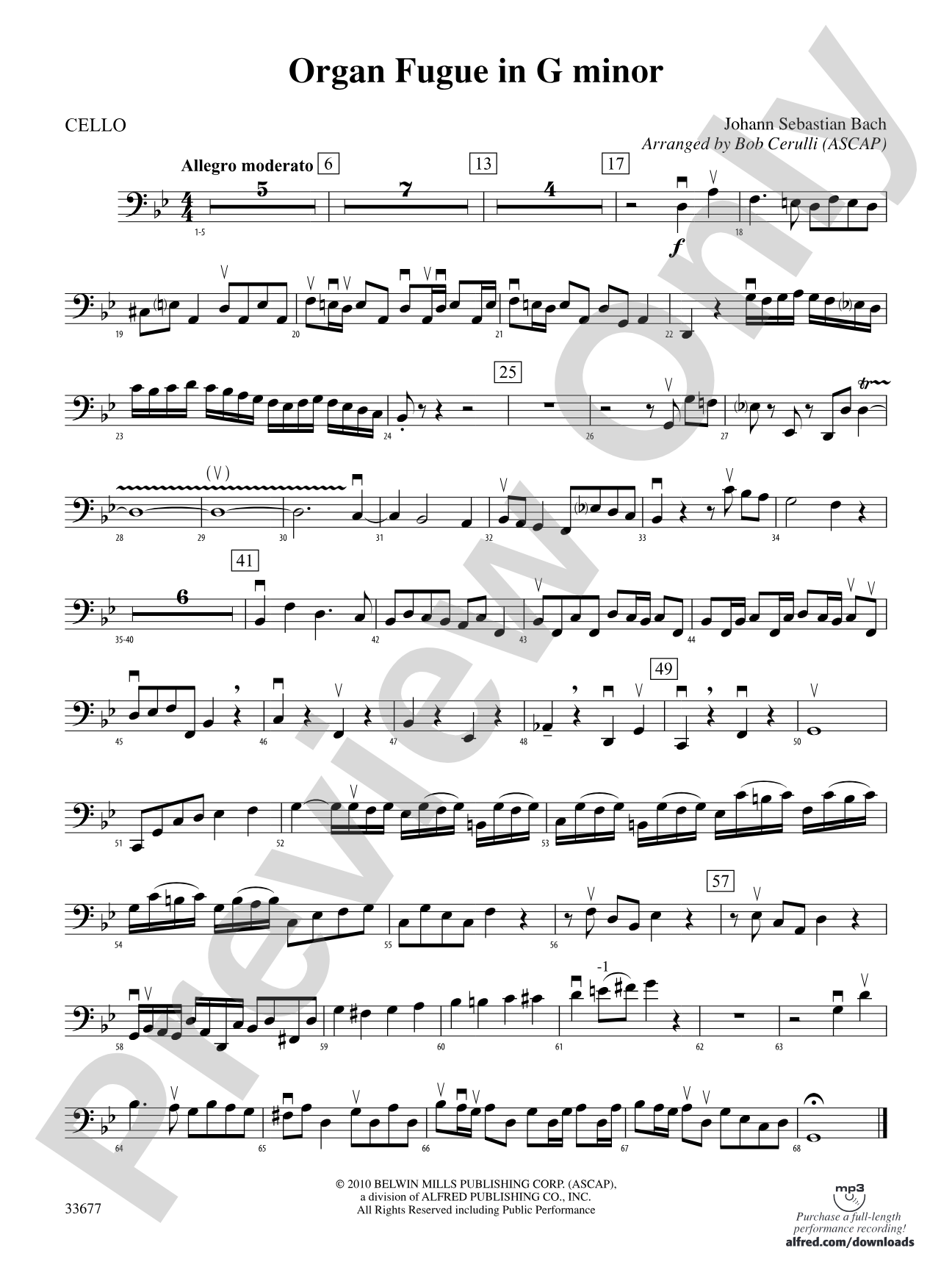
Organ Fugue in G Minor: Cello Sheet Music Preview

Organ Fugue in G Minor: Cello

Little

By Johann Sebastian Bach / arr. Bob Cerulli

Grade: 4

Item: 00-PC-0014468_VC1

Digital Download
$5.99
Description
A lovely transcription sure to delight audiences and students. (3:22) This title is available in MakeMusic Cloud.

Don't just read it, hear it, play along with it, and watch your students grow with it. In MakeMusic Cloud, Organ Fugue in G Minor: Cello comes alive with professional accompaniment, adjustable tempo, and built-in practice tools that turn solo practice into real progress.

Sample Audio
0:00
0:00
Sample Video
Additional Details
Series: Belwin Concert String Orchestra
Publisher: Alfred Music
Page Count: 104
SKU: 00-PC-0014468_VC1

More about this title

About the Composer: Johann Sebastian Bach

Johann Sebastian Bach (1685-1750) stands as one of the most influential composers in Western music history. His mastery of counterpoint, harmonic innovation, and structural design established principles that shaped composition for centuries. Bach's works remain central to music education because they teach musicians how voices interact, how musical ideas develop, and how rigorous technique serves expressive purpose.

Why we love this

This transcription brings one of Bach's most celebrated keyboard works into the string orchestra setting where its architectural brilliance becomes visceral and immediately accessible to audiences. Bob Cerulli's arrangement respects the original counterpoint while exploiting the richness strings bring to every voice, and Grade 4 orchestras can tackle genuine Baroque mastery without sacrifice.

What to expect

The music unfolds with architectural precision, each voice entering at exactly the right moment to build harmonic and emotional weight. There's a sense of inevitability to it, as if the music is working itself out according to laws of logic and beauty operating simultaneously. The writing feels formal yet never cold, learned yet deeply moving.

Who it's for

String orchestra directors working at the Grade 4 level who want to program substantial, intellectually rigorous music without stepping outside their ensemble's technical reach. This works equally well for concert and festival settings, giving serious young musicians something genuinely important to learn and perform.

How to get the most out of it

  • Establish the subject clearly in the first violin from the opening; every entrance of this fugal theme afterward depends on listeners recognizing its shape and contour.
  • Balance the inner voices (viola and second violin) as carefully as you balance the outer ones. Fugal writing only works when all lines have equal presence.
  • Shape phrases through bow direction rather than sudden dynamic changes. Let the harmonic rhythm and voice leading itself guide the swell and release.
  • Resist dragging the tempo as the texture thickens. Maintain the rhythmic integrity of the subject even as counterpoint accumulates.

How to use it

Anchor a concert with this as a centerpiece work that shows what young orchestras can accomplish at the Grade 4 level. It pairs naturally with other Baroque or Renaissance pieces, or it can stand alone as the serious work in a program otherwise built from lighter fare. Consider featuring it in a festival context where adjudicators appreciate students engaging with authentic masterworks.

Skills your students will build

  • Following and executing fugal subject entries across multiple voices
  • Maintaining rhythmic precision while balancing complex contrapuntal textures
  • Shaping long melodic lines through articulation and bow control rather than excessive vibrato
  • Listening to inner voices and understanding how counterpoint creates harmony
  • Reading and performing in varied registers across the string section

You May Also Like