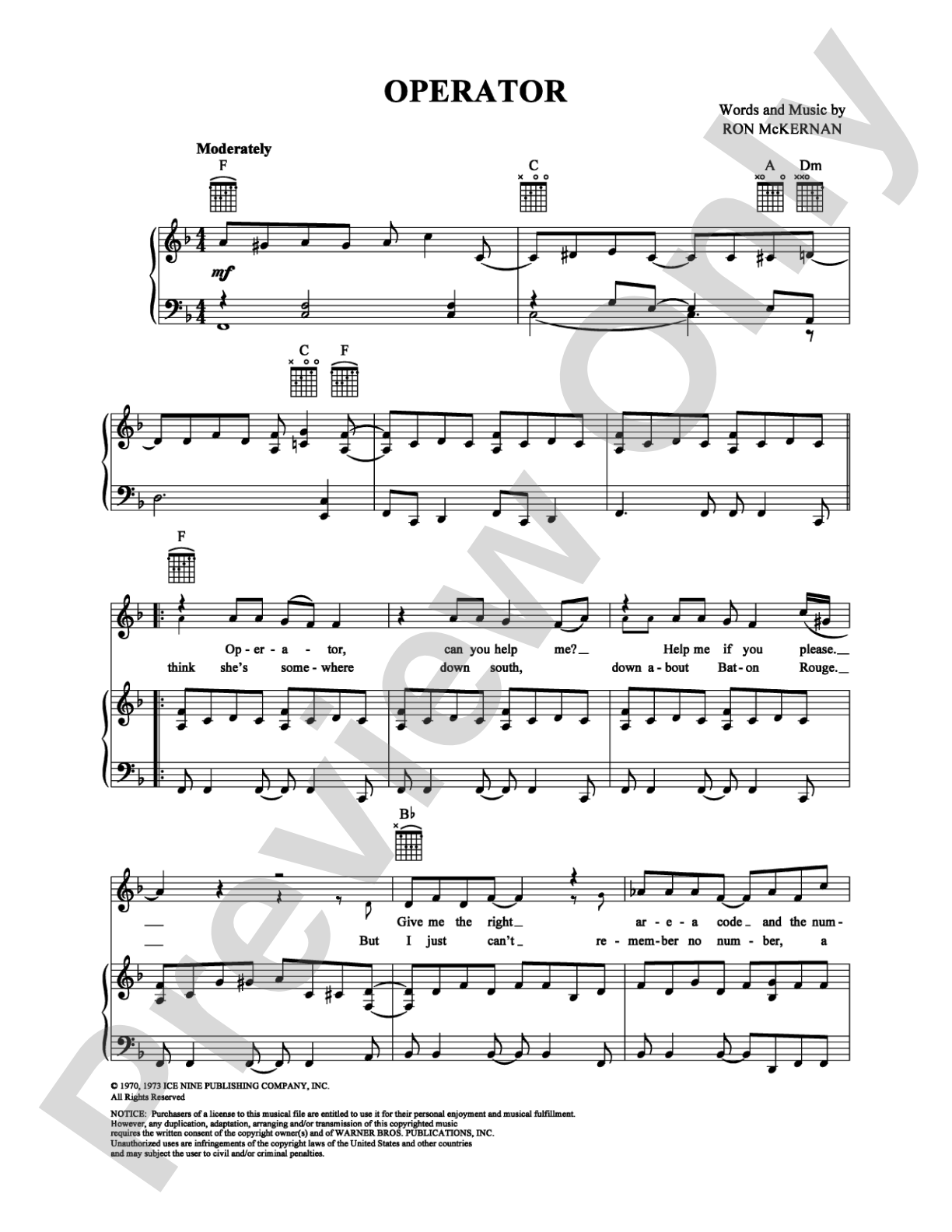
Operator: Piano/Vocal/Chords Digital Sheet Music

Operator: Piano/Vocal/Chords Digital Sheet Music

Grateful Dead, Ron McKernan

Item: 00-PS-0006824

Digital Download
$2.95
Description

Operator: Piano/Vocal/Chords Digital Sheet Music isn't in MakeMusic Cloud just yet...but it could be. Let us know you'd like to see it, and you'll help shape what comes next. In the meantime, start a free trial and dive into thousands of interactive titles your students can play along with today.

Sample Audio
No sample audio found.
Sample Video
Additional Details
SKU: 00-PS-0006824

More about this title

About the Artist: Grateful Dead

The Grateful Dead emerged from the San Francisco Bay Area in the mid-1960s as pioneers of improvisational rock and jam-based performance. Their decades-long career redefined what live music could be, building a devoted community of listeners who valued musicianship, experimentation, and the unpredictable nature of performance. The band's influence extends far beyond rock music into jazz, folk, and classical circles, making their catalog a rich resource for understanding American musical innovation.

For music educators, the Grateful Dead represent a gateway into studying composition and arrangement across a wide stylistic spectrum. Their songs blend complex harmonic progressions with accessible melodies, offering students practical models for how sophisticated musicianship and popular appeal can coexist.

Why we love this

Operator works as a surprising entry point into the band's catalog for student musicians. The song sits in a sweet spot between harmonic substance and lyrical directness, giving singers engaging material to work with while pianists encounter chord movements and rhythmic feels that reward careful listening. It's the kind of piece that makes students curious about what else the Grateful Dead wrote.

What to expect

Operator moves with a grounded, conversational quality. The song sits comfortably in the human voice while the piano work feels both driving and reflective, creating space for the narrative to breathe without losing momentum.

Who it's for

Singer-pianists preparing repertoire for recitals or auditions will find strong material here. High school and college students studying contemporary songwriting and arrangement can use this piece to examine how popular music structures harmony and melody.

How to get the most out of it

  • Pay attention to the rhythmic pocket of the original recording. The groove has a subtle swing to it that makes the difference between playing it straight and capturing its actual feel.
  • Treat the chord changes as conversational rather than mechanical. Let the voice lead the harmony, and adjust the piano voicings to support the natural phrasing of the lyrics.
  • Balance accompaniment and melody so neither overwhelms. The accompaniment should create a clear harmonic landscape without competing for the listener's focus.

How to use it

This works well in a contemporary American songwriting recital, especially when paired with folk or singer-songwriter repertoire from the same era. It also serves as a bridge piece for programs exploring the relationship between rock composition and classical song traditions.

Skills your students will build

  • Reading and interpreting lead sheet notation with chord symbols
  • Coordinating vocal phrasing with piano accompaniment patterns
  • Understanding harmonic rhythm in rock and pop contexts
  • Developing interpretive choices within a notated framework

You May Also Like