
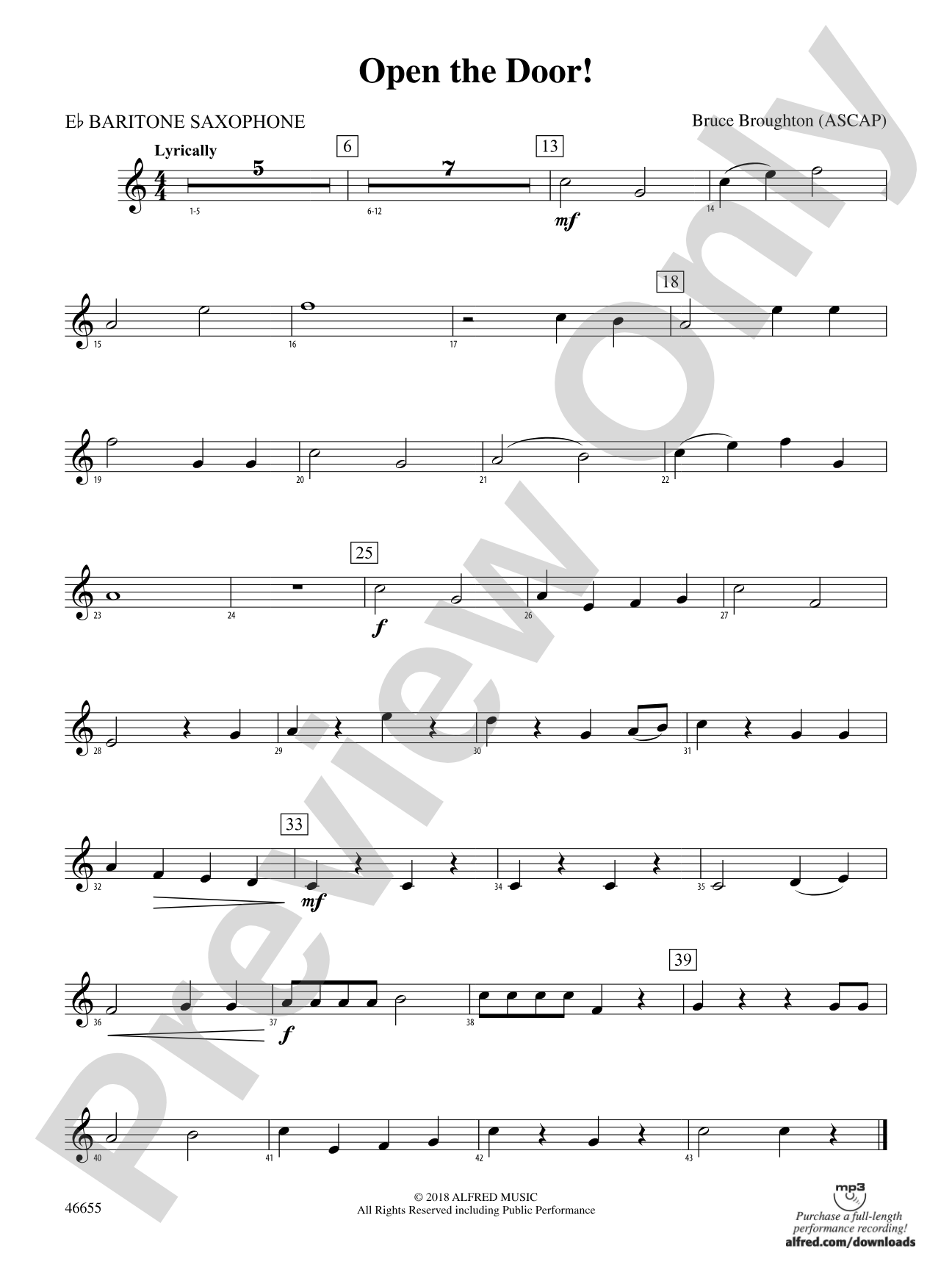

Open the Door!: E-flat Baritone Saxophone
By Bruce Broughton
Grade: 1 (Very Easy)
Item: 00-PC-0018085_BTX
$3.00
Pickup currently not available
Description
This piece was written for young band by world-renowned film score composer Bruce Broughton. Open the Door! is a descriptive piece with an insistent percussion part that imitates a knock on a door that gets louder and louder as the piece progresses.


Don't just read it, hear it, play along with it, and watch your students grow with it. In MakeMusic Cloud, Open the Door!: E-flat Baritone Saxophone comes alive with professional accompaniment, adjustable tempo, and built-in practice tools that turn solo practice into real progress.
Open in the Player
Jump straight in and assign it today.
Start Your Free Trial
Open this title and explore the full library in minutes.
Sample Audio
1
Audio File
--:--
0:00
0:00
Sample Video
Additional Details
Series:
Alfred Debut Series
Publisher:
Alfred Music
Page Count:
124
SKU:
00-PC-0018085_BTX
More about this title
About the Composer: Bruce Broughton

Bruce Broughton has shaped the sound of American film and television for decades, composing scores for major motion pictures including Silverado, Tombstone, The Rescuers Down Under, and the Homeward Bound series. His work across cinema, television, and theme parks has earned him an Oscar nomination, a Grammy nomination, and ten Emmy Awards from twenty-three nominations, establishing him as one of the industry's most prolific and honored composers.
Beyond Hollywood, Broughton has cultivated a significant concert music catalog performed by orchestras such as the Cleveland Orchestra and Chicago Symphony. His leadership roles in ASCAP, the Academy of Motion Picture Arts and Sciences, and the Society of Composers and Lyricists reflect his commitment to the broader artistic community. His ability to write memorably across genres makes his young band compositions particularly valuable for music educators seeking music with genuine compositional craft.
Why we love this
Broughton brings his decades of film scoring expertise to this Grade 1 piece, and it shows in the clarity of his orchestration and his instinctive understanding of dramatic tension. The knock-on-the-door concept gives students a literal, visual anchor for understanding how music can tell a story and build intensity, making it an excellent teaching tool for musical narrative even at the easiest level. Young players feel genuinely engaged playing something that sounds like "real" music, not a simplified exercise.
What to expect
The opening presents curiosity and mystery as the knock begins softly, almost tentative. As the piece unfolds, the knock grows more insistent and demanding, creating mounting tension that carries the band and audience along a clear dramatic arc. There's humor and playfulness in the concept, balanced with genuine musical architecture that keeps things interesting from start to finish.
Who it's for
This piece is ideal for first-year and developing concert bands looking for music with genuine character that doesn't talk down to players. Directors seeking repertoire that teaches musical storytelling and dynamic control at Grade 1 will find a rare gift here; Broughton's orchestration transparency means every section can hear what they're doing and contribute meaningfully.
How to get the most out of it
- Establish a steady, even pulse in the rhythm section from the start; the percussion knock needs a rock-solid foundation to build effectively.
- Shape the dynamic arc carefully as the knock intensifies; resist jumping to full volume too early so you have room to crescendo toward the climax.
- Balance the knock sound clearly so audiences hear it develop, but keep it proportional to the rest of the band so it doesn't overwhelm younger players' confidence.
- Consider the mallets and sticks used for the knock part; different materials will shift the character of the sound and affect how well it projects in your space.
How to use it
This works beautifully as an opening piece on a concert, immediately capturing attention and setting a narrative tone for the program. It pairs well alongside other light concert selections and provides a natural contrast to more lyrical or chorale-based pieces. Early in the school year, it's an excellent choice for building ensemble dynamics and introducing the concept of musical storytelling before tackling more technically demanding repertoire.
Skills your students will build
- Dynamic control and crescendo in a structured musical context
- Listening to and balancing a featured percussion part within the ensemble
- Maintaining steady rhythm while surrounding percussion executes rhythmic variation
- Understanding how repetition and variation create musical narrative
- Responding to clear, programmatic musical gestures