
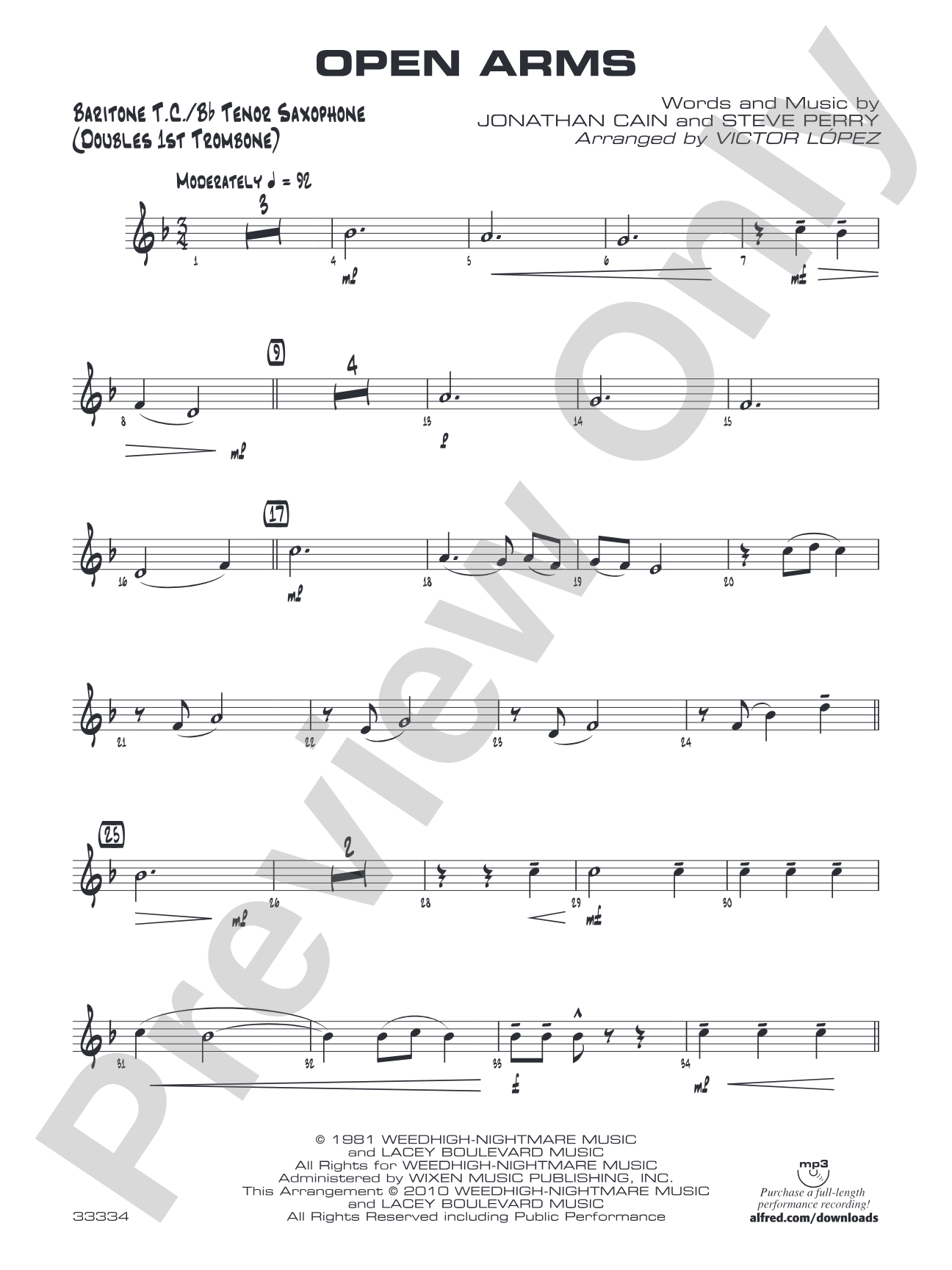

Open Arms: Baritone T.C.
Words and music by Jonathan Cain and Steve Perry [Journey] / arr. Victor López
Grade: 1 (Easy)
Item: 00-PC-0017517_BTC1
$3.00
Pickup currently not available
Description
Check out this ever-popular ballad from the group Journey---the melody is truly captivating. The chart is an easy waltz that goes into a swing-waltz feel as arranged by Victor López. Features include a written melody solo for 1st trumpet, no improvised solos, 1st trumpet range to written D fourth line. All the usual optional parts are included. A classy chart on a wonderful pop tune.


Don't just read it, hear it, play along with it, and watch your students grow with it. In MakeMusic Cloud, Open Arms: Baritone T.C. comes alive with professional accompaniment, adjustable tempo, and built-in practice tools that turn solo practice into real progress.
Open in the Player
Jump straight in and assign it today.
Start Your Free Trial
Open this title and explore the full library in minutes.
Sample Audio
1
Audio File
--:--
0:00
0:00
Sample Video
No sample videos found.
Additional Details
Series:
First Year Charts for Jazz Ensemble
Publisher:
Alfred Music
Page Count:
70
SKU:
00-PC-0017517_BTC1
More about this title
About the Composer: Jonathan Cain
Jonathan Cain joined Journey in 1980 as keyboardist and quickly became a central creative force in the band's sound. His compositions and co-compositions anchored some of Journey's most enduring hits, and he remains an active composer for film, television, and stage.
Cain's melodic sensibility has made him a natural fit for jazz ensemble arrangers seeking accessible pop material with genuine emotional weight. His work translates remarkably well to educational jazz contexts, where the balance of singability and harmonic interest serves both student musicians and audiences.
Why we love this
Victor López's arrangement strips this ballad down to its emotional core while keeping the technical demands genuine for a Grade 1 ensemble. The written melody solo for first trumpet and absence of improvisation make it immediately accessible, yet the transition from waltz to swing-waltz feel gives students real style work without overwhelming them. You get a piece that sounds classier than its difficulty level suggests.
What to expect
The opening has a tender, introspective quality as the waltz meter settles in. The melody floats above gentle accompaniment with the kind of restraint that makes space for genuine musicality. When the swing-waltz feel arrives, energy builds without chaos; the piece never loses its fundamentally lyrical character, just adds rhythmic sophistication and forward motion.
Who it's for
This chart works beautifully for younger or newer jazz ensembles that need repertoire with recognizable melodies and manageable technical demands. It's equally valuable for directors programming a concert that needs an accessible but sophisticated pop standard. Any ensemble wanting to build confidence with a tune the audience already knows will find an ideal vehicle here.
How to get the most out of it
- Shape the opening waltz section with careful attention to the melody's phrase contours. This is your students' chance to prove they can phrase lyrical material, not just hit notes.
- The transition into swing-waltz requires a deliberate shift in rhythmic feel from the ensemble. Mark the exact bar where the style changes in rehearsal and have the rhythm section lock in the new pocket before the full ensemble joins.
- Balance the first trumpet solo against the ensemble texture. The melody needs room to sing without the accompaniment drowning it out.
- Keep the tempo consistent between the two feels. A common mistake is letting the swing section drag. Keep the quarter-note pulse steady.
How to use it
Program this as a concert opener or closer to frame a set with an accessible crowd-pleaser that doesn't sacrifice musical integrity. It pairs well with other pop standards or lighter swing charts at similar or slightly higher difficulty levels. The piece also works as a reliable selection for school assemblies and community performances where the audience connection matters as much as the technical display.
Skills your students will build
- Phrasing and shaping of lyrical melodic lines
- Transitioning between contrasting rhythmic feels (waltz and swing-waltz)
- Ensemble balance and accompaniment texture control
- Stylistic interpretation of a pop-based jazz arrangement
- Reading and executing written melody solos