
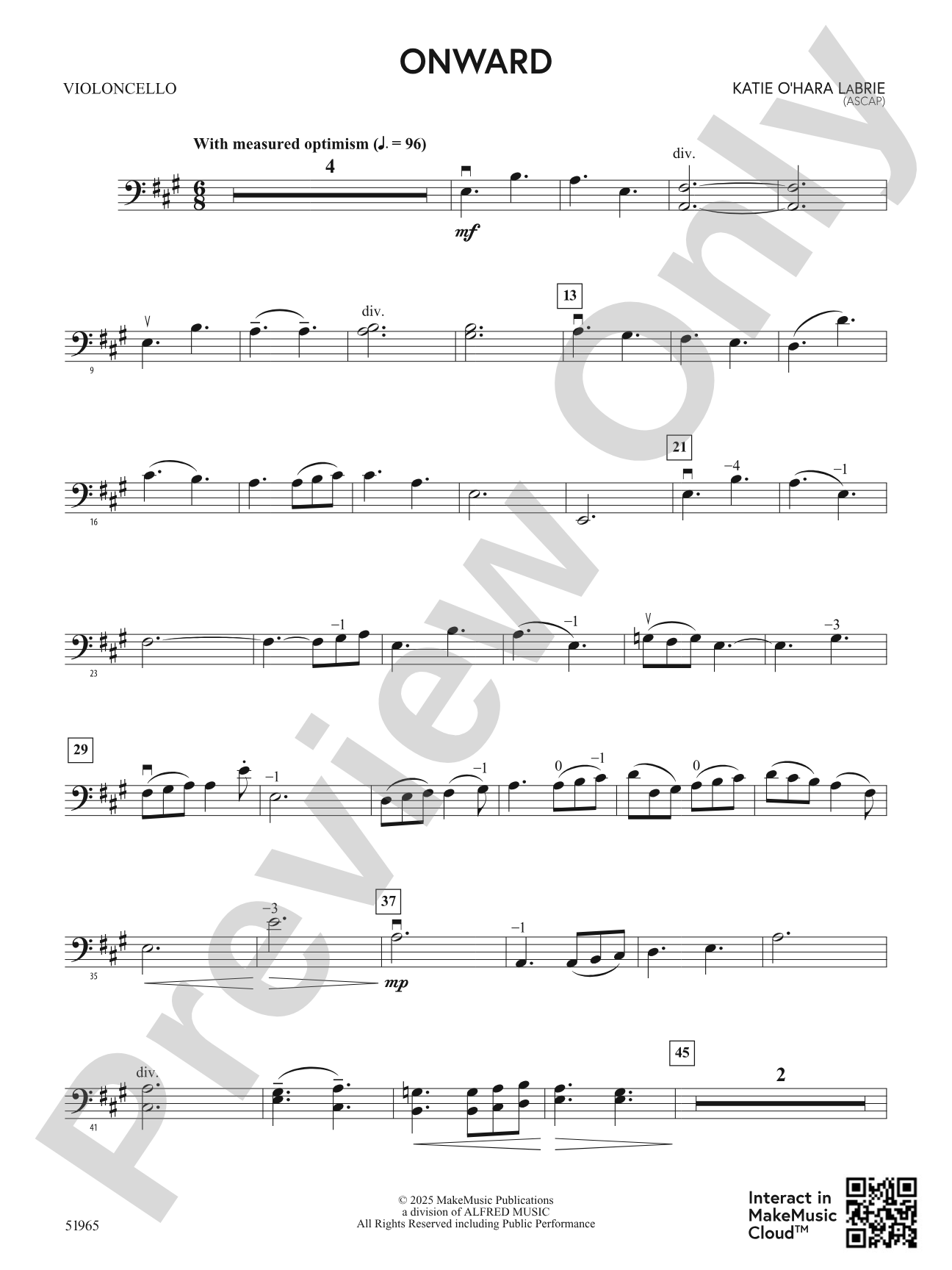

Onward: Cello
By Katie O'Hara LaBrie
Grade: 3.5
Item: 00-PC-0019535_VC1
$3.00
Pickup currently not available
Description
The swirling energy of this work looks to the future while juxtaposing excitement with sentimental and nervous feelings. Katie O'Hara LaBrie explores a wide range of layered rhythms and soaring melodies in a piece that works equally well in a festival setting or to honor your graduating class. Onward! (3:30)


Onward: Cello isn't in MakeMusic Cloud just yet...but it could be. Let us know you'd like to see it, and you'll help shape what comes next. In the meantime, start a free trial and dive into thousands of interactive titles your students can play along with today.
Request This Title
Tell us you want it.
Start Your Free Trial
Explore everything that's ready to play right now.
Sample Audio
1
Audio File
--:--
0:00
0:00
Sample Video
Additional Details
Series:
MakeMusic Symphony Strings
Publisher:
MakeMusic Publications
SKU:
00-PC-0019535_VC1
More about this title
About the Composer: Katie O'Hara LaBrie

Katie O'Hara LaBrie is a composer, conductor, clinician, and cellist based in Northern Virginia who shaped her artistic vision through 15 years as an orchestra educator in Fairfax County. Her training includes a Bachelor of Music in Music Education from St. Olaf College (studying with Steven Amundson) and a Master of Music in Instrumental Conducting from George Mason University (studying with Anthony Maiello).
LaBrie's compositional voice emerges directly from her work in the classroom and her life as a musician and parent. She writes music that serves educators first: pieces that are pedagogically purposeful, engaging for audiences, and genuinely enjoyable for the players performing them. Her work has earned repeated J.W. Pepper Editor's Choice selections and performances at major venues including the Midwest Band and Orchestra Directors Clinic and ASTA Conference. In 2022, Yamaha recognized her as one of their "40 Under 40" for her impact on music education. She founded the Fairfax Chamber Players and co-created "the Big IDEA" practice method, reflecting her commitment to helping students develop intentional practice habits.
Why we love this
This piece captures genuine graduation emotion without sentimentality, layering moments of forward momentum with reflective passages that honor what students are leaving behind. The rhythmic complexity keeps rehearsals engaging while remaining accessible at Grade 3.5, and its three-and-a-half-minute runtime makes it an ideal festival entry or concert closer that leaves audiences moved rather than exhausted.
What to expect
Onward captures the swirling mix of emotions that accompany moving forward: excitement pulses alongside quiet moments of reflection and the flutter of uncertainty about what comes next. The layered rhythms and soaring melodies create a sense of momentum without rushing, allowing performers and listeners to feel both hopeful and nostalgic in the same breath.
Who it's for
String orchestras at the middle school, early high school, or youth ensemble level looking for repertoire that speaks to major life transitions. This piece works equally well for directors seeking strong festival material or for those programming a meaningful graduation ceremony piece that resonates with both students and families.
How to get the most out of it
- Balance the layered rhythms by having your section leaders identify which lines carry the melody at each moment; this prevents the swirling energy from becoming muddy and keeps the architecture clear.
- Shape the sentimental passages by drawing out vibrato gradually rather than applying it uniformly; this allows the nervous tension to breathe naturally before the excitement returns.
- Record a rehearsal run-through and listen back focusing specifically on dynamic shape across the full three-and-a-half minutes; pieces with this kind of emotional range benefit from clarity about the arc from beginning to end.
- Practice transitions between sections in isolation, particularly where rhythm and tempo feel less stable; marking those spots in parts prevents students from losing confidence in the flow.
How to use it
This works brilliantly as a festival submission in the Grade 3-4 division, where its emotional maturity and compositional sophistication will stand out. Program it as a concert closer at an awards ceremony or end-of-year concert, or pair it with contrasting material earlier in the program to emphasize its reflective qualities.
Skills your students will build
- Balancing layered rhythmic lines while maintaining forward momentum
- Sustaining soaring melodic phrases across extended passages
- Transitioning between contrasting emotional moods (excited to sentimental to nervous) with musical control
- Reading rhythmic complexity at Grade 3.5 level without losing structural clarity
- Understanding how composers use rhythm and melody to convey emotional nuance