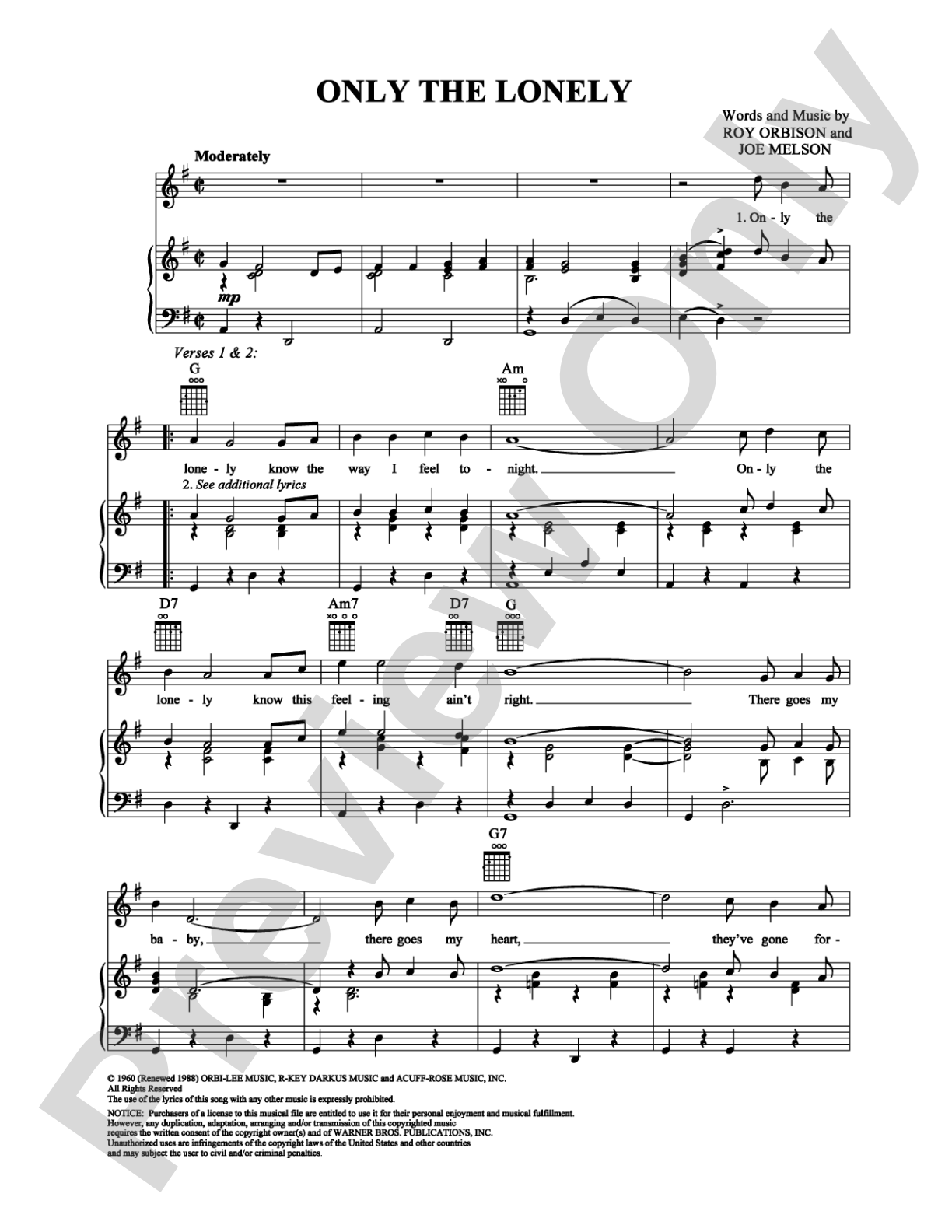
Only the Lonely: Piano/Vocal/Chords Digital Sheet Music

Only the Lonely: Piano/Vocal/Chords Digital Sheet Music

Roy Orbison, Joe Melson

Item: 00-PS-0007583

Digital Download
$2.95
Description

Only the Lonely: Piano/Vocal/Chords Digital Sheet Music isn't in MakeMusic Cloud just yet...but it could be. Let us know you'd like to see it, and you'll help shape what comes next. In the meantime, start a free trial and dive into thousands of interactive titles your students can play along with today.

Sample Audio
No sample audio found.
Sample Video
Additional Details
SKU: 00-PS-0007583

More about this title

About the Artist: Roy Orbison

Roy Orbison (1936-1988) was an American singer-songwriter whose distinctive vocal style and innovative recording techniques shaped rock and pop music across five decades. His tremolo voice, dramatic arrangements, and willingness to explore unconventional song structures influenced generations of musicians and remain central to music education discussions about vocal authenticity and emotional delivery.

Why we love this

This song rewards singers who understand the power of restraint and space. The emotional arc unfolds through dynamics and phrasing rather than technical fireworks, making it an excellent teaching tool for developing interpretive maturity and understanding how simplicity can convey profound feeling.

What to expect

The song carries a nocturnal quality, introspective and achingly tender. There's an understated vulnerability in the melody that sits comfortably in the middle voice, allowing singers to convey longing without strain or dramatic excess.

Who it's for

Pianists accompanying singers preparing solos for recitals, auditions, or performance classes will find this lead sheet format essential. Voice students exploring classic pop-rock repertoire and singers developing interpretive skills benefit from the straightforward layout that allows focus on phrasing and expression.

How to get the most out of it

  • Study the original recording to internalize the vocal timbre and breathing patterns; Orbison's phrasing creates intentional pauses that shape the listener's emotional response.
  • Balance the vocal melody against piano accompaniment so the lyrics remain the focal point; resist the urge to rush or oversing the quieter sections.
  • Pay close attention to chord changes in the piano part to anchor intonation, especially in the passages where the vocal line sits higher in the range.
  • Experiment with tempo flexibility in the verses; slight rubato can enhance the intimacy without losing musical coherence.

How to use it

Include this in a recital or concert that explores emotional storytelling across genres, pairing it with other contemporary art songs or classic pop standards. It works equally well as an opening piece that establishes an intimate mood or as a moment of genuine connection in the middle of a longer program.

Skills your students will build

  • Sustaining tone while maintaining natural speech-like phrasing
  • Reading and interpreting chord symbols for harmonic accompaniment
  • Balancing vocal line with piano texture to keep melody audible
  • Controlling dynamics across a wide emotional range
  • Handling rubato and flexible tempo without losing musical cohesion

You May Also Like