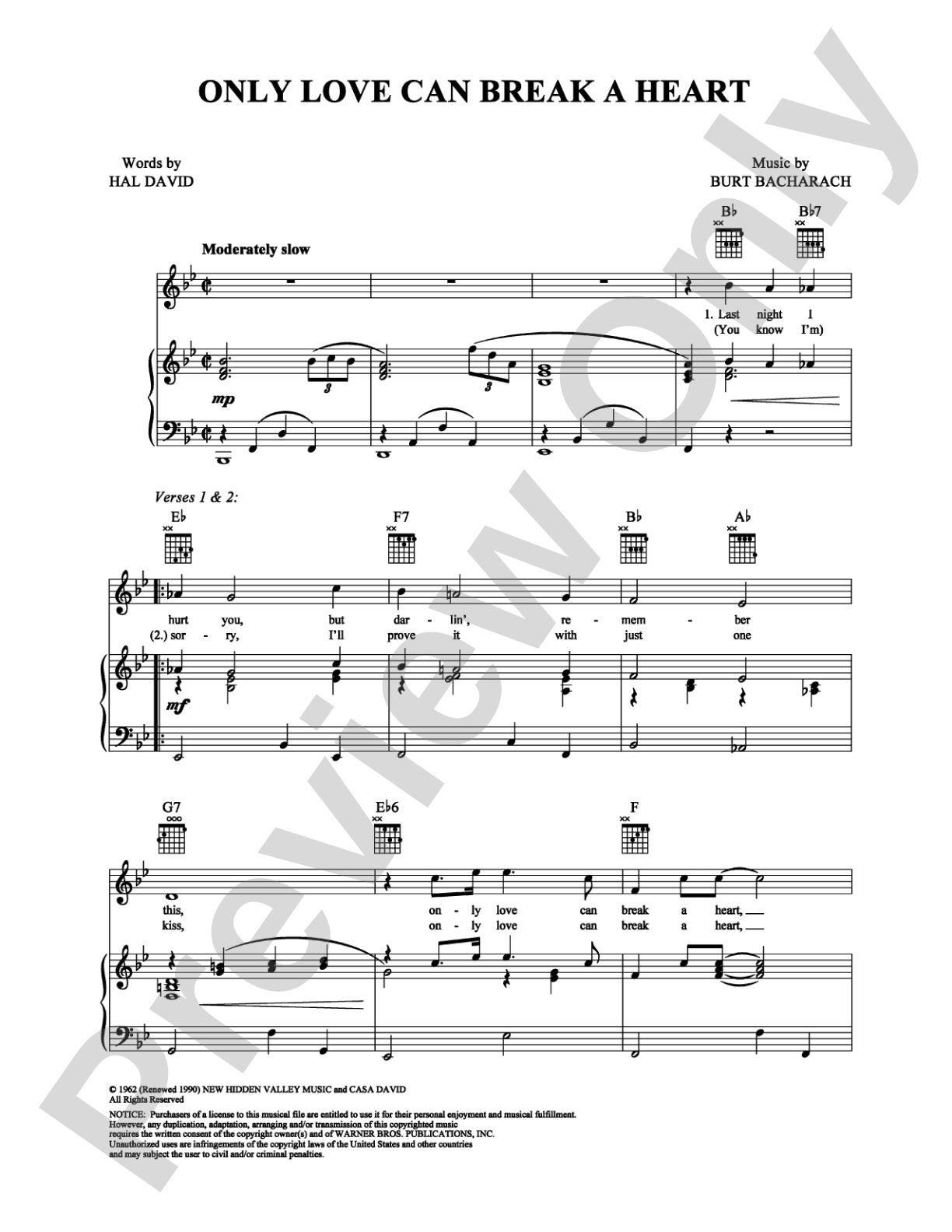
Only Love Can Break a Heart: Piano/Vocal/Chords Digital Sheet Music

Only Love Can Break a Heart: Piano/Vocal/Chords Digital Sheet Music

Burt Bacharach, Gene Pitney

Item: 00-PS-0003561

Digital Download
$3.99
Description

Only Love Can Break a Heart: Piano/Vocal/Chords Digital Sheet Music isn't in MakeMusic Cloud just yet...but it could be. Let us know you'd like to see it, and you'll help shape what comes next. In the meantime, start a free trial and dive into thousands of interactive titles your students can play along with today.

Sample Audio
No sample audio found.
Sample Video
Additional Details
SKU: 00-PS-0003561

More about this title

About the Artist: Gene Pitney

Gene Pitney (1941-2006) was an American pop rock singer and songwriter whose powerful baritone and emotional delivery made him a fixture of 1960s radio. Rising to prominence with hits like "Town Without Pity" and "The Man Who Shot Liberty Valance," Pitney became known for interpreting deeply felt ballads with dramatic intensity. His ability to convey vulnerability in uptempo arrangements and his willingness to inhabit character-driven narratives influenced how vocalists approached theatrical pop songs throughout the decade.

Beyond his recording career, Pitney was an accomplished composer and producer who wrote and arranged songs for other artists, contributing substantially to the pop songwriting landscape of his era. His performances of "Only Love Can Break a Heart" exemplify his signature approach: layered arrangements, strategic vocal dynamics, and a commitment to making the emotional core of the song unmistakable to every listener.

Why we love this

Pitney's vocal signature, that piercing, expressive tenor, demands real technique from singers tackling this material. The song's emotional arc gives students a chance to work with genuine dramatic intent while the piano voicings offer accessible but sophisticated harmonic movement that doesn't require advanced jazz knowledge.

What to expect

The song walks a tightrope between confession and conviction, with Pitney's vocal delivery suggesting both heartbreak and defiance. There's a restless quality to the arrangement, never quite settling, always reaching forward, that mirrors the emotional turbulence of the lyric.

Who it's for

Vocalists seeking a mid-range pop-rock standard that sits well across different voice types, and pianists who want to work with a song that rewards both straightforward and inventive accompaniment approaches. This works equally well in a solo recital, a pop standards evening, or as part of a 1960s song cycle.

How to get the most out of it

  • Balance the vocal line over the piano accompaniment by thinking of the voice as the primary melodic instrument; let the keyboard provide harmonic color rather than compete for attention.
  • Emphasize the lyrical phrasing in the verse to set up contrast with any key shifts or rhythmic changes; this gives the song emotional momentum rather than a static delivery.
  • Shape the dynamics around the song's emotional beats rather than phrase endings, allowing tension and release to guide when volume increases and decreases.
  • Explore the voicings suggested in the chord chart; jazz-influenced extensions and alterations can add sophistication to an otherwise straightforward progression.

How to use it

Program this alongside other period standards or pop covers when building a recital around songs from the 1960s-70s era. It also pairs well with other Pitney compositions if you're exploring a single artist's catalog, or use it as a bridge piece between more traditional vocal repertoire and contemporary pop interpretations.

Skills your students will build

  • Phrasing and sustained legit singing over a rhythmic accompaniment
  • Reading and interpreting chord symbols for flexible piano voicing
  • Balancing vocal projection and emotional restraint in pop contexts
  • Understanding song form and dynamic shaping in ballad-style pop-rock

You May Also Like