

One Star: SAB Choral Octavo
Music by Sally K. Albrecht and Jay Althouse
Item: 00-PO-0003979
$2.95
Minimum order quantity: 20 copies
Pickup currently not available
Related Items
One Star: SAB Choral Octavo |
$2.95
|
View |
Description
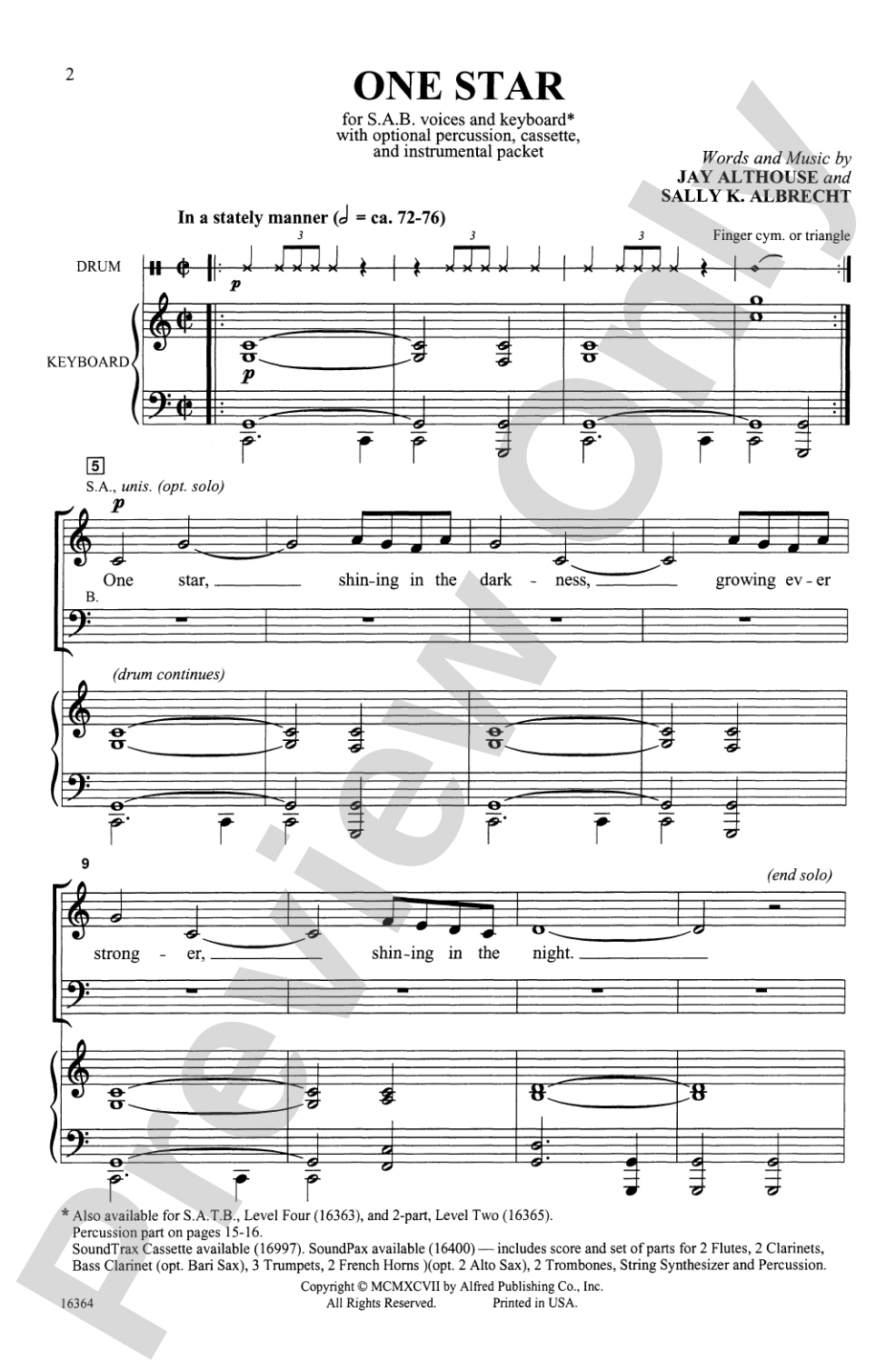
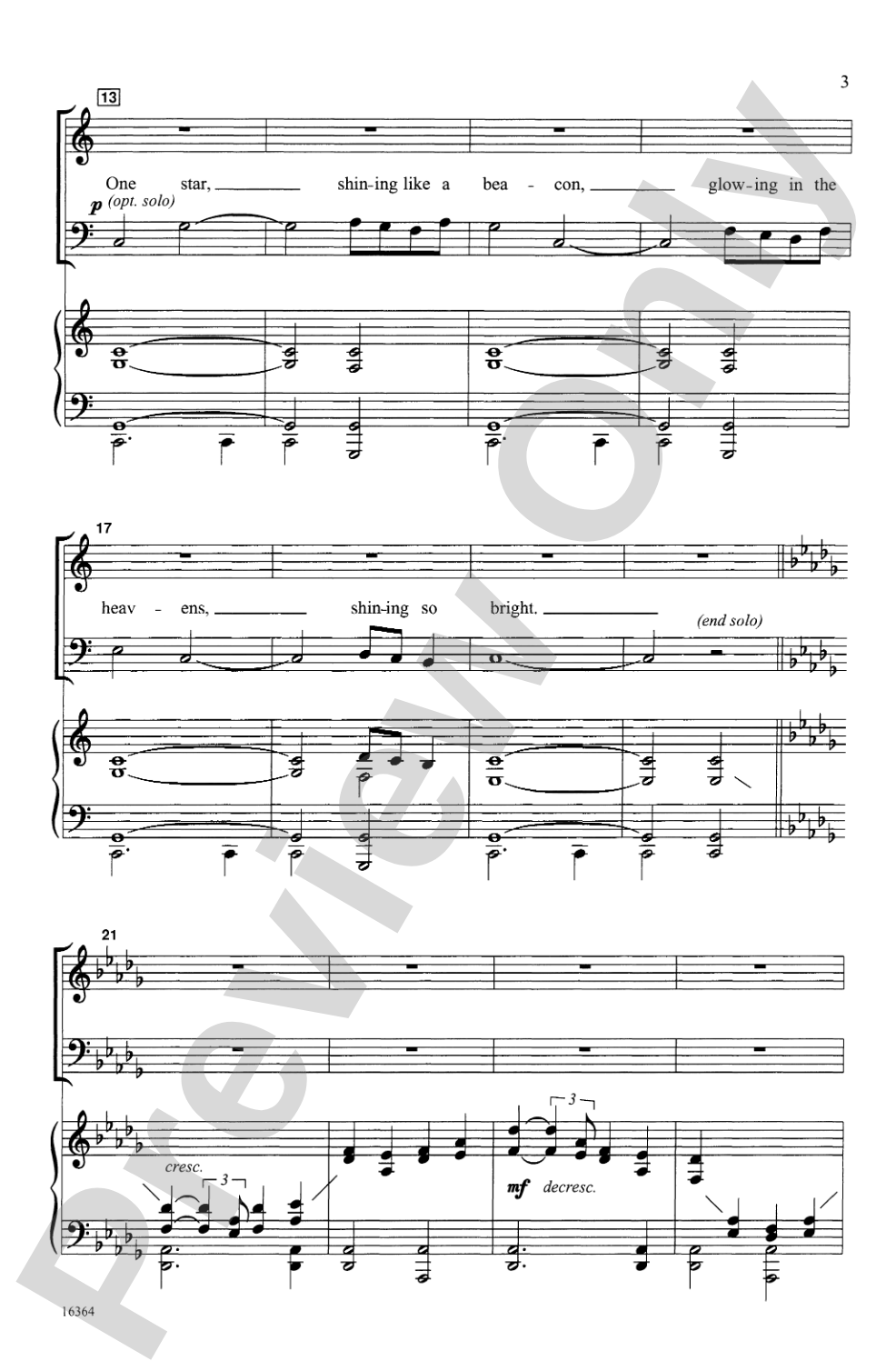
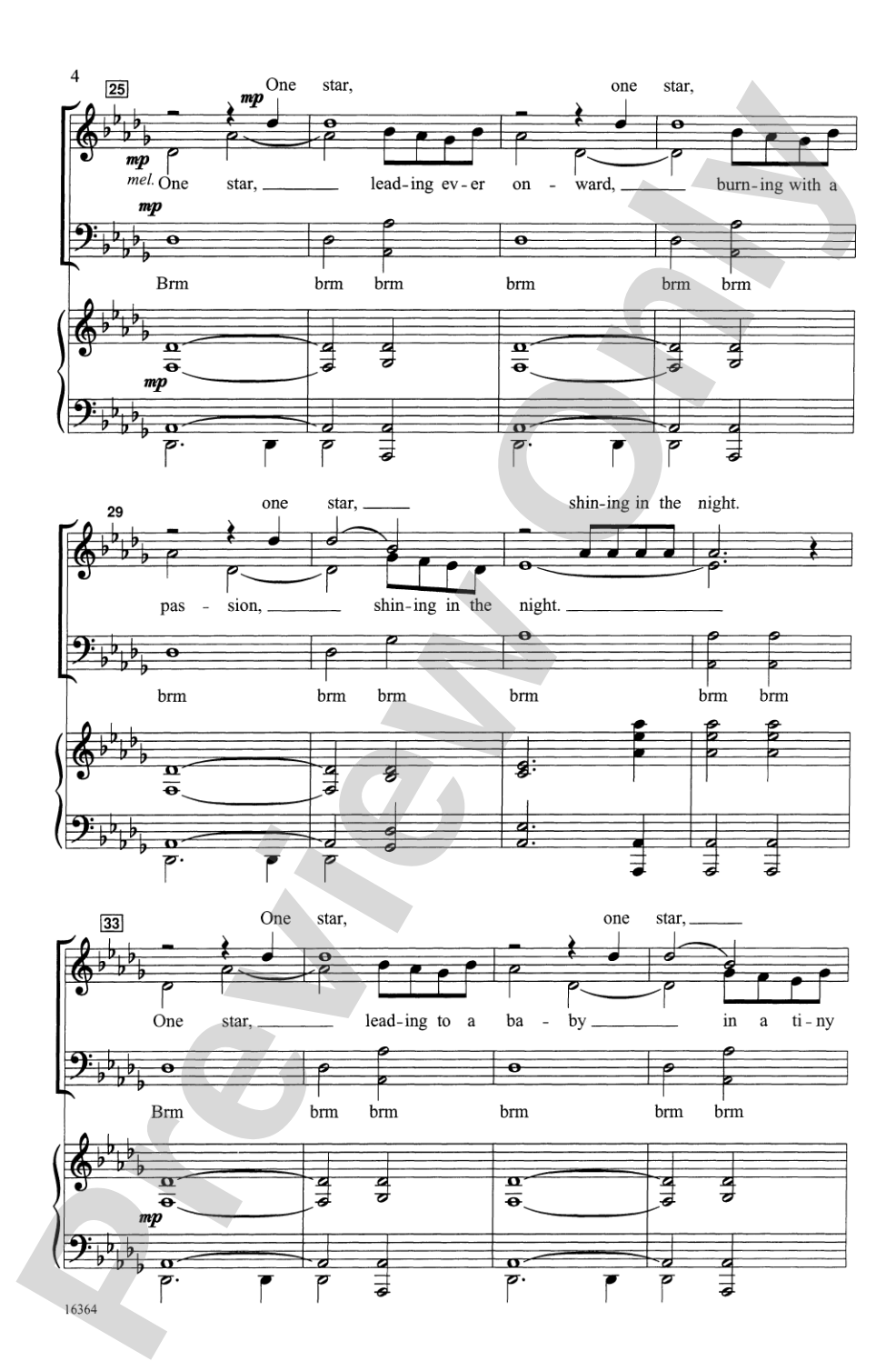
A "walking tempo" Christmas piece, reminiscent of "The Little Drummer Boy". The simple oft-repeated melody builds with successive half step modulatios before ending with a solo or unison statement of the melody fading into the distance. Solo drum/finger cymbal part is effective and included in the publication.


One Star: SAB Choral Octavo isn't in MakeMusic Cloud just yet...but it could be. Let us know you'd like to see it, and you'll help shape what comes next. In the meantime, start a free trial and dive into thousands of interactive titles your students can play along with today.
Request This Title
Tell us you want it.
Start Your Free Trial
Explore everything that's ready to play right now.
Sample Audio
No sample audio found.
Sample Video
No sample videos found.
Additional Details
Series:
Alfred Archive Edition: Alfred Choral Designs
Publisher:
Alfred Music
Page Count:
16
SKU:
00-PO-0003979
More about this title
About the Composer: Sally K. Albrecht

Sally K. Albrecht has shaped American choral music for decades as a composer, conductor, and clinician with particular expertise in choral movement and accessibility. Since 1987, she has received annual ASCAP Special Music Awards and maintains over 600 published choral works plus 75 songbooks and musicals in circulation. She has led honor choirs at major venues including Lincoln Center, Carnegie Hall, and The Kennedy Center, and spent more than thirty years directing choral, vocal, and elementary music publications at major educational publishers, including Alfred Music.
Albrecht holds degrees from Rollins College (B.A. in Music and Theater, 1976), the University of Miami (M.A. in Drama, 1977; M.M. in Accompanying, 1979), and has taught at Oakland University, Jersey City State College, and Meredith College. She serves as a member of the Board of Trustees at Rollins College and received the Distinguished Alumna Award from both Rollins and the University of Miami Frost School of Music in 2021. She lives in North Carolina with her husband, composer and arranger Jay Althouse.
Why we love this
The genius here is the economy of material paired with genuine emotional arc. A single, simple melody repeated and reharmonized through successive half-step modulations creates forward momentum without complexity, then dissolves into that fading solo or unison statement that leaves singers and listeners suspended in quiet reflection. The included percussion part transforms what could have been static into something alive and dimensional.
What to expect
Spare and meditative, with the repetitive simplicity of a prayer or lullaby. The half-step lifts generate subtle momentum, and the final solo statement fades like a voice disappearing down a snowy street. There's restraint here rather than spectacle, which makes the moment land differently than traditional Christmas arrangements.
Who it's for
Directors programming SAB choirs who need a Christmas selection that works for younger singers or developing ensembles without sacrificing musical integrity. The piece suits groups with limited soprano-alto-bass balance and benefits from the optional percussion part, making it a practical choice for schools with access to student percussionists.
How to get the most out of it
- Maintain a relaxed, steady walking tempo throughout; the piece's power comes from evenness, not rushing. The modulations should feel inevitable rather than jarring.
- Blend the repeated melody across the choir before adding accompaniment; this ensures the central musical idea reads clearly even as harmonies shift beneath it.
- Use the recorded accompaniment in rehearsal to lock the modulation transitions, which can destabilize voicing if singers aren't anchored to the harmonic movement.
- Give the drummer or finger cymbal player space in full rehearsals and dress rehearsal; this part is genuinely essential to the piece's texture and timing.
How to use it
Pair this with other Christmas selections from the Alfred Archive to create a concert with tonal variety and mood shifts. Its quiet, introspective character works particularly well as the penultimate piece before a finale, or as a centerpiece in a program emphasizing new and lesser-known carol arrangements. The walking tempo and accessible SAB voicing also make it suitable for mid-winter concerts with mixed difficulty levels.
Skills your students will build
- Sustaining tone across repeated melodic statements while maintaining musicality
- Following harmonic movement through successive key modulations (half-step shifts)
- Balancing blend in SAB voicing across different harmonic contexts
- Coordinate ensemble timing with independent percussion parts
- Shaping a phrase that diminishes and fades without losing intonation or purpose