
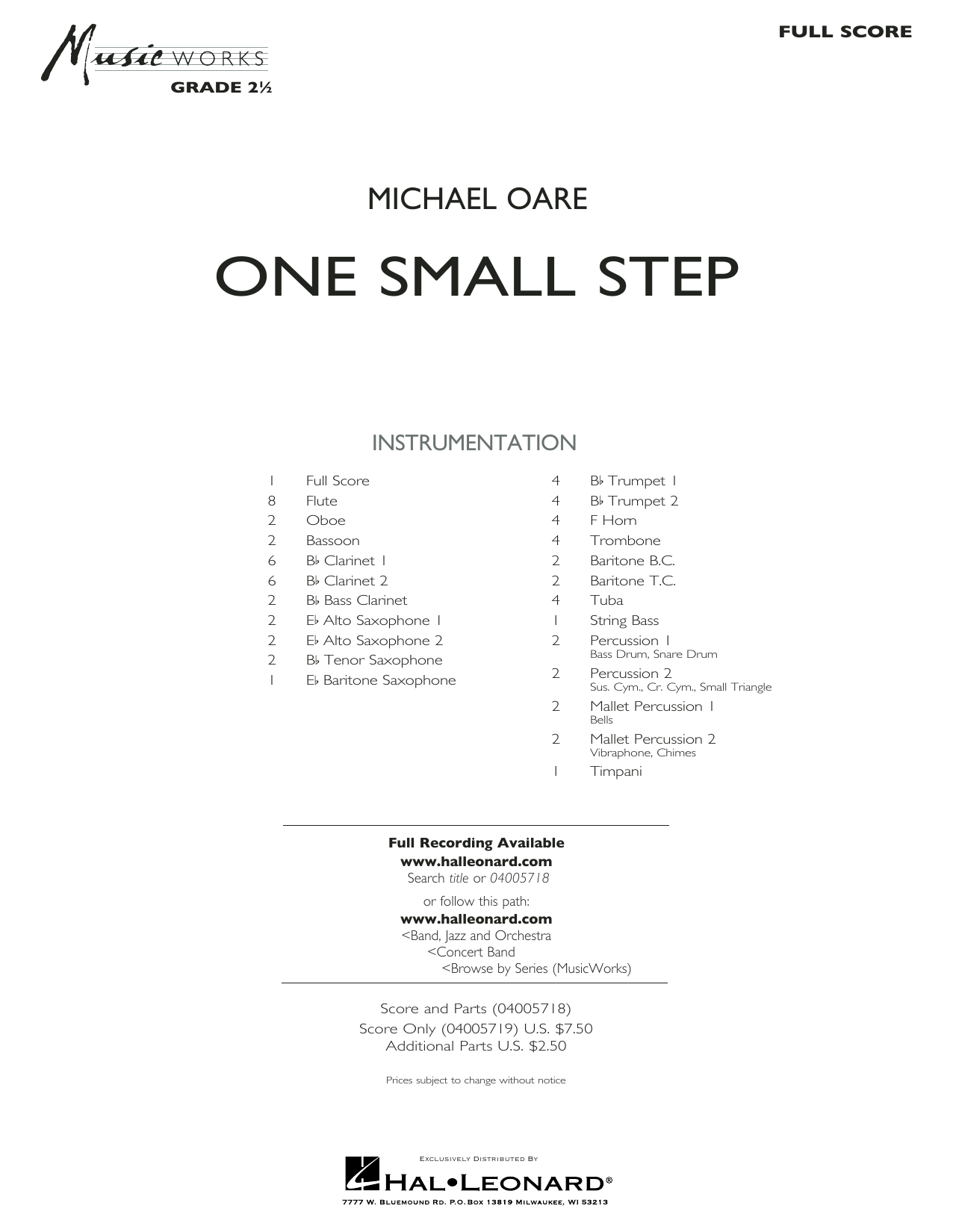

One Small Step: Concert Band Conductor Score & Parts
By Michael Oare
Grade: 2
Item: 35-PK00426281
$60.00
Pickup currently not available
Buy Extra Parts (Digital PDF Download)
| Product | Price | Quantity |
|---|---|---|
| One Small Step - Conductor Score (Full Score) | $7.50 | |
| One Small Step - Flute | $6.00 | |
| One Small Step - Oboe | $6.00 | |
| One Small Step - Bassoon | $6.00 | |
| One Small Step - Bb Clarinet 1 | $6.00 | |
| One Small Step - Bb Clarinet 2 | $6.00 | |
| One Small Step - Bb Bass Clarinet | $6.00 | |
| One Small Step - Eb Alto Saxophone 1 | $6.00 | |
| One Small Step - Eb Alto Saxophone 2 | $6.00 | |
| One Small Step - Bb Tenor Saxophone | $6.00 | |
| One Small Step - Eb Baritone Saxophone | $6.00 | |
| One Small Step - Bb Trumpet 1 | $6.00 | |
| One Small Step - Bb Trumpet 2 | $6.00 | |
| One Small Step - F Horn | $6.00 | |
| One Small Step - Trombone | $6.00 | |
| One Small Step - Baritone B.C. | $6.00 | |
| One Small Step - Baritone T.C. | $6.00 | |
| One Small Step - Tuba | $6.00 | |
| One Small Step - Bass | $6.00 | |
| One Small Step - Percussion 1 | $6.00 | |
| One Small Step - Percussion 2 | $6.00 | |
| One Small Step - Mallet Percussion 1 | $6.00 | |
| One Small Step - Mallet Percussion 2 | $6.00 | |
| One Small Step - Timpani | $6.00 |
Parts Added to Cart!
Description
In July 1969, Apollo 11 completed its mission to the moon and Neil Armstrong made his famous proclamation "That's one small step..." as he stepped out onto the lunar surface. Michael Oare's descriptive work for young bands captures the drama of that moment and offers the option of using actual audio clips from the mission for a truly magical effect.


One Small Step: Concert Band Conductor Score & Parts isn't in MakeMusic Cloud just yet...but it could be. Let us know you'd like to see it, and you'll help shape what comes next. In the meantime, start a free trial and dive into thousands of interactive titles your students can play along with today.
Request This Title
Tell us you want it.
Start Your Free Trial
Explore everything that's ready to play right now.
Sample Audio
No sample audio found.
Sample Video
No sample videos found.
Additional Details
Publisher:
Hal Leonard
SKU:
35-PK00426281
More about this title
About the Composer: Michael Oare

Michael Oare brings three decades of classroom experience to his composing and arranging work. After earning degrees in composition and music education from Old Dominion University, he spent 33 years leading the Great Bridge Middle School Bands in Chesapeake, Virginia, where his ensembles achieved superior ratings for 32 consecutive years and performed at the Virginia Music Educators Association Conference multiple times. His compositions for young musicians have earned recognition in GIA Publications' Teaching Music Through Performance series, and he has received the National Band Association's Citation of Excellence twice.
Beyond his distinguished teaching career, Oare maintains active roles as a conductor, adjudicator, and performer with the Virginia Wind Symphony. He currently conducts the Bay Youth Orchestras of Virginia Concert Band, serving students across southeastern Virginia and northeastern North Carolina. His work reflects a deep understanding of what young musicians need: engaging material that challenges without overwhelming, and pieces that connect to moments beyond the concert hall.
Why we love this
Oare has crafted a piece that teaches students to shape narrative through music while celebrating one of humanity's most iconic moments. The optional integration of actual Apollo 11 audio transforms a concert performance into something unforgettable for audiences; your students will feel the weight of that historical achievement as they play. At Grade 2, the writing stays accessible without sacrificing emotional impact or compositional substance.
What to expect
The opening unfolds with wonder and weightlessness, capturing that moment before humanity's greatest leap. Oare builds momentum and tension as the narrative accelerates toward Armstrong's words, creating a sonic landscape that feels both contemporary and timeless. The piece lands with the significance of the moment itself: profound, clear, and unmistakable.
Who it's for
Young concert bands ready to tackle a piece with genuine dramatic arc and historical substance. Directors seeking repertoire that sparks student engagement beyond the notes themselves will find real value here. This works equally well for bands building their first major concert or those looking to anchor a thematic program.
How to get the most out of it
- Build anticipation in the opening by resisting the urge to rush. Young players naturally accelerate when excited, so establish a clear pulse and lock it in early rehearsals.
- If you choose to incorporate the audio clips, rehearse with them present. Your band needs time to find their place within the real voices and ambient sound of the mission itself.
- Balance the descriptive passages with moments of clarity. Oare's writing likely contains both atmospheric textures and driving forward motion; let each breathe so the contrast lands.
- Assign student narrators or speakers to deliver Armstrong's words if your version includes spoken elements. Clear, deliberate diction will anchor the entire performance.
How to use it
Open a concert with this piece to establish an evening of bold programming that connects music to the wider world. Pair it with other twentieth-century works that balance accessibility with substance, or use it as the centerpiece of a thematic concert exploring exploration, achievement, and human accomplishment. Spring concerts work particularly well, as does any program celebrating student growth and possibility.
Skills your students will build
- Shaping dynamic arcs to support narrative and emotional intent
- Responding to historical context as interpretive musicians
- Balancing individual part clarity with ensemble cohesion in descriptive writing
- Coordinating ensemble entries and releases with precision
- Sustaining focus and energy through a single-movement work