One O'Clock Jump: Easy Piano Digital Sheet Music

One O'Clock Jump: Easy Piano Digital Sheet Music

Count Basie

Item: 00-PS-0000650

Digital Download
$3.99
Description

One O'Clock Jump: Easy Piano Digital Sheet Music isn't in MakeMusic Cloud just yet...but it could be. Let us know you'd like to see it, and you'll help shape what comes next. In the meantime, start a free trial and dive into thousands of interactive titles your students can play along with today.

Sample Audio
No sample audio found.
Sample Video
Additional Details
SKU: 00-PS-0000650

More about this title

Why we love this

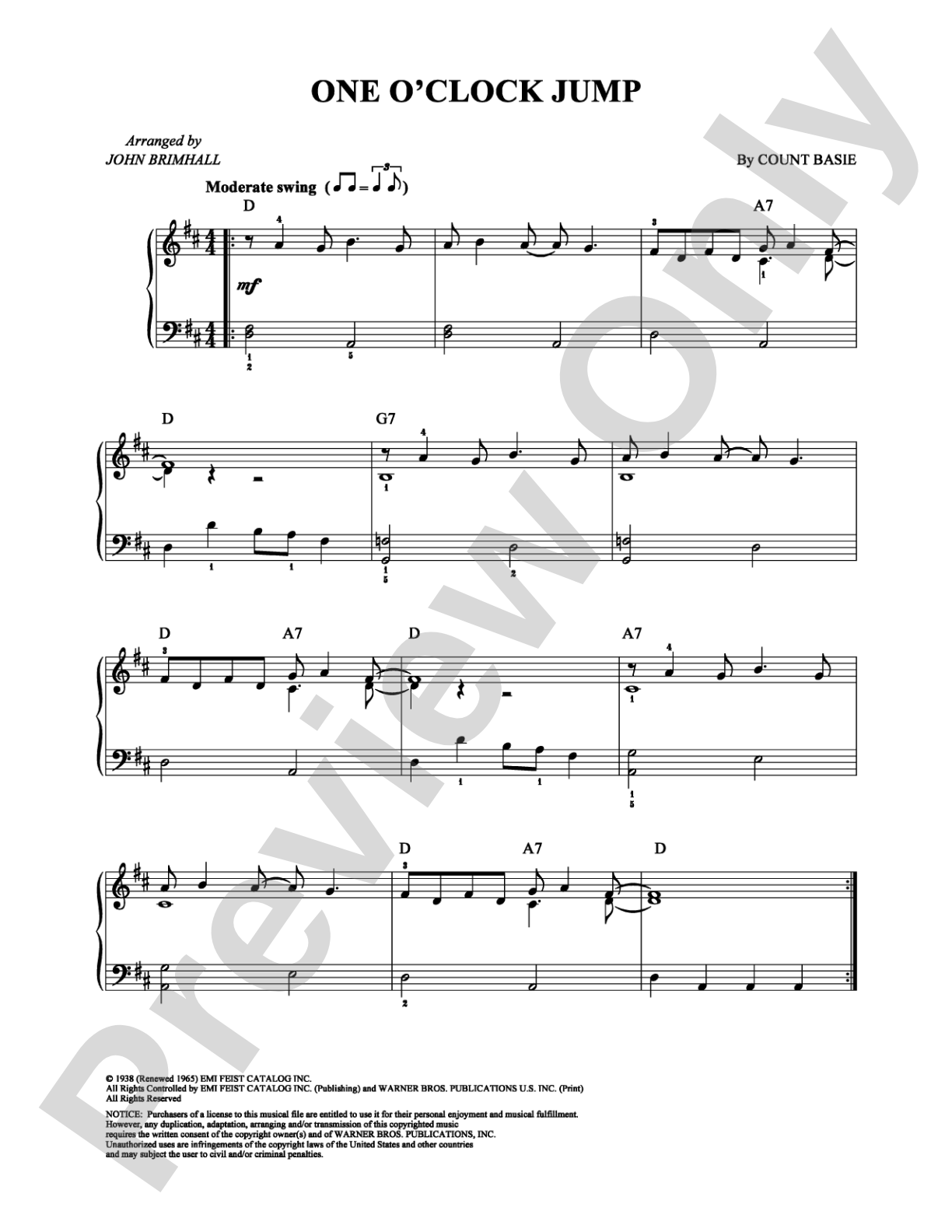
This is a genuine jazz standard, not a watered-down approximation, which means your students learn from the real tradition rather than a simplified substitute. The easy arrangement preserves the blues changes and swing feel that make the tune iconic, giving pianists a solid foundation in jazz vocabulary without overwhelming them technically.

What to expect

Walking bass lines and jumping right-hand melodies that capture the energy of a 1940s Count Basie jam session. The piece swings hard while remaining accessible, with that unmistakable blues backbone that makes jazz feel both playful and purposeful.

Who it's for

Pianists in the early intermediate range who are ready to explore jazz beyond classical technique. This works for students who want to understand jazz fundamentals through a historically important tune, whether in a jazz band context, a solo recital, or as a gateway into improvisation.

How to get the most out of it

  • Keep the tempo steady and resist the urge to rush; the swung eighth-note feel sits behind the beat, so lock in with your internal pulse rather than chasing the written notes.
  • The blues progression is the heart here; listen to recordings and internalize where the band breathes, especially around the turnarounds.
  • Find the groove in your left hand first, then layer the melody and any comping patterns on top once that foundation is solid.
  • Experiment with dynamics and touch to find your own voice in the tune; jazz standards are meant to be interpreted, not played metronomically.

How to use it

Feature this in a jazz-focused recital or as a bridge between classical and jazz repertoire in a mixed concert. It also serves as an excellent warm-up or ensemble piece when your jazz band needs a straightforward, engaging learning vehicle.

Skills your students will build

  • Reading and performing swing eighth-note rhythms
  • Playing walking bass patterns in the left hand
  • Understanding 12-bar blues progression changes
  • Interpreting jazz comping and accompaniment figures
  • Developing articulation and phrasing appropriate to jazz idiom

You May Also Like