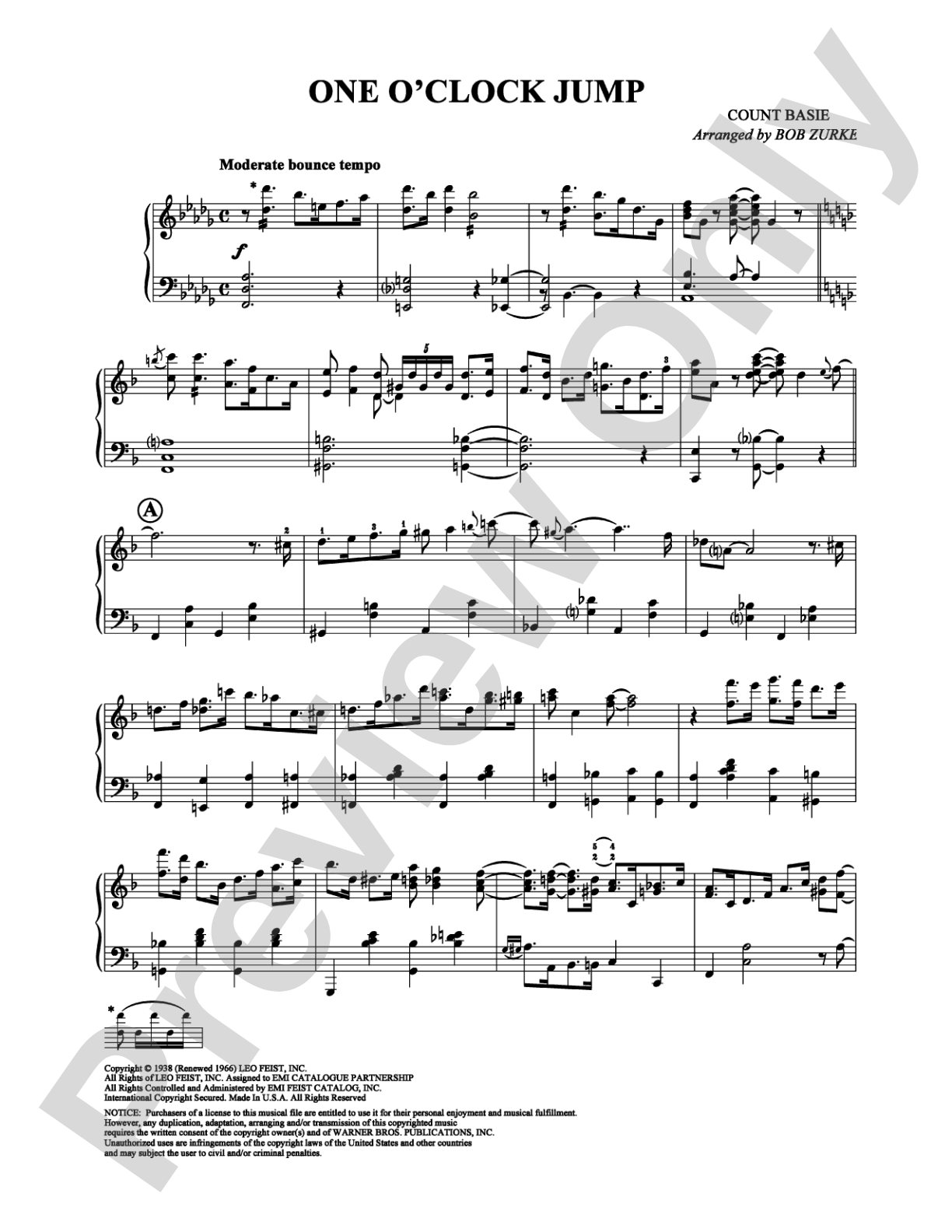
One O'Clock Jump: Piano Digital Sheet Music

One O'Clock Jump: Piano Digital Sheet Music

Count Basie

Item: 00-PS-0000649

Digital Download
$3.99
Description

One O'Clock Jump: Piano Digital Sheet Music isn't in MakeMusic Cloud just yet...but it could be. Let us know you'd like to see it, and you'll help shape what comes next. In the meantime, start a free trial and dive into thousands of interactive titles your students can play along with today.

Sample Audio
No sample audio found.
Sample Video
Additional Details
SKU: 00-PS-0000649

More about this title

About the Artist: Count Basie

Count Basie (1904, 1984) was the architect of one of jazz's most powerful and influential big bands. His approach to rhythm section playing revolutionized how pianists and bands thought about time, space, and groove. Basie's economical touch at the keyboard and his band's precision became the gold standard for swing-era jazz and left an indelible mark on American music education and performance practice.

Why we love this

One O'Clock Jump is the perfect entry point for pianists learning to navigate the blues form and swing feel without getting lost in complex harmony. The piece moves with such infectious momentum that players feel the groove immediately, and its straightforward structure rewards both technical clarity and expressive freedom. It's a standard that announces itself as jazz history the moment you sit down to play it.

What to expect

One O'Clock Jump propels forward with casual authority, built on a foundation of steady blues changes and a riff that lodges itself in your head instantly. The piece swings with the kind of effortless confidence that comes from years of bandstand playing; there's no strain, just irresistible forward motion and joy.

Who it's for

Jazz pianists building swing vocabulary and understanding blues-based improvisation will find this piece essential. It works equally well for intermediate players learning their first real jazz standard and advanced students exploring the nuances of Basie's specific approach to comping and soloing.

How to get the most out of it

  • Keep the left hand locked in the bass line; it's the heartbeat of the piece. Any wavering in the rhythm section's foundation undermines the whole swing feel.
  • Approach the right-hand lines with a light, behind-the-beat touch. Basie's piano sounds deceptively simple because of his command of timbre and space, not because of what he's playing.
  • Let the repetitive riffs breathe and evolve. Each statement should feel fresh, even when the melody stays consistent; use dynamics and touch variation to create momentum across choruses.
  • Anchor your soloing to the blues structure. Once you know the form cold, you can play with the beat and surprise the ear without losing the listener.

How to use it

Feature this as a solo jazz piano recital piece or as part of a broader swing era program exploring Basie's influence. It also serves as a bridge between classical repertoire and jazz for students making the transition into improvisation-based music.

Skills your students will build

  • Reading and internalizing 12-bar blues form
  • Playing swing eighth notes and behind-the-beat phrasing
  • Left-hand bass line independence and rhythmic lock
  • Understanding comping and ensemble interaction within a solo context
  • Blues improvisation within a structured harmonic framework

You May Also Like