
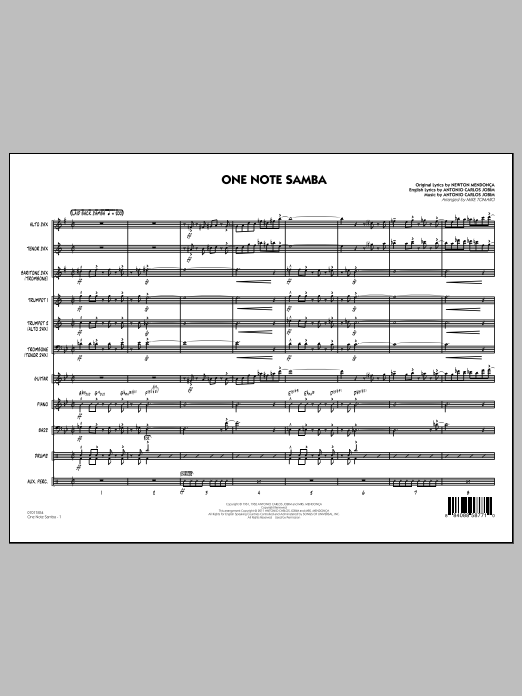

One Note Samba: Jazz Ensemble Conductor Score & Parts
By Newton Mendonca / By Antonio Carlos Jobim / By Pat Thomas / Arranged by Mike Tomaro
Grade: 3-4
Item: 35-PK00202888
$50.00
Pickup currently not available
Buy Extra Parts (Digital PDF Download)
| Product | Price | Quantity |
|---|---|---|
| One Note Samba - Conductor Score (Full Score) | $6.00 | |
| One Note Samba - Alto Sax | $6.00 | |
| One Note Samba - Tenor Sax | $6.00 | |
| One Note Samba - Baritone Sax | $6.00 | |
| One Note Samba - Trumpet 1 | $6.00 | |
| One Note Samba - Trumpet 2 | $6.00 | |
| One Note Samba - Trombone | $6.00 | |
| One Note Samba - Guitar | $6.00 | |
| One Note Samba - Piano | $6.00 | |
| One Note Samba - Bass | $6.00 | |
| One Note Samba - Drums | $6.00 | |
| One Note Samba - Aux Percussion | $6.00 | |
| One Note Samba - Alternate Alto Sax | $6.00 | |
| One Note Samba - Alternate Tenor Sax | $6.00 | |
| One Note Samba - Alternate Trombone | $6.00 |
Parts Added to Cart!
Description
Here is a striking and well-scored arrangement of Jobim's well-known standard. Presented here as part of Hal Leonard's Little Big Band series, Mike's smooth Latin arrangement provides plenty of variety and a great sounding groove.


One Note Samba: Jazz Ensemble Conductor Score & Parts isn't in MakeMusic Cloud just yet...but it could be. Let us know you'd like to see it, and you'll help shape what comes next. In the meantime, start a free trial and dive into thousands of interactive titles your students can play along with today.
Request This Title
Tell us you want it.
Start Your Free Trial
Explore everything that's ready to play right now.
Sample Audio
No sample audio found.
Sample Video
No sample videos found.
Additional Details
Publisher:
Hal Leonard
SKU:
35-PK00202888
More about this title
About the Composer: Newton Mendonca
Newton Mendonca was a Brazilian songwriter and composer who co-wrote "One Note Samba" with Antonio Carlos Jobim in 1961. Working alongside Jobim during the height of bossa nova's international expansion, Mendonca contributed lyrics and compositional ideas that helped define the genre's sophisticated harmonic language and rhythmic sophistication. His partnership with Jobim produced some of the era's most enduring standards, blending accessible melody with complex underlying chord changes that continue to captivate musicians and audiences alike.
Why we love this
Mike Tomaro's arrangement captures the essence of bossa nova without sacrificing the ensemble's ability to execute it cleanly. The writing distributes the melodic and harmonic weight evenly, so no section gets buried while the Latin groove stays front and center. At this grade level, students get authentic exposure to jazz arranging principles and Brazilian rhythm without fighting through unnecessary technical barriers.
What to expect
Warm and sophisticated. The arrangement breathes like a conversation, trading melody between sections with enough rhythmic space that every phrase lands clearly. There's a built-in groove that carries students even as they learn to navigate the tune's gentle harmonic turns.
Who it's for
Jazz ensembles in grades 7-9 ready to move beyond swing into Latin rhythms, or high school groups looking for a standard that reads cleanly without sacrificing musicality. Community college and adult jazz bands will appreciate the familiar tune paired with fresh voicings that challenge without overwhelming.
How to get the most out of it
- Balance the clave rhythm section carefully. The piano and bass establish the harmonic and rhythmic foundation, so lock them together first before layering the horns.
- Shape the melody across the ensemble sections rather than letting it sit static. Smooth handoffs between saxes and trumpets create forward motion that matches the standard's inherent momentum.
- Settle into a relaxed, breathing pulse. The notation might sit on the page, but bossa nova lives in the space between the written rhythms.
- Feature your soloists with space and light accompaniment behind them. The arrangement will open up when the full ensemble steps back.
How to use it
Pair this with other Jobim standards or Latin jazz repertoire to build a cohesive set that celebrates Brazilian songwriting tradition. It works equally well as a concert feature in a jazz showcase or as the appetizer before launching into more challenging contemporary material. Program it after students have developed foundational reading skills in jazz articulation and feel.
Skills your students will build
- Reading and executing clave rhythm patterns in ensemble context
- Balancing written melody against underlying Latin grooves
- Voicing jazz harmonies across sections with clarity and blend
- Solo improvisation over bossa nova changes
- Stylistic articulation specific to Brazilian jazz idiom