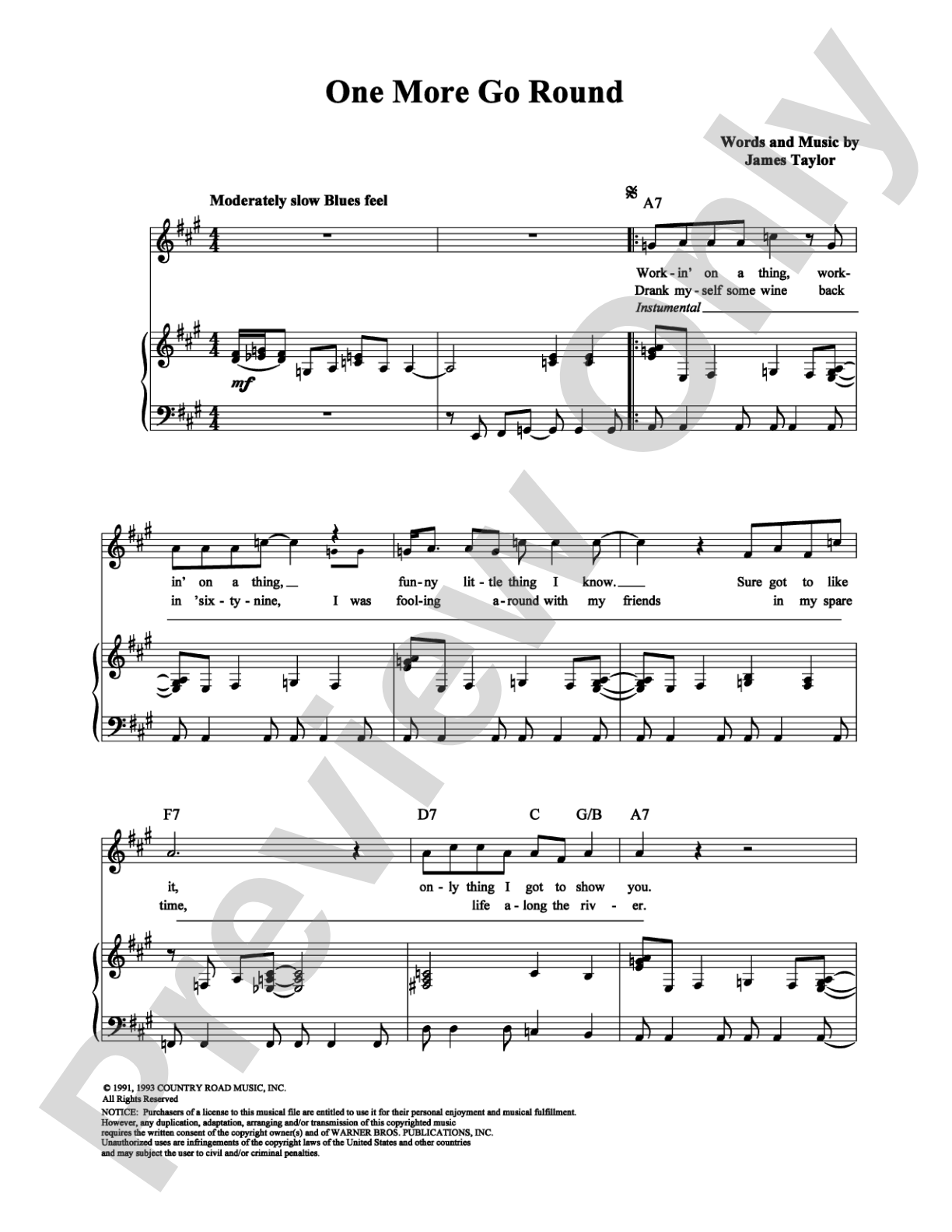
One More Go Round: Piano/Vocal/Chords Digital Sheet Music

One More Go Round: Piano/Vocal/Chords Digital Sheet Music

James Taylor

Item: 00-PS-0005931

Digital Download
$3.99
Description

One More Go Round: Piano/Vocal/Chords Digital Sheet Music isn't in MakeMusic Cloud just yet...but it could be. Let us know you'd like to see it, and you'll help shape what comes next. In the meantime, start a free trial and dive into thousands of interactive titles your students can play along with today.

Sample Audio
No sample audio found.
Sample Video
Additional Details
SKU: 00-PS-0005931

More about this title

About the Artist: James Taylor

James Taylor emerged as one of America's most significant singer-songwriters in the early 1970s, bringing intimate storytelling and acoustic sophistication to popular music. His career spans five decades of consistent artistry, marked by Grammy Awards, induction into the Rock and Roll Hall of Fame, and a catalog that ranges from introspective ballads to upbeat pop-rock arrangements.

Why we love this

Taylor's songs reward both serious study and genuine enjoyment in performance. The chord progressions offer enough sophistication to hold musicians' interest while remaining accessible enough for singers at various levels to communicate authentically with an audience.

What to expect

This song carries the warmth and directness characteristic of Taylor's writing, with an inviting melody that sits comfortably in the middle-to-upper vocal range. The arrangement balances rootedness and lift, grounded in acoustic sensibility while allowing room for interpretation.

Who it's for

Vocalists looking for contemporary repertoire with strong melodic and harmonic substance will find this accessible. Piano students accompanying singers or preparing solo arrangements benefit from the clear chord voicings and straightforward accompaniment patterns.

How to get the most out of it

  • Honor the rubato in the vocal line; Taylor's phrasing often sits slightly behind the beat, creating a conversational quality that feels natural rather than metrically rigid.
  • Balance the piano accompaniment to support without overwhelming the voice. The chords should enhance the lyrical content, not compete with it.
  • Pay attention to dynamics marked in the sheet music; small shifts in volume often define the emotional arc of the song.

How to use it

Include this in a contemporary music showcase, a singer-songwriter concert, or a recital program where adult contemporary repertoire complements classical or musical theater selections. It works equally well as a solo feature or as part of a tribute concert exploring singer-songwriters from the 1970s forward.

Skills your students will build

  • Reading chord symbols and interpreting voicings in real time
  • Sustaining vocal phrasing over longer melodic lines
  • Balancing melody and accompaniment in a duo setting
  • Interpreting rubato and conversational phrasing in a contemporary song

You May Also Like