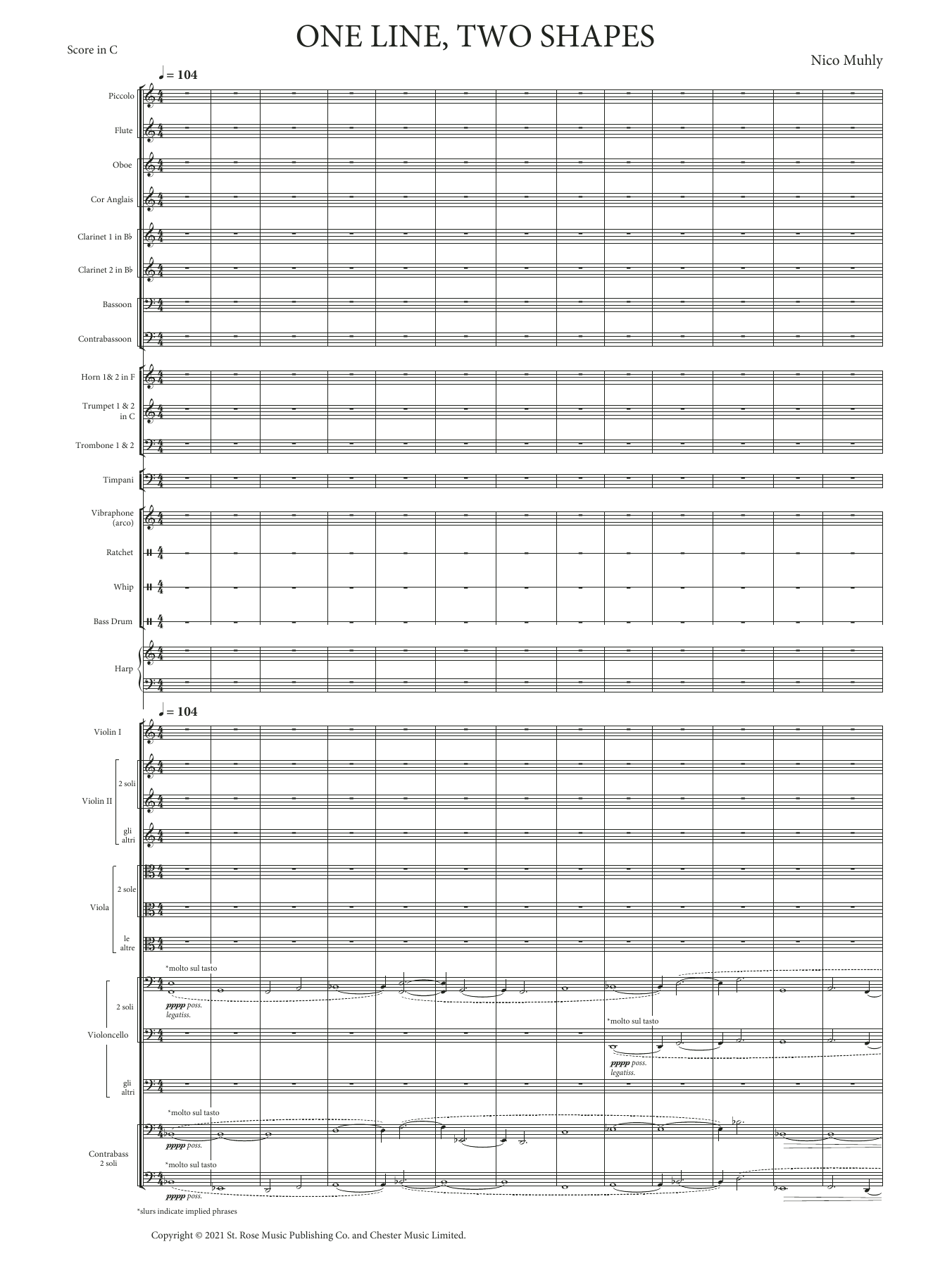
One Line, Two Shapes (Study Score) Sheet Music Preview

One Line, Two Shapes (Study Score): String Orchestra Conductor Score & Parts

By Nico Muhly

Item: 35-PK01540223

Digital Download
$18.99

Buy Extra Parts (Digital PDF Download)

Product Price Quantity
One Line, Two Shapes - Study Score $18.99

Parts Added to Cart!

Description
One Line, Two Shapes (Study Score)

One Line, Two Shapes (Study Score): String Orchestra Conductor Score & Parts isn't in MakeMusic Cloud just yet...but it could be. Let us know you'd like to see it, and you'll help shape what comes next. In the meantime, start a free trial and dive into thousands of interactive titles your students can play along with today.

Sample Audio
No sample audio found.
Sample Video
Additional Details
Publisher: Hal Leonard
SKU: 35-PK01540223

More about this title

About the Composer: Nico Muhly

Nico Muhly is an American composer whose work spans orchestral, chamber, operatic, and vocal idioms with equal fluency. His music is rooted in minimalist practice and structural clarity, yet it pushes toward lyricism and emotional directness that feels contemporary and urgent. Muhly has become a fixture in modern concert programming, and his pieces for student and professional ensembles alike reward careful listening and rehearsal attention.

Why we love this

Muhly's conceptual precision meets genuine string writing here. The piece's title hints at an idea that unfolds through pure instrumental gesture, and orchestras at all levels find the music intellectually engaging without becoming unnecessarily difficult. It's the kind of contemporary work that convinces students and audiences alike that new music can be both rigorously made and genuinely affecting.

What to expect

The music unfolds with geometric precision and emotional restraint, yet something quietly urgent lives inside it. Listening feels like watching a simple gesture become infinitely complex through repetition, layering, and subtle transformation. It's modern without cynicism and structured without coldness.

Who it's for

Advanced high school orchestras, college string ensembles, and professional groups seeking contemporary repertoire that respects both player and listener. This work speaks to musicians who have developed solid fundamentals and are ready to engage with 21st-century compositional thinking.

How to get the most out of it

  • Attend closely to the balance between individual voices and collective sonority; Muhly's writing often pits solo or sectional material against the full ensemble, and clarity of line becomes the expressive vehicle.
  • Establish tempo stability early. The study score will reveal rhythmic architecture that can feel elusive if the pulse wavers, so lock the foundation and let the voices emerge from that security.
  • Listen for harmonic context rather than relying on fingering habits. Muhly's harmonic language is economical and purposeful, and intonation problems often signal a misunderstanding of the underlying sonority.

How to use it

Pair this with standard repertoire as a curtain raiser or centerpiece of a contemporary concert. Its relative brevity and focused character make it an excellent anchor for a mixed program exploring how different composers approach string texture and line.

Skills your students will build

  • Executing precise rhythmic ensemble coordination within minimalist harmonic frameworks
  • Listening for internal voice leading while maintaining overall phrase shape
  • Responding to subtle dynamic and articulation shifts that generate expressive content
  • Reading and performing contemporary notational practices with confidence

You May Also Like