
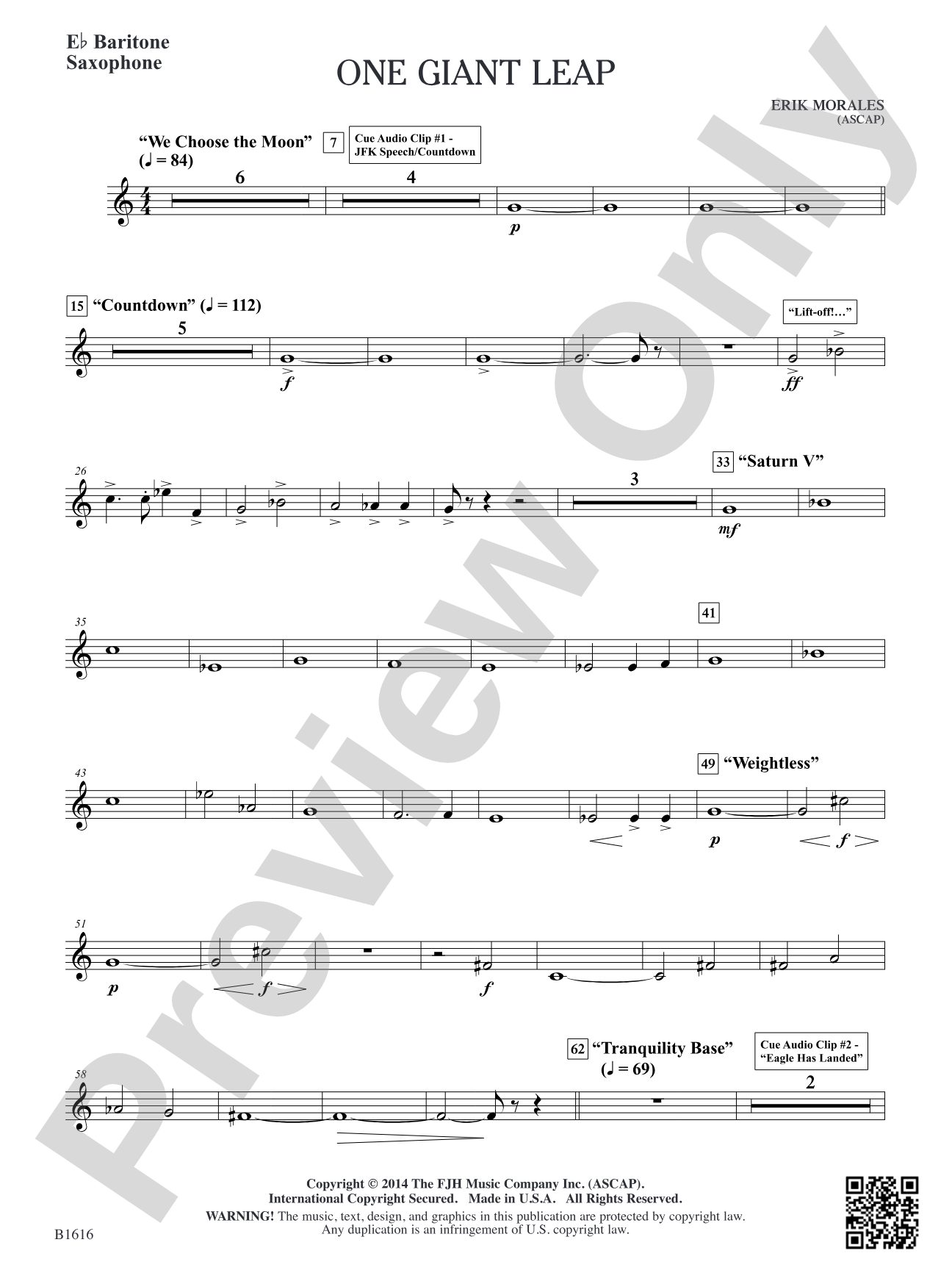

One Giant Leap: E-flat Baritone Saxophone
By Erik Morales
Grade: 3
Item: 98-PC-DB1616_BTX
$7.00
Pickup currently not available
Description
Perhaps no challenge has been greater in history than setting foot on the moon. Relive those amazing moments with this piece that uses audio clips from President Kennedy, Commander Neil Armstrong and others. The ultimate multimedia adventure with endless educational potential!


Don't just read it, hear it, play along with it, and watch your students grow with it. In MakeMusic Cloud, One Giant Leap: E-flat Baritone Saxophone comes alive with professional accompaniment, adjustable tempo, and built-in practice tools that turn solo practice into real progress.
Open in the Player
Jump straight in and assign it today.
Start Your Free Trial
Open this title and explore the full library in minutes.
Sample Audio
1
Audio File
--:--
0:00
0:00
Sample Video
No sample videos found.
Additional Details
Series:
FJH Concert Band
Publisher:
The FJH Music Company, Inc.
SKU:
98-PC-DB1616_BTX
More about this title
About the Composer: Erik Morales

Erik Morales has built a prolific composing career spanning multiple genres and ensemble types. Born in New York City in 1966, he studied composition at Florida International University and earned his bachelor's degree from the University of Louisiana at Lafayette in 1989. His trajectory began immediately after high school when a former band director commissioned him to arrange marching band music, launching decades of work in educational publishing alongside concert works for wind, orchestral, jazz, and chamber ensembles.
With over 150 publications to his name, Morales has established himself as a composer committed to balancing artistic substance with pedagogical utility. His trumpet works, drawing on his own mastery of the instrument, have garnered recognition at national competitions and conferences. In 2016, he was inducted into the Louisiana Association for Jazz Education's Hall of Fame, a testament to his lasting impact across multiple musical traditions.
Why we love this
Morales writes concert band music that respects young players' capabilities while delivering genuine musical payoff. The integration of historical audio footage transforms this from a novelty into a teachable moment about American achievement and the power of music to document history, making it far more engaging than a purely instrumental treatment would be.
What to expect
A stirring journey from earthbound anticipation to the triumph of a moonwalk, built on melodic ideas that feel both accessible and genuinely patriotic. The historical voices anchor the music in real events, lending weight and authenticity to what might otherwise feel like pure sentimentality.
Who it's for
Concert bands at the Grade 3 level looking for repertoire with genuine programmatic substance and a hook that engages audiences beyond the typical concert experience. Directors interested in building student investment through multimedia and historical narrative will find this particularly rewarding.
How to get the most out of it
- Coordinate the audio playback carefully during rehearsals so students understand exactly where the spoken passages fall relative to their entrances and exits. Mark cues clearly in all parts.
- Balance the volume of the recorded speeches and Neil Armstrong's voice so they project without overwhelming the band's sound. This often requires adjusting levels during dress rehearsal in your actual performance space.
- Build ensemble precision around the fixed timing of the audio segments. Unlike standard accompaniment tracks, these historical clips cannot flex, so the band must lock to the recording rather than the reverse.
- Consider the emotional arc: this piece asks students to honor a moment of genuine human accomplishment. Coach the band toward noble, assured playing rather than bombastic or sentimental interpretations.
How to use it
Reserve this for a spring concert or festival setting where the multimedia presentation can be managed with proper sound and lighting support. Its historical significance and clear narrative arc make it an ideal showcase piece for opening a concert or closing the first half of a program.
Skills your students will build
- Ensemble synchronization with recorded audio elements
- Phrasing and dynamic control in patriotic and programmatic contexts
- Reading a concert band score with integrated multimedia cues
- Listening and responding to conductor while locked to fixed audio timing