
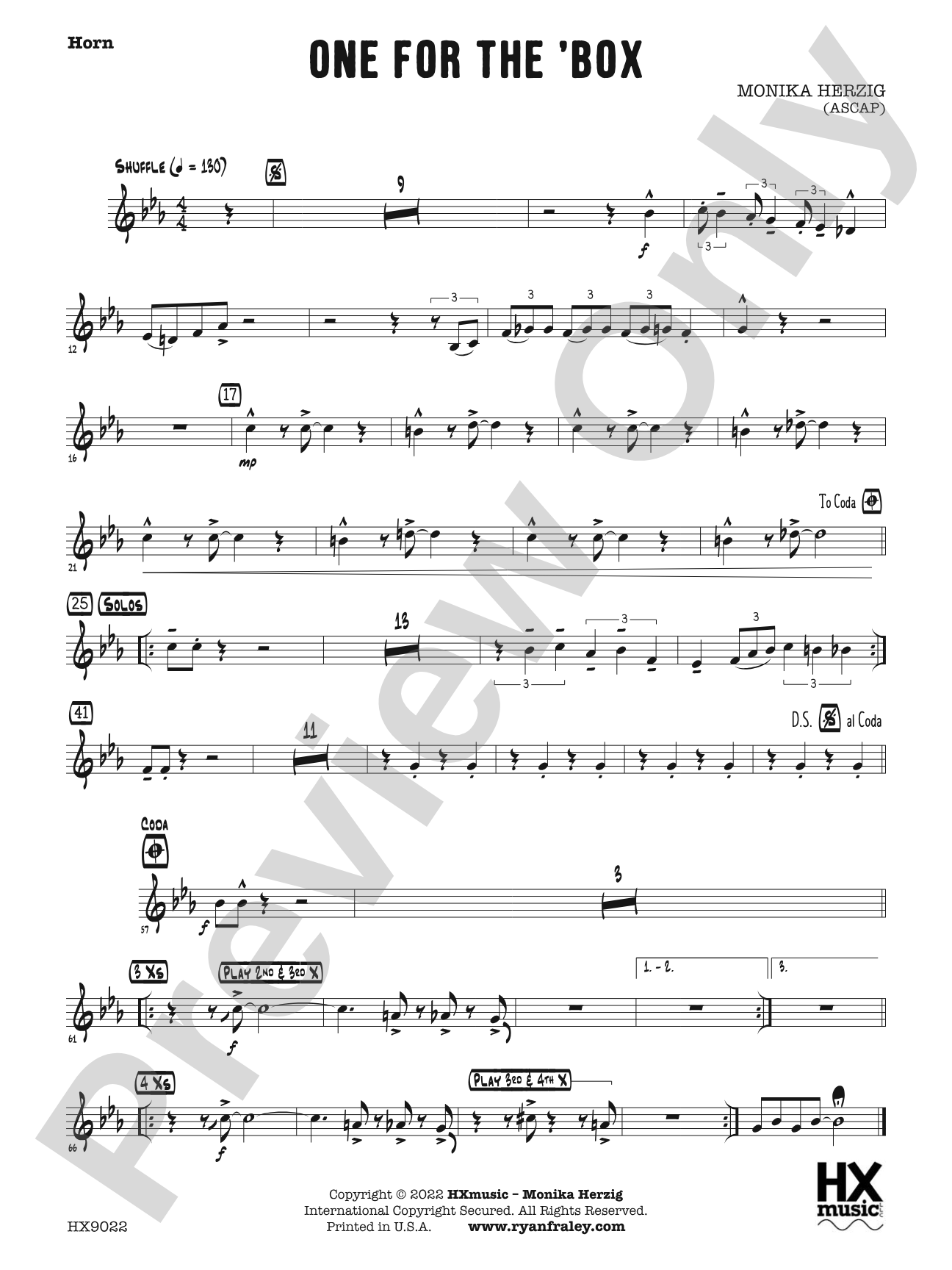

One for the 'Box: F Horn
By Monika Herzig
Grade: 3.5
Item: 98-PC-DHX9022_H1
$3.99
Pickup currently not available
Description
Not just any box, but the venerable Chatterbox jazz club! Monika originally recorded this hard-driving shuffle with her Acoustic Project. Now, the angular bebop lines are traded between trumpets and saxes. Solos for trombone, tenor sax, and guitar are provided in note-for-note transcriptions. However, there is room for any soloist before a sax soli further develops the melodic theme. Punchy and confident, this chart does not let up! Top trumpet note: G5 (4:00)


One for the 'Box: F Horn isn't in MakeMusic Cloud just yet...but it could be. Let us know you'd like to see it, and you'll help shape what comes next. In the meantime, start a free trial and dive into thousands of interactive titles your students can play along with today.
Request This Title
Tell us you want it.
Start Your Free Trial
Explore everything that's ready to play right now.
Sample Audio
1
Audio File
--:--
0:00
0:00
Sample Video
Additional Details
Series:
HXmusic
Publisher:
HXmusic
SKU:
98-PC-DHX9022_H1
More about this title
About the Composer: Monika Herzig

Monika Herzig arrived in the United States in 1988 with a guitar, a suitcase, and an exchange scholarship from her native Germany. She earned her doctorate in Music Education with a jazz studies focus from Indiana University, where she now serves on the faculty in Arts Administration. Her career has spanned both the academic and performance worlds: she's a touring bandleader whose ensembles have opened for Tower of Power and Sting, a recording artist with more than a dozen releases on her own ACME Records label, and a scholar whose books on David Baker and Chick Corea examine jazz history and pedagogy.
Herzig's honors include a 1994 Down Beat Magazine Award for Best Original Song and a 2015 Jazz Journalist Association Hero award, along with funding from the NEA and Indiana Arts Commission. Her recent project SHEroes showcases leading female jazz instrumentalists and reflects her commitment to expanding representation in jazz. She brings both performing experience and educational depth to every chart she writes.
Why we love this
This chart captures something vital about jazz ensemble writing at the educational level: the confidence to not overthink it. Herzig trades angular bebop lines between sections with enough clarity that students can hear the conversation, yet keeps the energy forward-moving and sharp. The combination of fully notated solos and space for interpretation gives your students room to grow without overwhelming them, and the shuffle groove is the kind of material that reminds young players why jazz matters.
What to expect
A night out at a real jazz club, captured in note form. The tune pulses with confidence, trades quick musical ideas between sections, and maintains an upbeat, no-nonsense energy throughout. There's room for individual voices to shine in the solos, but the ensemble remains the star.
Who it's for
Jazz ensembles at the Grade 3.5 level ready for material with real swing feel and section writing. Your students need solid fundamentals in rhythm and basic chord reading, but they don't need advanced upper-register facility or extreme technical demands to execute this with style.
How to get the most out of it
- Lock the shuffle pocket early in rehearsals. The 'hard-driving' character lives in the rhythm section's precision here, not in rushing; once the kick and hi-hat lock, the horns can sit back and trade comfortably.
- Balance the trumpet and sax lines in the head. Both sections carry angular bebop figures that should land with equal clarity; if one overpowers the other, the traded melody loses its playfulness.
- Encourage your soloists to fully own the provided transcriptions first, then gradually add small variations once they've internalized the changes. This approach builds confidence and musicianship at Grade 3.5.
- Watch the register on top trumpet at the 4:00 mark (G5). It's high but not unreasonable for a Grade 3.5 ensemble; have your section work on the approach and landing a few bars before to arrive securely.
How to use it
Program this for a jazz festival or concert where you want something contemporary and swinging without academic complexity. It pairs well alongside a more lyrical ballad, giving your audience the full spectrum of what your ensemble can do in a single set.
Skills your students will build
- Reading and executing swing rhythms and shuffle grooves
- Trading melodic lines between trumpet and saxophone sections
- Interpreting written bebop lines with phrasing and articulation
- Solo improvisation over chord changes (with transcription support provided)
- Section cohesion and balance in ensemble lines
- Responding to dynamic changes within a driving shuffle feel