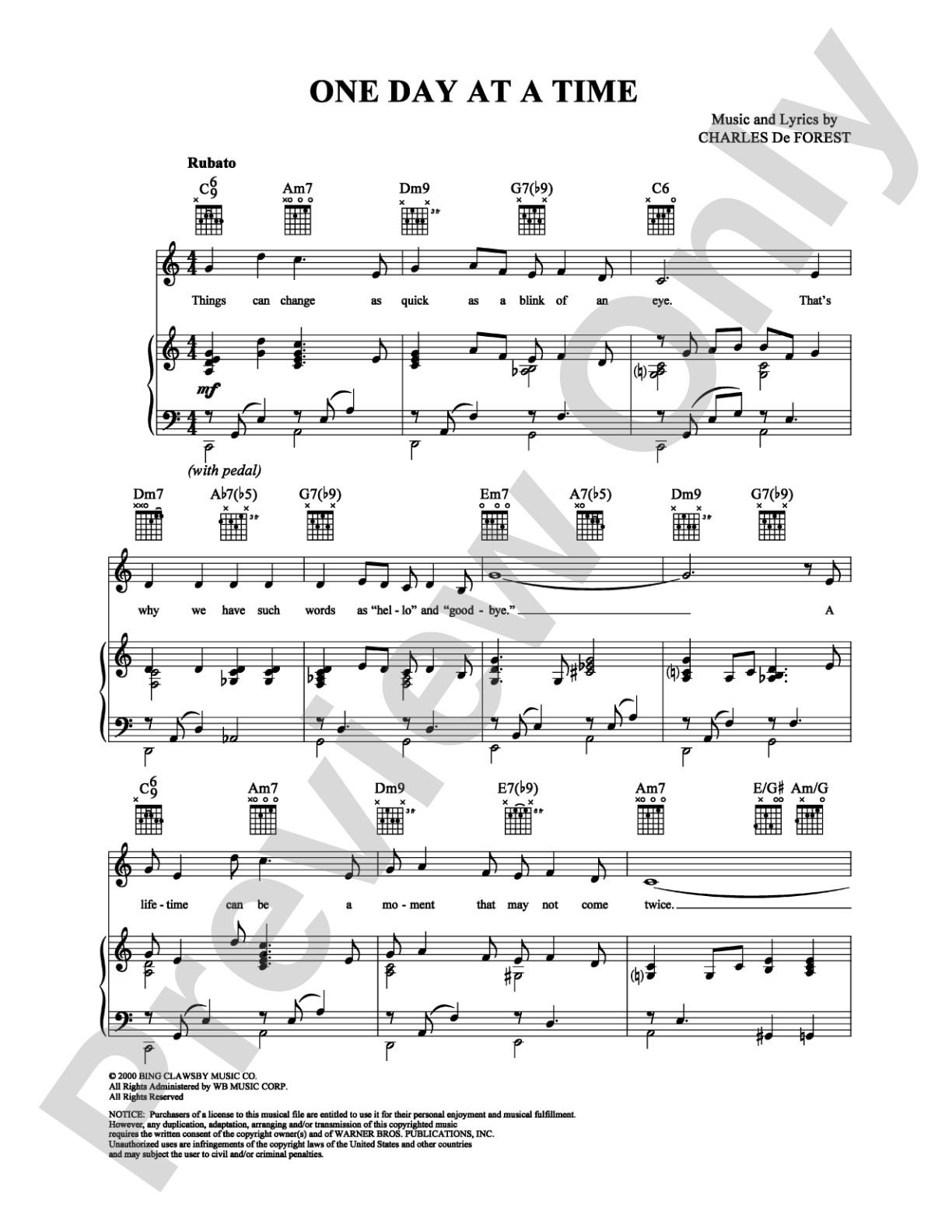
One Day at a Time: Piano/Vocal/Chords Digital Sheet Music

One Day at a Time: Piano/Vocal/Chords Digital Sheet Music

Michael Feinstein, Charles De Forest

Item: 00-PS-0005129

Digital Download
$3.99
Description

One Day at a Time: Piano/Vocal/Chords Digital Sheet Music isn't in MakeMusic Cloud just yet...but it could be. Let us know you'd like to see it, and you'll help shape what comes next. In the meantime, start a free trial and dive into thousands of interactive titles your students can play along with today.

Sample Audio
No sample audio found.
Sample Video
Additional Details
SKU: 00-PS-0005129

More about this title

About the Artist: Michael Feinstein

Michael Feinstein is a pianist and vocalist specializing in American song standards and the Great American Songbook. He has spent decades restoring and interpreting classic compositions from composers like Irving Berlin, George Gershwin, and Cole Porter, bringing meticulous attention to harmonic detail and lyrical nuance. His work as a performer and interpreter has made him a leading authority on standard jazz repertoire in concert and educational settings.

Why we love this

Feinstein's arrangement respects the architecture of this standard while remaining accessible for pianists and singers working at intermediate levels. The chord notation makes this ideal for jazz singers, cabaret performers, or vocalists who want to deepen their understanding of harmonic vocabulary through a beloved song.

What to expect

The song carries the warmth and philosophical acceptance its title suggests, moving through gentle harmonic shifts that reflect moments of resilience and quiet hope. Feinstein's arrangement honors the standard's introspective quality while maintaining the elegant simplicity that made it enduring.

Who it's for

This arrangement serves jazz vocalists, cabaret singers, and intermediate to advanced pianists who want to explore American standards with professional voicings. It works equally well for students learning to read chord charts or performers preparing for recitals and performances.

How to get the most out of it

  • Study the chord changes carefully before focusing on melody; understanding the harmonic progression will inform your phrasing and help you anticipate the song's emotional turning points.
  • Balance the vocal line against the piano part rather than competing with it; the accompaniment should support and enhance the singer's interpretation, not overshadow it.
  • Pay attention to the lyrical shape and narrative arc; this standard rewards singers who find personal meaning in the text and allow that to guide tempo and dynamic choices.
  • Experiment with rubato in sections where the chords suggest harmonic movement; rhythmic flexibility often feels most natural over richer harmonic changes.

How to use it

Include this in a jazz vocal concert or cabaret-style recital where standards serve as the backbone of the program. It pairs naturally with other songs from the Great American Songbook and provides a moment of intimate reflection in a set of American song literature.

Skills your students will build

  • Reading chord symbols and jazz voicings
  • Connecting harmonic progression to vocal phrasing
  • Interpreting standards with musical intention
  • Balancing accompaniment and melody
  • Understanding the architecture of American song forms

You May Also Like