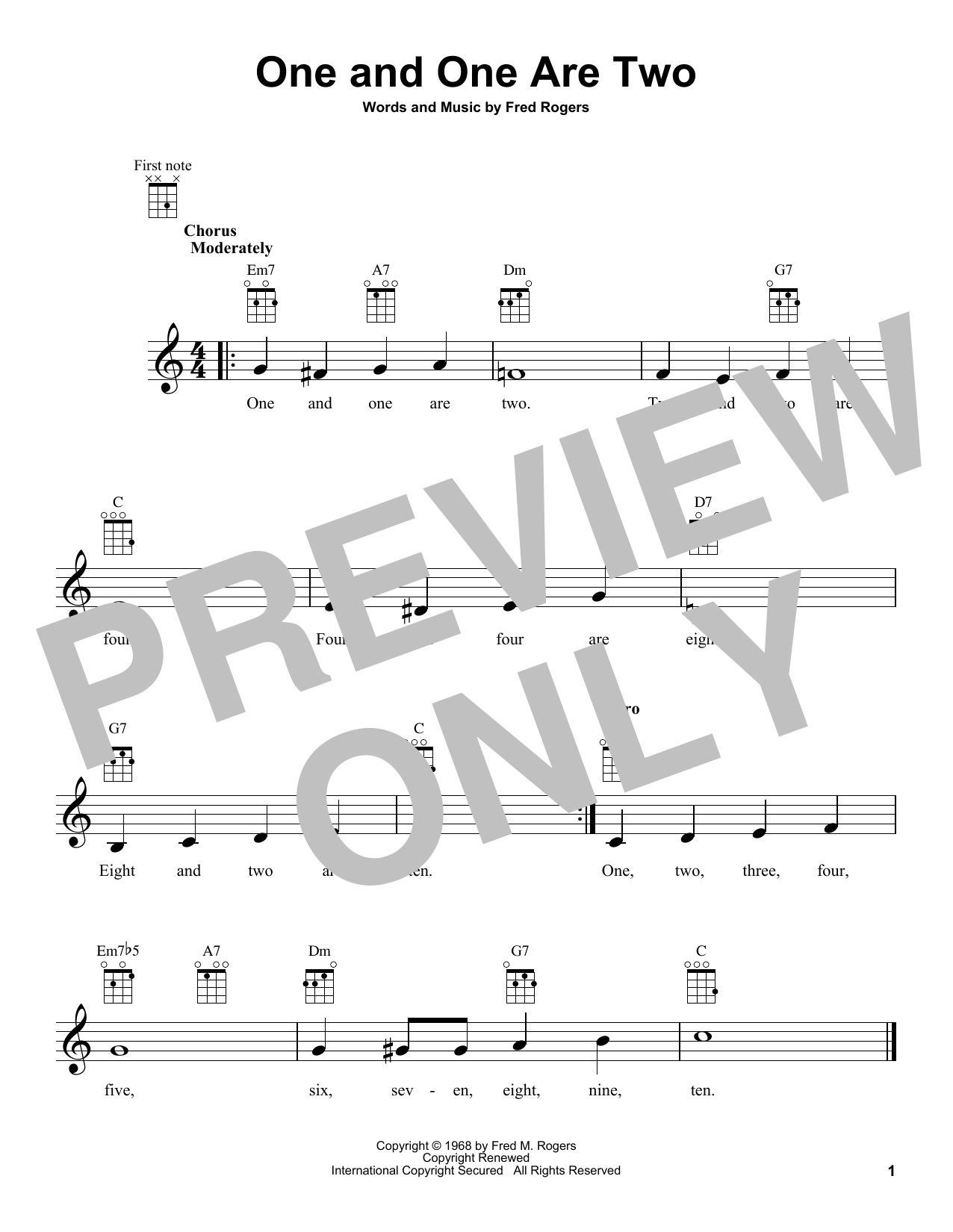
One And One Are Two (from Mister Rogers' Neighborhood) Sheet Music Preview

One And One Are Two (from Mister Rogers' Neighborhood): Ukulele

As performed by Fred Rogers / As performed by Mister Rogers

Item: 35-DS00446780

Digital Download
$3.99
Description

One And One Are Two (from Mister Rogers' Neighborhood): Ukulele isn't in MakeMusic Cloud just yet...but it could be. Let us know you'd like to see it, and you'll help shape what comes next. In the meantime, start a free trial and dive into thousands of interactive titles your students can play along with today.

Sample Audio
No sample audio found.
Sample Video
Additional Details
Publisher: Hal Leonard
Page Count: 1
SKU: 35-DS00446780

More about this title

About the Artist: Fred Rogers

Fred Rogers created Mister Rogers' Neighborhood, a groundbreaking children's television program that ran for over three decades. His approach to music education was inseparable from his philosophy of emotional development; every song served a pedagogical purpose, whether teaching numbers, social skills, or feelings that young people needed to name and understand.

Rogers composed hundreds of pieces for the show, many of which have become standards in early childhood music education. His melodies are designed for young voices and hands: simple enough for beginning musicians to grasp quickly, yet crafted with genuine harmonic sophistication and emotional authenticity that respects children as intelligent listeners.

Why we love this

This song brings the joy of mathematical thinking into music class without a trace of condescension. Young ukulele players get to engage with a piece that entertained millions of children while building their confidence on the instrument, and the straightforward melody means they can focus on producing a warm, clear tone from day one.

What to expect

Bright, gentle, and playful. The song has the warmth of a trusted teacher explaining something wonderful, with just enough repetition to feel reassuring without being monotonous.

Who it's for

Ukulele beginners in early elementary grades and absolute beginners of any age who want an encouraging first piece. Teachers looking for repertoire that combines music learning with foundational math concepts will find this especially valuable.

How to get the most out of it

  • Keep the tempo steady and unhurried; the charm of the piece depends on clarity and directness rather than speed.
  • Shape small phrases naturally, allowing the melody to breathe between the paired statements (one and one, two and two).
  • Balance the melody so it sits slightly above the accompaniment, making the counting game audible to listeners.

How to use it

Ideal for an early-in-the-year performance showcasing beginning ukulele students, or as part of a family concert where young performers share what they've learned. The mathematical theme also works naturally in an interdisciplinary assembly celebrating numeracy.

Skills your students will build

  • Playing simple quarter-note and half-note rhythms with consistent pulse
  • Reading single-line melodies on the ukulele staff
  • Maintaining steady tempo while counting
  • Producing clean tone transitions between adjacent frets
  • Performing with confidence in front of an audience

You May Also Like