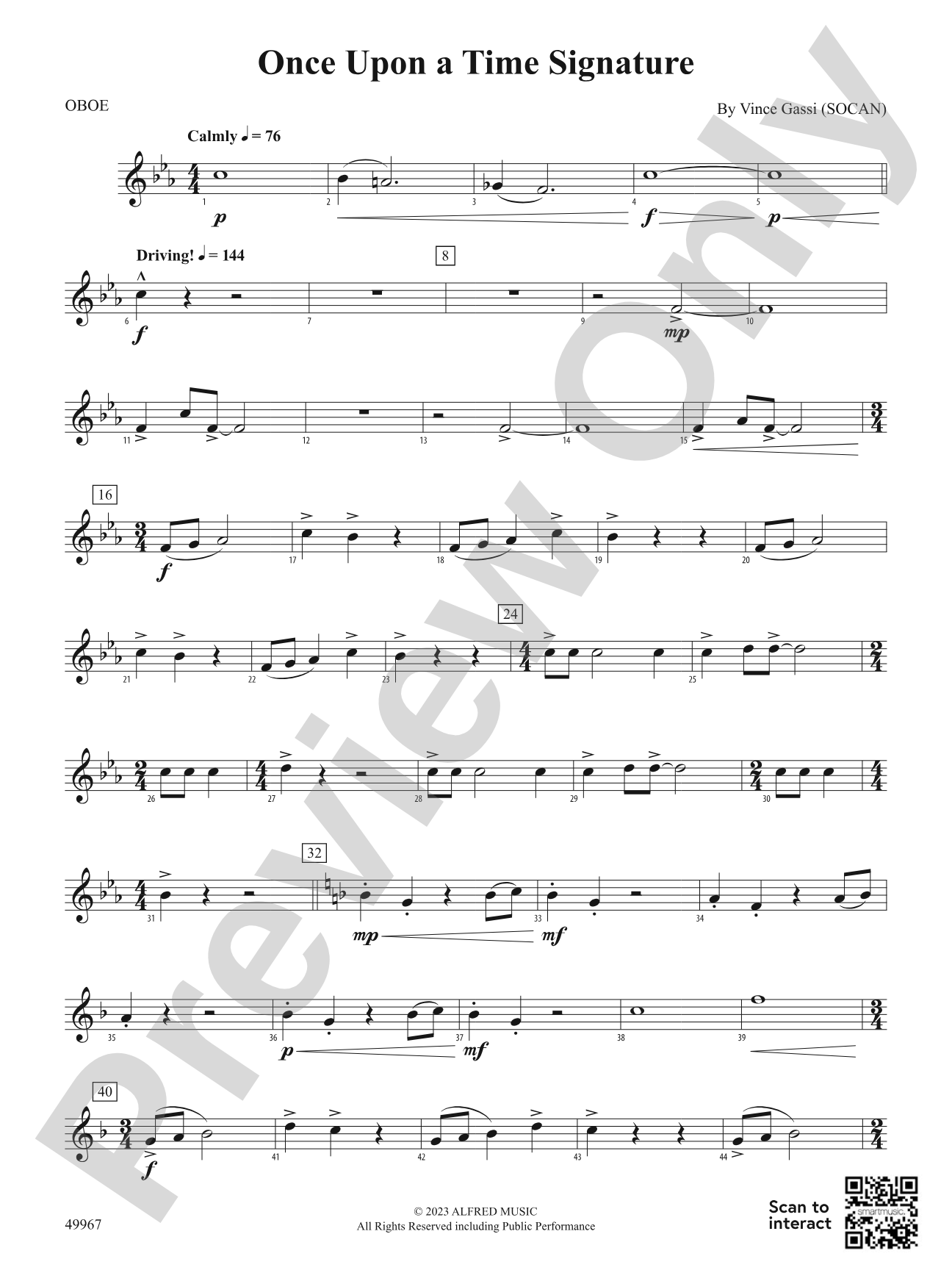
Once Upon a Time Signature: Oboe Sheet Music Preview

Once Upon a Time Signature: Oboe

By Vince Gassi

Grade: 2

Item: 00-PC-0019033_O1

Digital Download
$3.00
Description
Themes are pliable; they can evolve and exist in more than one time signature. Once Upon a Time Signature is the perfect opportunity for your young musicians to improve their craft by adapting to frequent changes in time. 4/4 to 3/4, and back again, they will rise to the challenge. Count on it! (2:30)

Don't just read it, hear it, play along with it, and watch your students grow with it. In MakeMusic Cloud, Once Upon a Time Signature: Oboe comes alive with professional accompaniment, adjustable tempo, and built-in practice tools that turn solo practice into real progress.

Sample Audio
0:00
0:00
Sample Video
Additional Details
Series: Developing Band Series
Publisher: Alfred Music
SKU: 00-PC-0019033_O1

More about this title

About the Composer: Vince Gassi

Vince Gassi

Vince Gassi has been composing for young musicians since 2006, building a catalog of over 100 published works that balance accessibility with genuine musical substance. His training spans the University of Western Ontario, the Dick Grove School of Music in Los Angeles, and a Ph.D. from York University in Toronto, giving him deep expertise in both composition and the pedagogical demands of school ensembles.

For twenty-five years, Gassi taught instrumental music at elementary and secondary levels, work that shaped his understanding of what young musicians need to grow. He remains active as a guest conductor, adjudicator, and clinician throughout North America, leading seminars on student engagement, arranging concepts, and digital workflows for music directors. His pieces appear regularly on festival and contest programs across the United States, Canada, Europe, and Japan, and he is frequently performed at the Midwest Clinic in Chicago.

Why we love this

Meter changes sound like they should be a problem, but Gassi turns them into the whole point of the piece. Young bands thrive when they have a clear musical reason to develop a new skill, and here the changing time signatures aren't a technical hurdle to clear; they're built into a tuneful, engaging concert work. The Developing Band Series label is earned by pieces exactly like this one.

What to expect

Light, accessible, and rhythmically playful. The recurring theme anchors the piece across its meter shifts, giving students a musical home while their counting moves around. There's energy and momentum, never a sense of strain or struggle.

Who it's for

Grade 2 concert bands ready to move beyond single meters but needing scaffolded exposure to time signature changes. This piece suits young ensembles working toward festival or contest performance where technical growth is expected and celebrated.

How to get the most out of it

  • Establish a steady pulse before introducing the meter changes. Have the band feel the underlying beat as continuous, even as the grouping shifts from 4/4 to 3/4. This mental framework prevents the transition from feeling like a restart.
  • Mark the meter changes clearly in parts and use a preparatory beat in the measure before the switch. Younger musicians need visual confirmation that the conductor is aware of what's coming.
  • Let the melodic line carry the momentum through transitions. When players focus on the tune rather than counting bar lines, the meter changes integrate naturally into the musical phrase.

How to use it

Slot this into a festival program or concert alongside other Grade 2 selections to demonstrate your ensemble's rhythmic maturity and adaptability. It works equally well as a contest piece where the technical feature (meter changes) is woven so naturally into the music that judges hear musicianship before difficulty.

Skills your students will build

  • Reading and performing time signature changes (4/4 to 3/4 and back)
  • Maintaining pulse continuity across different metric groupings
  • Following a conductor's preparatory beats and visual cues for transitions
  • Identifying and emphasizing melody to support musical phrasing across meter changes

You May Also Like