
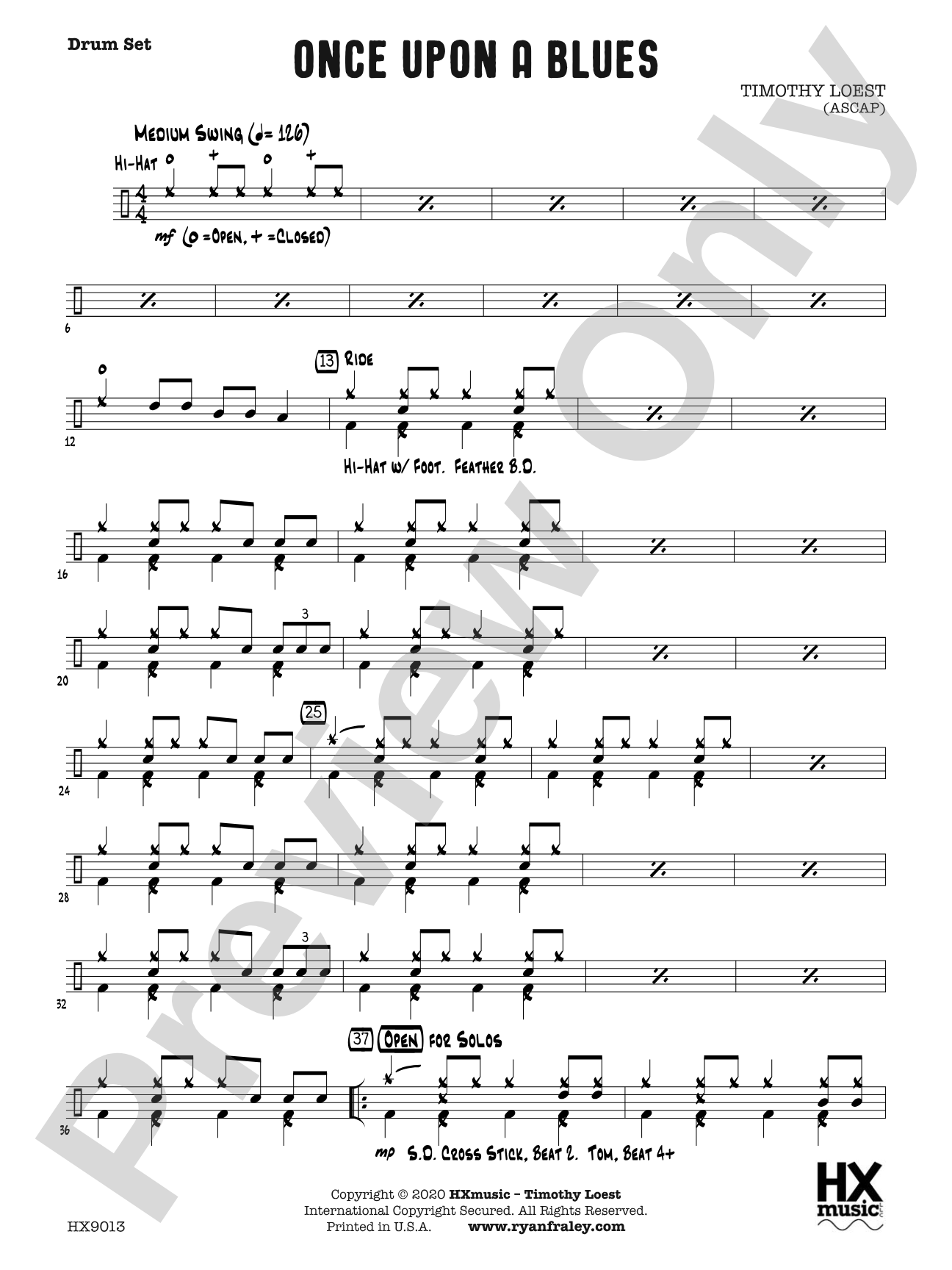

Once Upon a Blues: Drum Set
By Timothy Loest
Grade: 1.5
Item: 98-PC-DHX9013_DS
$3.99
Pickup currently not available
Description
Now even your youngest players get to swing. And swing hard they will! This super achievable twelve-bar blues chart has it all, including a "head" that's as catchy as its title, an open solo section complete with backgrounds and optional written-out solos, a stop-time soft shout chorus, and a full blast restatement of the main theme. Get ready to wail! Top trumpet note: D5.


Once Upon a Blues: Drum Set isn't in MakeMusic Cloud just yet...but it could be. Let us know you'd like to see it, and you'll help shape what comes next. In the meantime, start a free trial and dive into thousands of interactive titles your students can play along with today.
Request This Title
Tell us you want it.
Start Your Free Trial
Explore everything that's ready to play right now.
Sample Audio
1
Audio File
--:--
0:00
0:00
Sample Video
Additional Details
Series:
HXmusic
Publisher:
HXmusic
SKU:
98-PC-DHX9013_DS
More about this title
About the Composer: Timothy Loest

Timothy Loest has spent over thirty years in the classroom at F.E. Peacock Middle School in Illinois, where he developed the practical instincts that define his compositions. His works are performed by ensembles worldwide, and his influence extends through pedagogical partnerships with best-selling methods including Measures of Success, Warm-ups and Beyond, and Rhythms and Beyond. In 2017, his composition Cloud Gate drew over 5,000 spectators to Chicago's Millennium Park, and that same year he received the Illinois Grade School Music Association's Cloyd Myers Memorial Award for Excellence in Music Education.
Loest's catalog spans multiple publishers including Warner Bros. Publications, C.L. Barnhouse, and FJH Music, with his music appearing on national television programs from The Tonight Show to Good Morning America. A member of ASCAP and holder of degrees from Illinois State University and Northwestern University, he founded Fanfare Music Press in 2022 to publish high-quality band compositions and arrangements. He continues to accept commissions and maintains an active presence in music education leadership.
Why we love this
Grade 1.5 blues charts rarely nail both swing feel and genuine musical substance, but Loest gives you a head that sticks in your students' heads immediately while building real jazz vocabulary. The architecture here rewards ensemble cohesion: backgrounds that lock the soloists in place, a stop-time shout that demands precision and confidence, and enough structural clarity that even first-time jazz players know exactly where they are.
What to expect
Accessible and fun without being condescending. The twelve-bar form feels instantly familiar, but Loest's head is memorable enough to stick with students long after rehearsal ends. When the stop-time moment hits and the ensemble locks in, there's a real groove happening.
Who it's for
Beginning jazz ensembles and first-year jazz programs looking for repertoire that teaches ensemble listening, solo confidence, and swing style without overwhelming young players. This works equally well for groups preparing for festival play or building a jazz concert that mixes standards with accessible original material.
How to get the most out of it
- Establish the swing eighth-note feel in rehearsal before worrying about solo trading. A steady high-hat or ride cymbal pulse will anchor your rhythm section.
- The backgrounds behind the solo section should sit just underneath the soloist's line. They're there to support, not compete; think of them as a safety net rather than a full accompaniment.
- Build dynamic contrast into the stop-time shout chorus. Starting softer makes the arrival back into the full blast restatement land with real impact.
- Your trumpet soloist will appreciate a walkthrough of the optional written-out solo before turning them loose. It shows what's idiomatic while still encouraging improvisation.
How to use it
Slot this early in a jazz concert or festival set to build momentum and settle your ensemble into the style. It pairs well with other blues-based material and serves as an excellent teaching piece if you're building a unit on jazz composition and arrangement structures.
Skills your students will build
- Swing eighth-note feel and straight vs. swung rhythm discrimination
- Comping and background figure placement in relation to a soloist
- Basic 12-bar blues form and harmonic progression
- Ensemble balance and listening while maintaining your own line
- Solo confidence in an open improvisation section
- Stop-time ensemble precision and rhythmic unison