Once in a While: Piano Digital Sheet Music

Once in a While: Piano Digital Sheet Music

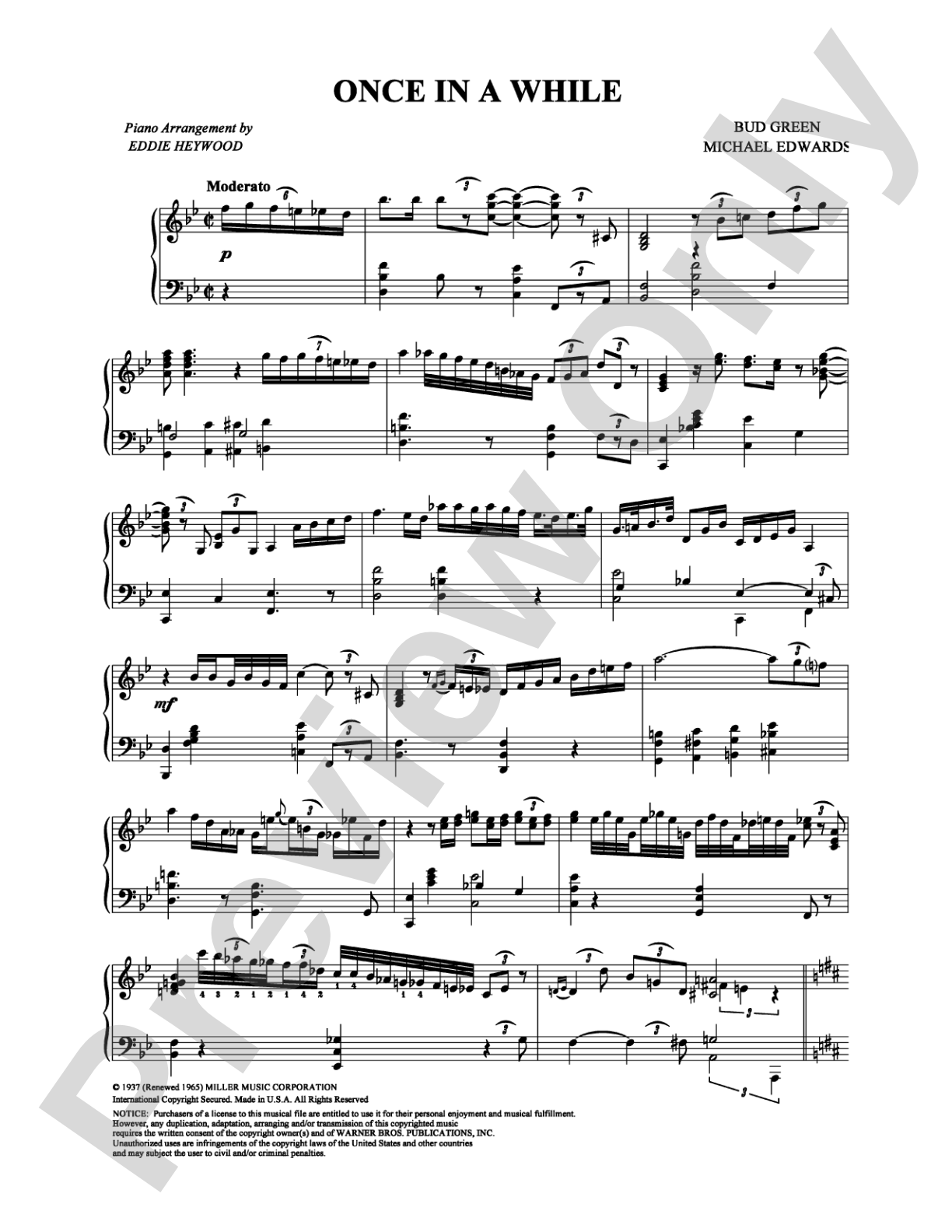
Michael Edwards, Bud Green, Eddie Heywood

Item: 00-PS-0007193

Digital Download
$3.99
Description

Once in a While: Piano Digital Sheet Music isn't in MakeMusic Cloud just yet...but it could be. Let us know you'd like to see it, and you'll help shape what comes next. In the meantime, start a free trial and dive into thousands of interactive titles your students can play along with today.

Sample Audio
No sample audio found.
Sample Video
Additional Details
SKU: 00-PS-0007193

More about this title

About the Artist: Eddie Heywood

Eddie Heywood (1915-1989) was a pianist and composer who bridged swing and bebop eras with his sophisticated harmonic language and swinging touch. His work as both a performer and composer helped shape the jazz standards repertoire, and his arrangements and original compositions remain essential listening for understanding jazz piano development in the 1940s and 1950s.

Why we love this

This standard gives jazz pianists a vehicle for exploring swing-era voicings and comping vocabulary without overwhelming harmonic complexity. The melody sits naturally under the hands, leaving room to focus on accompaniment styles, tension and release, and the interplay between solo lines and walking bass patterns that define the jazz piano sound.

What to expect

Warm and conversational, with a melody that glides smoothly over gently swinging changes. The tune has an unhurried elegance; there's room to stretch and phrase naturally, inviting the pianist to find personal expression within a familiar harmonic framework.

Who it's for

Jazz pianists at the intermediate to advanced level who want to deepen their familiarity with standards repertoire and develop improvisation skills in a swing context. It also serves students exploring 1940s-1950s jazz arranging and composition techniques.

How to get the most out of it

  • Anchor the left hand with a steady walking bass or stride pattern that locks with the harmonic structure; this foundation lets the right hand breathe and improvise.
  • Listen carefully to the chord changes and explore voice leading that connects extensions and alterations smoothly between measures.
  • Experiment with varying the density of your comping from measure to measure: sparse, syncopated accompaniment in some sections and fuller, busier voicings in others builds momentum.
  • Sing or hum the melody while playing changes to internalize how harmony and line interact, especially during improvised passages.

How to use it

Feature this in a jazz recital or informal jazz performance where the focus is on solo piano and improvisation. It pairs well with other standards from the same era, creating a mini-set that showcases how different composers approached similar harmonic territory.

Skills your students will build

  • Voice leading through jazz chord changes
  • Walking bass patterns and stride accompaniment
  • Improvisation over swing-era harmony
  • Phrasing and dynamics in solo piano performance
  • Comping texture and density control

You May Also Like