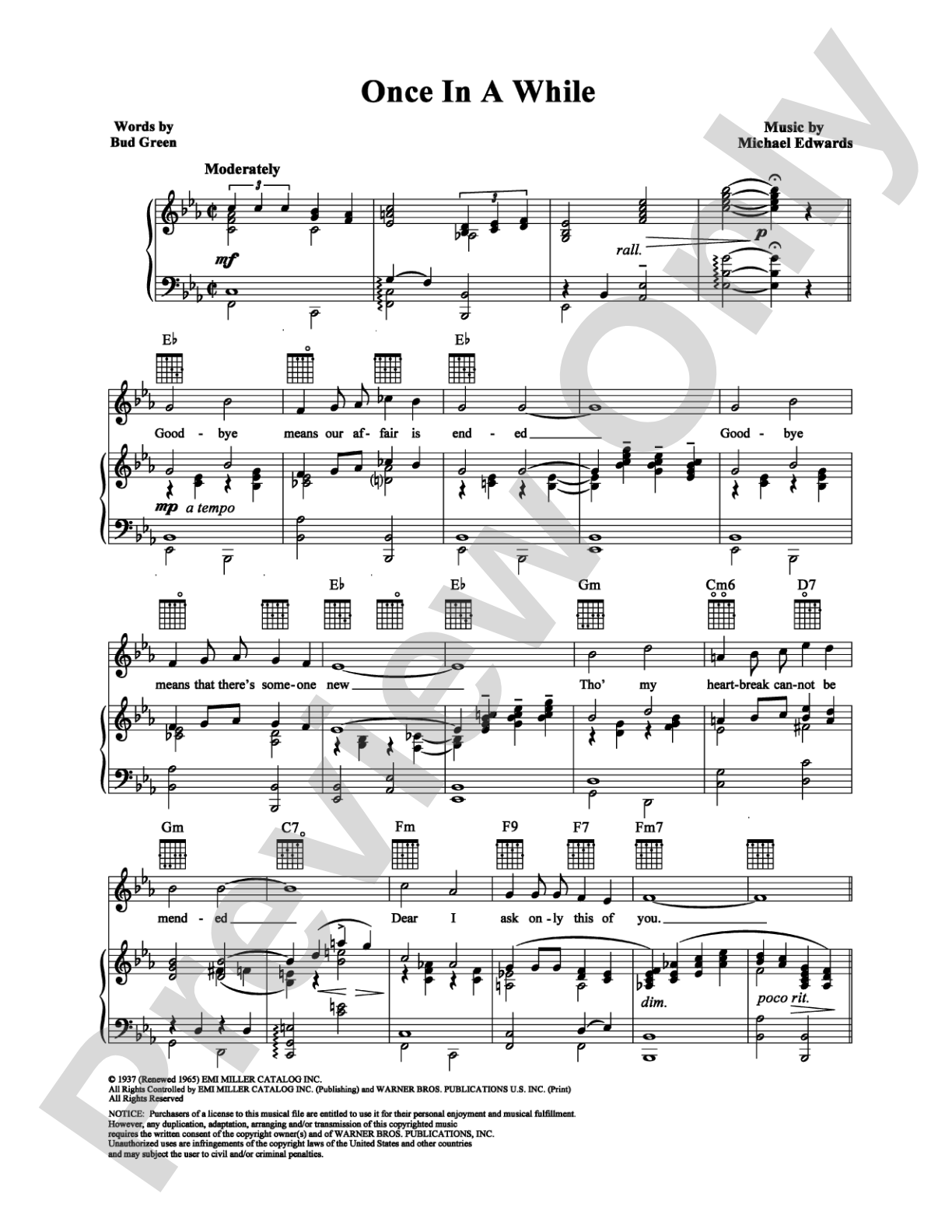
Once in a While: Piano/Vocal/Chords Digital Sheet Music

Once in a While: Piano/Vocal/Chords Digital Sheet Music

Michael Edwards, Tommy Dorsey, Fats Waller

Item: 00-PS-0004310

Digital Download
$3.99
Description

Once in a While: Piano/Vocal/Chords Digital Sheet Music isn't in MakeMusic Cloud just yet...but it could be. Let us know you'd like to see it, and you'll help shape what comes next. In the meantime, start a free trial and dive into thousands of interactive titles your students can play along with today.

Sample Audio
No sample audio found.
Sample Video
Additional Details
SKU: 00-PS-0004310

More about this title

About the Artist: Fats Waller

Fats Waller (1904, 1943) was a pianist, organist, bandleader, and composer whose wit and technical brilliance defined the stride piano tradition. His prolific output included standards that became jazz repertoire staples, and his ability to blend sophisticated harmonies with infectious swing made him a bridge between stride piano's ragtime roots and modern jazz.

Why we love this

This standard captures the sophisticated harmonies and flexible phrasing that define great American songwriting. The piano/vocal/chords format lets singers explore swing phrasing and arrangement choices while pianists navigate the rich harmonic language that makes this repertoire so rewarding to teach and perform.

What to expect

Warm, urbane, and unhurried. The harmonic language opens up space for interpretation and personal expression, inviting the performer to inhabit the lyric with genuine feeling rather than rush through the melody.

Who it's for

Vocalists and pianists preparing jazz standards for recitals, jam sessions, or formal performances will find this a valuable resource. It serves singers working on swing phrasing and pianists developing jazz comping vocabulary, as well as teaching artists building repertoire around American songbook classics.

How to get the most out of it

  • Study the recorded versions to understand where swing eighth notes and syncopation sit in relation to the beat; the notation provides the skeleton, but the feel lives in the space around it.
  • Balance the vocal line against the piano part so the harmony supports rather than obscures the melody; pay particular attention to dense voicings in the bridge.
  • Use the chord symbols to explore different comping styles and rhythmic approaches; pianists can try stride, rootless voicings, or walking patterns depending on the desired mood.

How to use it

Pair this with other standards from the same era to create a jazz vocal recital segment, or use it as a bridge between classical art song and contemporary jazz contexts. It works especially well in programs exploring the intersection of popular song and concert music.

Skills your students will build

  • Interpreting swing eighth notes and syncopated rhythms in a jazz context
  • Reading and voicing jazz chord symbols (seventh chords, alterations, extensions)
  • Balancing melody and harmonic accompaniment in a jazz setting
  • Phrasing with flexibility while maintaining metric integrity

You May Also Like