Once in a While: Piano Digital Sheet Music

Once in a While: Piano Digital Sheet Music

Michael Edwards, Earl Hines, Bud Green

Item: 00-PS-0000616

Digital Download
$3.99
Description

Once in a While: Piano Digital Sheet Music isn't in MakeMusic Cloud just yet...but it could be. Let us know you'd like to see it, and you'll help shape what comes next. In the meantime, start a free trial and dive into thousands of interactive titles your students can play along with today.

Sample Audio
No sample audio found.
Sample Video
Additional Details
SKU: 00-PS-0000616

More about this title

About the Artist: Earl Hines

Earl Hines (1903-1983) was a pianist and bandleader who fundamentally shaped the sound of swing jazz. Known as "Fatha," Hines pioneered the "trumpet style" of piano playing, where he voiced chords and melodies to echo the phrasing and articulation of a trumpet, creating a percussive yet singing approach that influenced generations of jazz pianists. His work with Louis Armstrong and his own big band during the 1930s and 1940s made him one of the most recorded and influential figures in early jazz history.

For music educators, Hines's recordings and compositions offer invaluable study material in jazz articulation, harmonic sophistication, and rhythmic independence. His approach to solo piano demonstrates how classical training (he studied under classical teachers) merged with African American improvisation traditions to create a distinctly American art form.

Why we love this

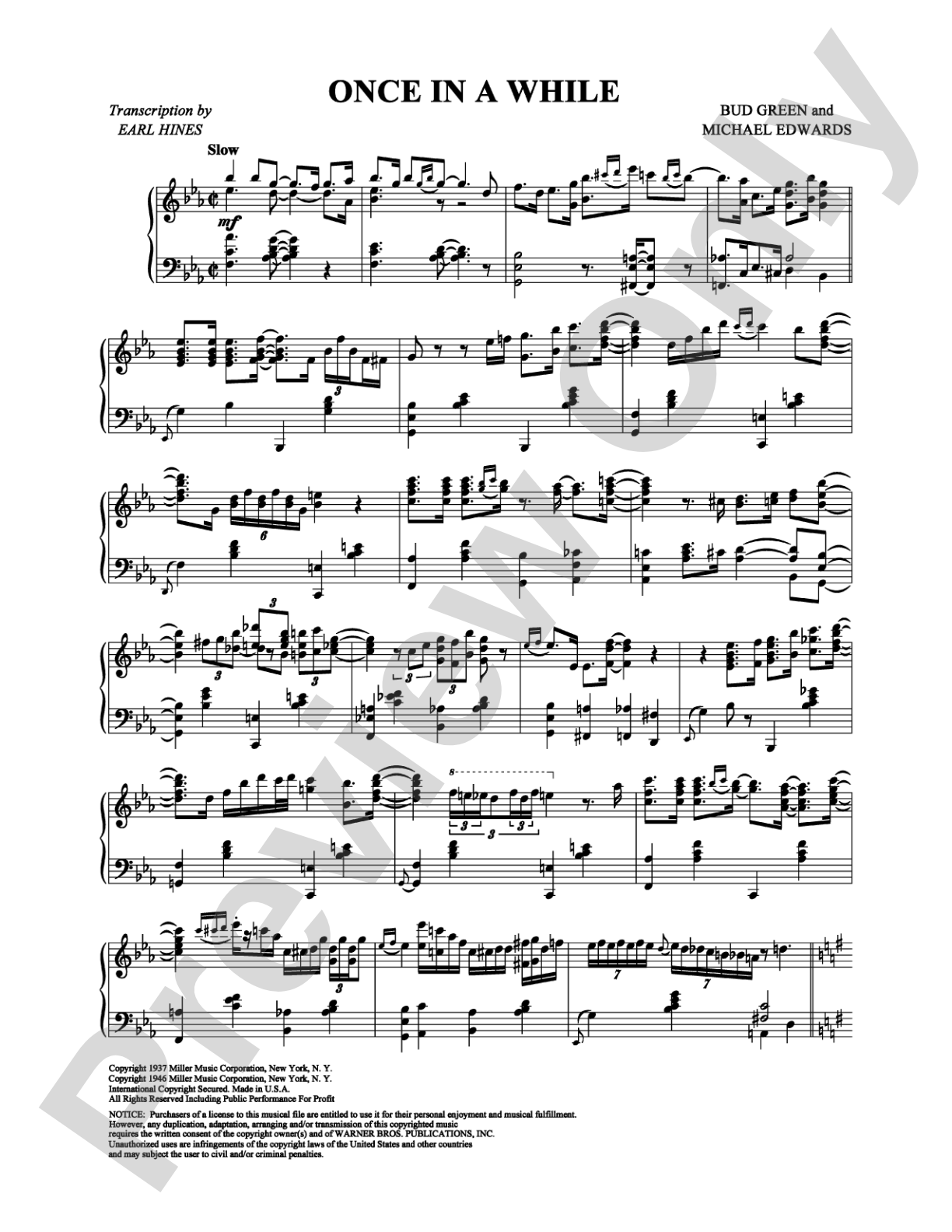
This standard gives pianists direct access to Hines's vocabulary and phrasing through a tune he knew well. Studying his approach to this song reveals his signature techniques: the way he voices block chords, articulates single-note lines like a horn player, and builds momentum through stride and comping patterns. It's an essential reference recording for any pianist serious about understanding how swing-era jazz pianists actually played.

What to expect

Elegant yet grounded, with a conversational ease that belies its technical sophistication. The melody floats over a rhythmically supple accompaniment that swings without rushing, creating the sense of a master musician at complete command of his instrument and fully present with the music.

Who it's for

Jazz pianists who want to learn from one of the instrument's founders and understand how stride, swing articulation, and improvisation converge. Intermediate to advanced pianists studying the historical development of jazz piano language will find this standard a gateway into Hines's approach.

How to get the most out of it

  • Listen to how Hines articulates the melodic line with tongue-like clarity, separating notes rather than legato phrasing. This "trumpet style" requires precise finger work and controlled attack on each note.
  • Notice the rhythmic placement of his comping chords beneath the melody. They don't sit squarely on the beat but anticipate and react to the solo line, creating conversational tension.
  • Study his left hand independence. The bass line doesn't simply anchor harmony; it moves with countermelodic purpose, especially during walking sections.
  • Pay attention to his dynamic range and touch. Hines commands both delicate single-note passages and powerful block chord statements within a single chorus, using dynamics as a primary expressive tool.

How to use it

Include this in a jazz recital that traces the evolution of American piano jazz, pairing it with later interpretations by pianists influenced by Hines. It also works well as a study score alongside listening assignments where students transcribe and analyze his comping and solo lines.

Skills your students will build

  • Swing articulation and phrasing
  • Left hand independence in stride and comping patterns
  • Block chord voicing and voice leading
  • Listening to and transcribing jazz solos
  • Understanding harmonic reharmonization and substitution in jazz standards
  • Rhythmic flexibility and ahead-of-the-beat placement

You May Also Like