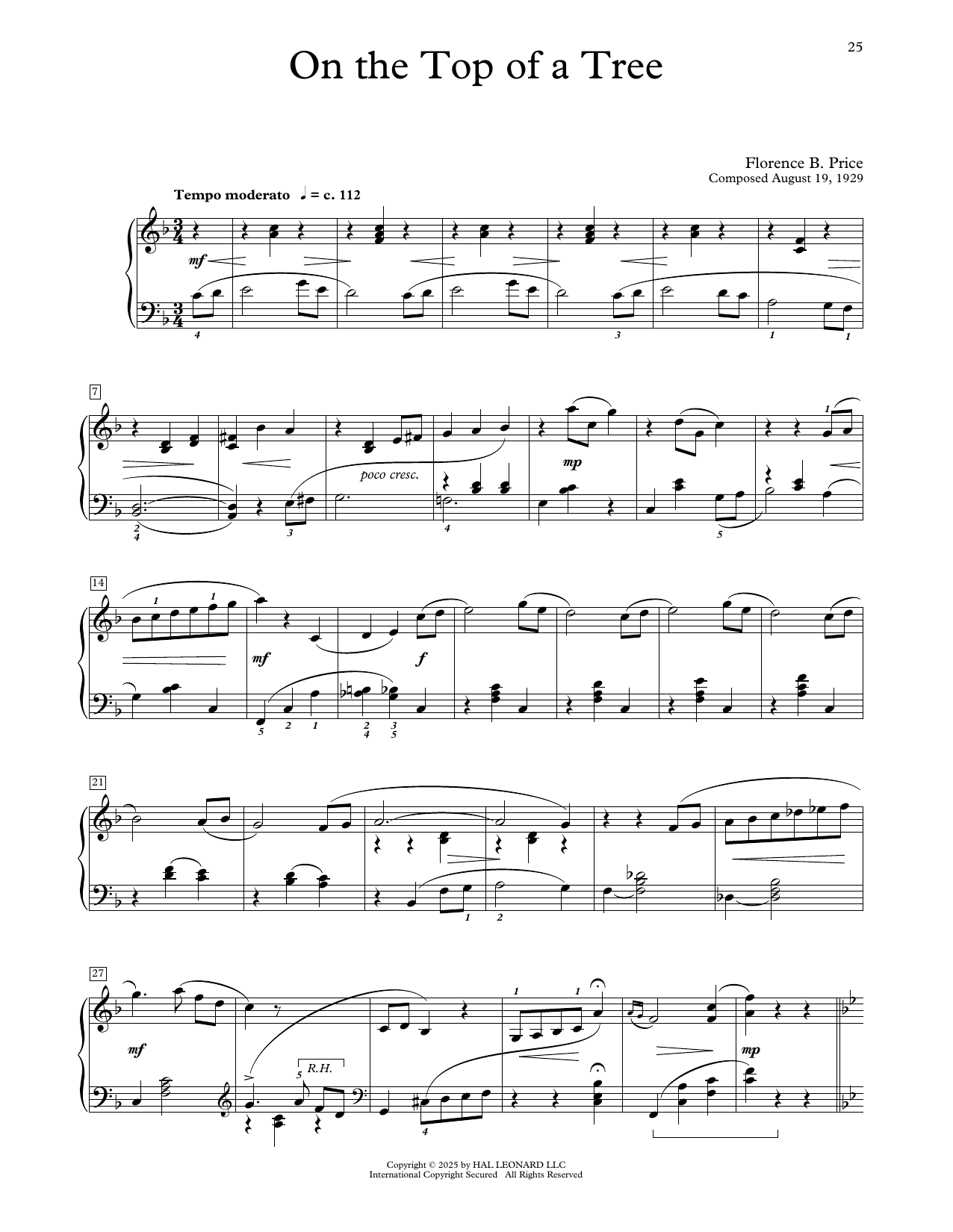
On The Top Of  A Tree Sheet Music Preview

On The Top Of A Tree: Educational Piano

By Florence Price / Edited by Michael Clark

Item: 35-DS01576387

Digital Download
$4.99
Description

Discover MakeMusic Cloud: thousands of interactive titles your students can play along with today.

Sample Audio
No sample audio found.
Sample Video
Additional Details
Publisher: Hal Leonard
Page Count: 3
SKU: 35-DS01576387

More about this title

About the Composer: Florence Price

Florence Price (1887-1953) was the first African American woman to have a symphony performed by a major orchestra. A pianist and composer of remarkable versatility, she created works across genres including symphonies, concertos, chamber music, and art songs, all while navigating the profound racial and gender barriers of her era. Her compositional voice drew from both European classical traditions and African American musical idioms, creating something entirely her own.

Price's educational works remain vital in contemporary music pedagogy, offering students access to a major American composer while building technical and interpretive skills. Her pieces for young pianists balance musical substance with approachable difficulty, demanding real musicianship without overwhelming developing players.

Why we love this

This piece showcases Price's gift for lyrical melody and harmonic sophistication at a level intermediate students can actually accomplish. Programming work by a pioneering African American composer signals to your students that classical music history is richer and more inclusive than traditional curricula suggest, and this particular title proves that musical substance and accessibility are not opposites.

What to expect

A contemplative vignette painted in sound. The piece captures the particular quality of observation from above, with melody that floats above carefully constructed harmonic support. There's an intimate quality that rewards close listening and patient interpretation.

Who it's for

Intermediate pianists ready to engage with material that combines technical development with meaningful musical content. Teachers looking to expand their students' exposure to underrepresented voices in classical music will find this piece both pedagogically sound and historically important.

How to get the most out of it

  • Shape the melodic line with careful attention to phrase contours rather than mechanical repetition of passage work. Price's melodies reward expressive voicing.
  • Balance the harmonic language by letting inner voices speak without overwhelming the primary melody. The texture asks for sophistication in touch control.
  • Approach tempo flexibility with intention. The title suggests a programmatic element that benefits from interpretive freedom within a steady pulse.
  • Notice whether Price uses register or dynamic shifts to signal structural changes, and use those landmarks as guides for larger musical architecture.

How to use it

Include this in a recital exploring music inspired by nature or place, where it provides a gentle, introspective contrast to more dramatic works. It also serves beautifully in a themed program celebrating American women composers or works by African American classical composers, grounding that celebration in genuine musical substance rather than token programming.

Skills your students will build

  • Legato pedaling and managing sustain across harmonic changes
  • Balancing melody and accompaniment with independent hand voices
  • Interpreting chromatic harmony and voice leading
  • Shaping longer melodic lines with structural awareness
  • Expressive interpretation of programmatic or descriptive music

You May Also Like