
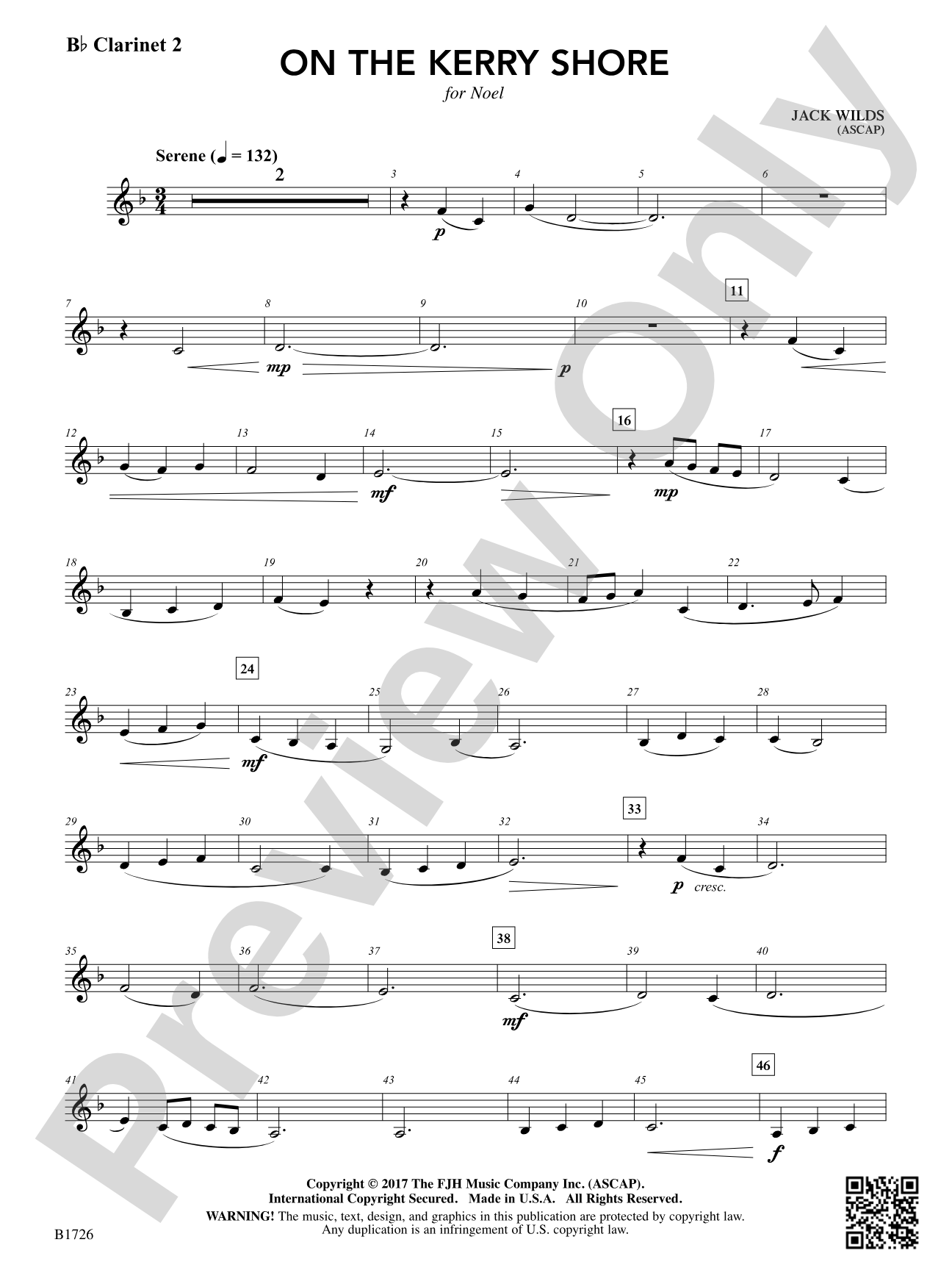

On the Kerry Shore: B-flat Clarinet 2
By Jack Wilds
Grade: 1.5;2
Item: 98-PC-DB1726_C2
$7.00
Pickup currently not available
Description
This musical portrait of a picturesque harbor town on the Irish coast seeks to communicate the feeling of serenity that would accompany sitting on the dock and staring out to sea. While musically satisfying, the piece’s phrasing demands are very accessible. Subtle ocean drum and ship’s bell sounds come together with a beautiful melody and creative contrapuntal writing to create a moving work for developing ensembles.


Don't just read it, hear it, play along with it, and watch your students grow with it. In MakeMusic Cloud, On the Kerry Shore: B-flat Clarinet 2 comes alive with professional accompaniment, adjustable tempo, and built-in practice tools that turn solo practice into real progress.
Open in the Player
Jump straight in and assign it today.
Start Your Free Trial
Open this title and explore the full library in minutes.
Sample Audio
1
Audio File
--:--
0:00
0:00
Sample Video
Additional Details
Series:
FJH Developing Band
Publisher:
The FJH Music Company, Inc.
SKU:
98-PC-DB1726_C2
More about this title
About the Composer: Jack Wilds

Jack Wilds composes for ensembles across the full spectrum of musical life, from children's choirs through professional orchestras, drawing inspiration from visual art, literature, and philosophical texts alongside purely musical ideas. His chamber works have been championed by ensembles including the Attacca Quartet and members of the New York Philharmonic and Atlanta Symphony, while his wind band and choral music for developing musicians has accumulated over 40 publications performed at festivals worldwide and featured on contest lists across multiple continents.
A former public school band director, Wilds brings classroom experience to every score he writes. He teaches composition, theory, ear training, and music technology at Texas State University, serves as Co-Director of Music at First Presbyterian Church in San Marcos, and maintains an active schedule as a clinician and adjudicator. His studies in composition with Michael Ippolito, Chris Trapani, and Donald Grantham inform work that consistently balances artistic ambition with the needs of the ensemble in front of it.
Why we love this
The restraint here is remarkable. Rather than overloading young conductors with textural complexity, Wilds achieves genuine atmosphere through strategic orchestration choices: ocean drum and ship's bell become characters in the piece, not mere color. The contrapuntal writing develops ensemble musicianship without requiring virtuosity, and the phrasing lands naturally even for groups still building independence.
What to expect
Sitting quietly on a dock in late afternoon, watching water move gently and light shift across the harbor. The piece unfolds without urgency, inviting players and listeners into a moment of calm reflection where even the simplest melody feels profound.
Who it's for
This works for band programs in grades 1.5 through 2 looking to program concert or festival music that builds genuine musicianship without overwhelming developing ensembles. Directors seeking repertoire that balances accessible technical demands with sophisticated musical content will find a reliable choice here.
How to get the most out of it
- Balance the melody across sections rather than spotlighting a single voice; the Irish character emerges from how all lines weave together, and young players benefit from hearing how their individual line contributes to the whole fabric.
- Allow the ocean drum and ship's bell effects space to breathe and resonate fully. These sounds anchor the listener's imagination of place, so resist the urge to fill silence.
- Shape phrases with the harbor imagery in mind. A dock scene is quiet and unhurried; ensemble attacks and releases should reflect that contemplative quality.
- Use the parts to identify where individual sections carry the melody versus where they provide harmonic support. This clarity helps students understand voice independence and leads to more transparent ensemble sound.
How to use it
Program this early in a concert to establish an intimate mood and give the audience a chance to settle into listening, or use it as the emotional anchor in a festival set where contrasting energy and complexity surround it. The phrasing accessibility also makes it suitable for early-season programming when ensemble foundation building is still underway.
Skills your students will build
- Conducting clear, sustained phrasing across multiple bars
- Balancing transparent counterpoint within a section-based ensemble
- Responding to visual cues for ensemble entries and cutoffs
- Creating atmosphere and mood through controlled dynamics and articulation
- Listening across the full ensemble to identify and blend melodic and harmonic roles