
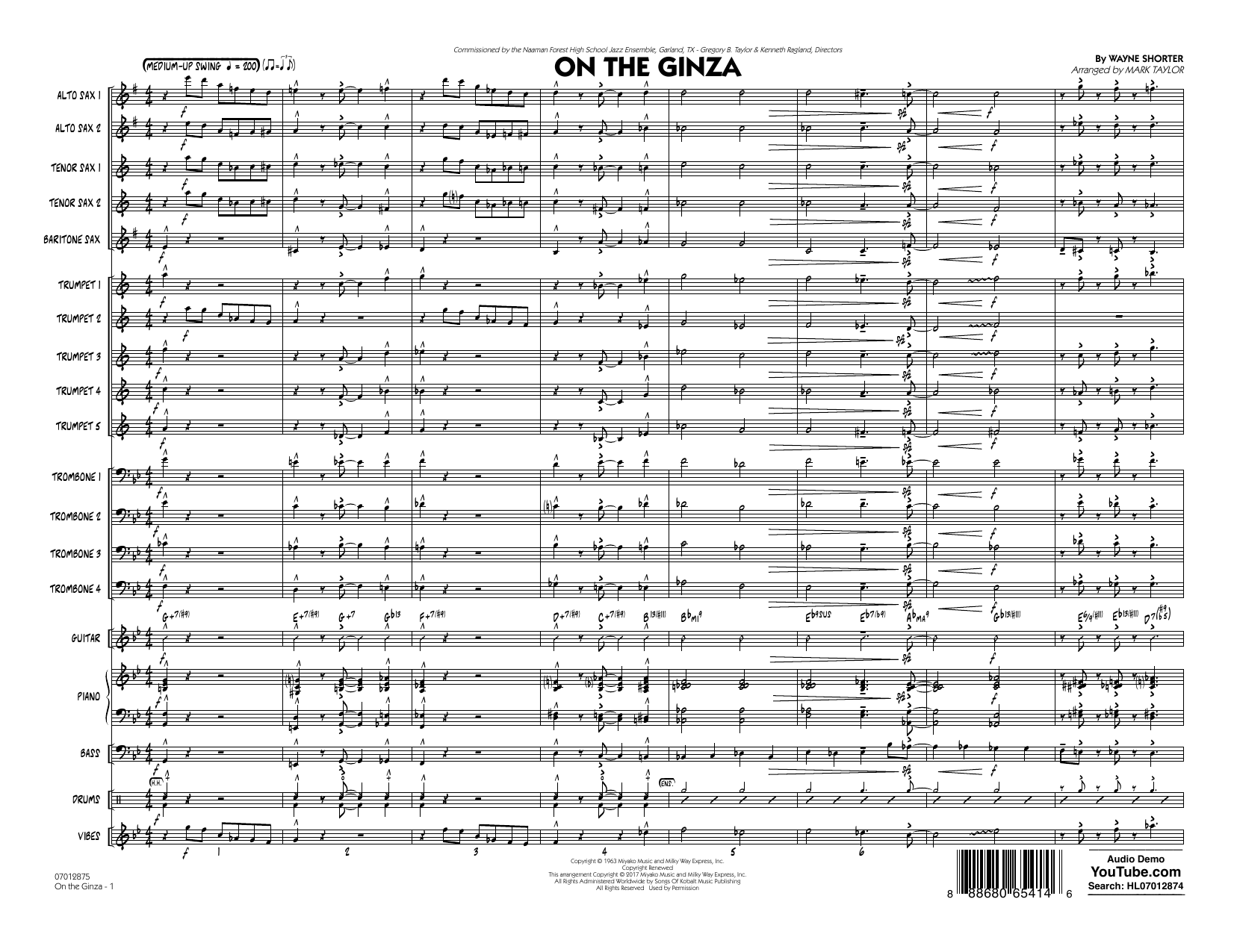

On The Ginza: Jazz Ensemble Conductor Score & Parts
As performed by Wayne Shorter / Arranged by Mark Taylor
Grade: 4
Item: 35-PK00381641
$55.00
Pickup currently not available
Buy Extra Parts (Digital PDF Download)
| Product | Price | Quantity |
|---|---|---|
| On The Ginza - Conductor Score (Full Score) | $7.50 | |
| On The Ginza - Alto Sax 1 | $6.00 | |
| On The Ginza - Alto Sax 2 | $6.00 | |
| On The Ginza - Tenor Sax 1 | $6.00 | |
| On The Ginza - Tenor Sax 2 | $6.00 | |
| On The Ginza - Baritone Sax | $6.00 | |
| On The Ginza - Trumpet 1 | $6.00 | |
| On The Ginza - Trumpet 2 | $6.00 | |
| On The Ginza - Trumpet 3 | $6.00 | |
| On The Ginza - Trumpet 4 | $6.00 | |
| On The Ginza - Trumpet 5 | $6.00 | |
| On The Ginza - Trombone 1 | $6.00 | |
| On The Ginza - Trombone 2 | $6.00 | |
| On The Ginza - Trombone 3 | $6.00 | |
| On The Ginza - Trombone 4 | $6.00 | |
| On The Ginza - Guitar | $6.00 | |
| On The Ginza - Piano | $6.00 | |
| On The Ginza - Bass | $6.00 | |
| On The Ginza - Drums | $6.00 | |
| On The Ginza - Vibes | $6.00 | |
| On The Ginza - C Solo Sheet | $6.00 | |
| On The Ginza - Bb Solo Sheet | $6.00 | |
| On The Ginza - Eb Solo Sheet | $6.00 | |
| On The Ginza - Bass Clef Solo Sheet | $6.00 |
Parts Added to Cart!
Description
Mark Taylor uses a mix of small group playing contrasted with full ensemble passages in this early composition from jazz master Wayne Shorter. After a solo section featuring alto sax then trombone, a sax soli leads to a short yet powerful tutti ensemble shout.


On The Ginza: Jazz Ensemble Conductor Score & Parts isn't in MakeMusic Cloud just yet...but it could be. Let us know you'd like to see it, and you'll help shape what comes next. In the meantime, start a free trial and dive into thousands of interactive titles your students can play along with today.
Request This Title
Tell us you want it.
Start Your Free Trial
Explore everything that's ready to play right now.
Sample Audio
No sample audio found.
Sample Video
No sample videos found.
Additional Details
Publisher:
Hal Leonard
SKU:
35-PK00381641
More about this title
About the Artist: Wayne Shorter
Wayne Shorter stands among jazz's most consequential composers and saxophonists. His work with Art Blakey's Jazz Messengers and later with Miles Davis shaped the sound of modern jazz; his compositions reveal a restless harmonic mind that refuses easy answers. For educators, Shorter's pieces offer students a window into how jazz repertoire can balance accessibility with genuine sophistication, where melody and harmony command equal attention.
Why we love this
Mark Taylor's arrangement captures the essence of Shorter's compositional voice while making it teachable for Grade 4 ensembles. The alternation between intimate small group moments and full ensemble power gives young players the chance to experience both the vulnerability and collective energy that define jazz; the structure itself becomes a lesson in how arrangement shapes narrative.
What to expect
Sophisticated and conversational. The piece moves fluidly from introspective solo moments into collective celebration, letting listeners witness the give-and-take at jazz's heart. There's an ease to the writing that belies its musical intelligence.
Who it's for
Jazz ensemble directors working with Grade 4 groups who want substantive repertoire that doesn't condescend. This works equally well for students taking first steps in improvisation and for ensembles seeking to deepen their understanding of how jazz composition actually works.
How to get the most out of it
- Shape the alto sax solo with genuine call-and-response phrasing rather than treating it as a single statement. The accompaniment should breathe with the soloist, creating space that invites rather than crowds.
- Balance the sax soli section carefully; these voices need clarity without losing the cohesion of the section sound. Think ensemble unison, not four separate voices.
- The final tutti ensemble shout demands unanimous commitment. Brief as it is, this passage should feel inevitable and earned, not rushed or tentative.
How to use it
Pair this with other Shorter compositions or with bebop-era standards to build a jazz history unit that reveals how compositional approaches evolved. It also sits comfortably on a concert alongside blues-based charts, where it can serve as a bridge into more complex harmonic territory.
Skills your students will build
- Reading jazz articulations and phrasing conventions
- Solo improvisation within a structured harmonic framework
- Ensemble balance across different sectional textures
- Recognizing formal structure in jazz composition (solo, soli, tutti sections)
- Time-feel consistency in a swing context