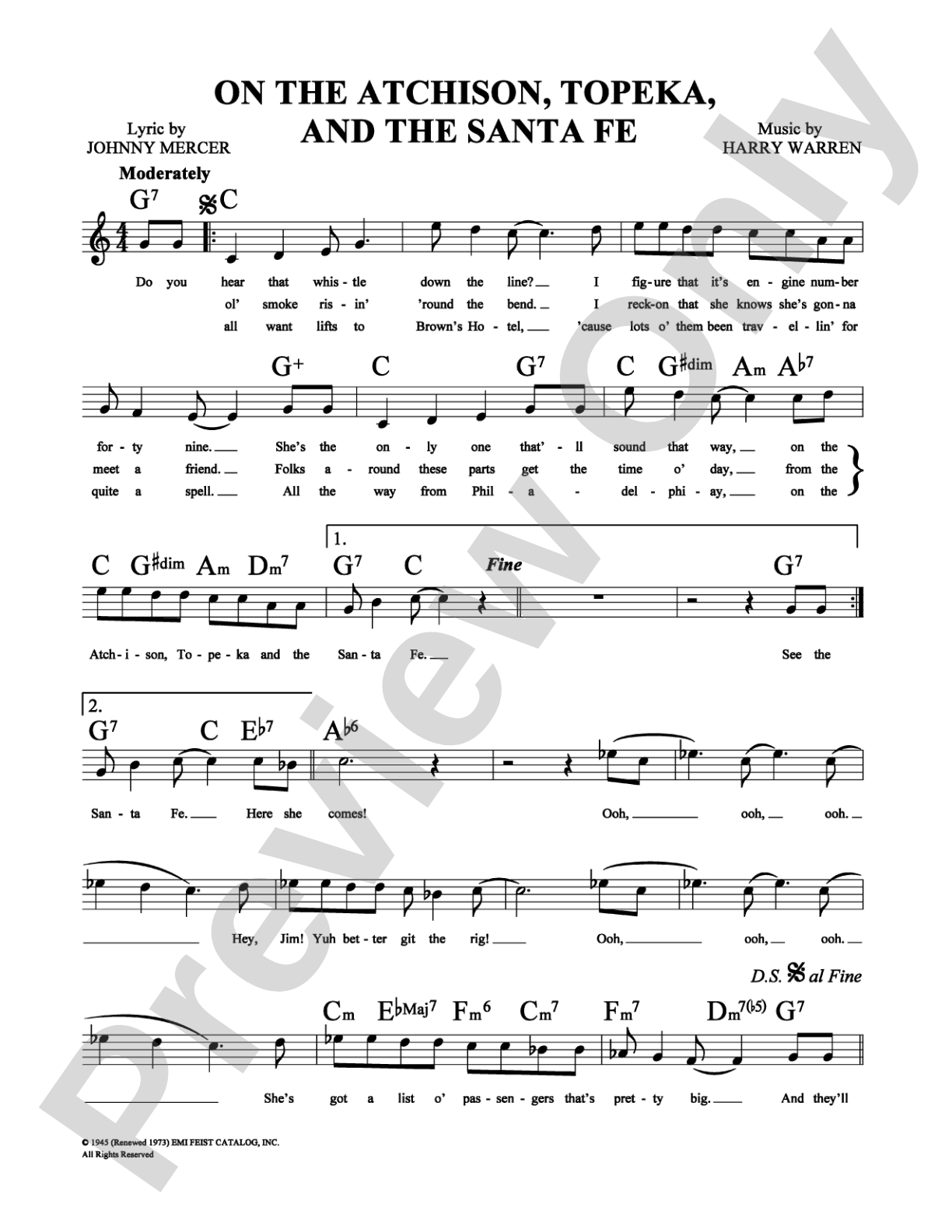
On the Atchison, Topeka, and the Santa Fe: Lead Sheet Digital Sheet Music

On the Atchison, Topeka, and the Santa Fe: Lead Sheet Digital Sheet Music

Harry Warren, Bing Crosby, Judy Garland, Tommy Dorsey, The Pied Pipers

Item: 00-PS-0000697

Digital Download
$1.99
Description

On the Atchison, Topeka, and the Santa Fe: Lead Sheet Digital Sheet Music isn't in MakeMusic Cloud just yet...but it could be. Let us know you'd like to see it, and you'll help shape what comes next. In the meantime, start a free trial and dive into thousands of interactive titles your students can play along with today.

Sample Audio
No sample audio found.
Sample Video
Additional Details
SKU: 00-PS-0000697

More about this title

About the Artist: Bing Crosby

Bing Crosby's influence on American popular music and vocal pedagogy remains substantial. His innovative approach to microphone technique and phrasing fundamentally changed how singers approached both jazz standards and popular songs, making him a model for generations of vocalists in educational settings.

Crosby's career spanned decades and genres, from big band work with Tommy Dorsey to film performances and radio broadcasts. His interpretive choices and rhythmic flexibility in standards like this one offer valuable lessons in how to balance technical precision with expressive storytelling.

Why we love this

This classic from the golden age of Hollywood gives students and performers access to a standard that's been recorded by generations of artists, making it an excellent piece for studying how different musicians interpret the same lead sheet. The melody is singable and memorable, the changes are clear enough to follow, and the piece sits naturally for many voices, making it workable across jazz ensembles, vocal jazz classes, and contemporary music settings.

What to expect

Relaxed and gently swinging, with the wanderlust of a train journey encoded in the melody. The piece balances accessibility with harmonic sophistication, offering just enough chromatic movement and unexpected changes to keep the ear engaged without becoming didactic.

Who it's for

Jazz musicians, vocalists learning standards, and music students exploring American popular song repertoire. This lead sheet works for soloists preparing for jazz combos, ensembles building a standards-based repertoire, or anyone developing fluency with common harmonic progressions found across jazz and popular music.

How to get the most out of it

  • Study the original Crosby recording to hear how he phrases the melody against the harmonic movement; his rhythmic displacement and rubato choices are instructive even if you choose a different approach.
  • Anchor your interpretation in the strong melodic line first, then layer in harmonic awareness as you gain confidence with the changes.
  • Pay attention to how the bridge shifts the harmonic landscape; make that section distinctly different in tone or dynamic weight from the A sections.

How to use it

Include this in a jazz standards unit or a "Great American Songbook" concert. It pairs well with other mid-century popular standards and works equally well as a solo vehicle, a combo feature, or a full ensemble arrangement. The recognizable melody makes it engaging for audiences while the harmonic content keeps musicians learning.

Skills your students will build

  • Reading and interpreting lead sheet notation
  • Phrasing over standard jazz chord changes
  • Understanding and responding to harmonic rhythm
  • Developing interpretive flexibility within a fixed melodic framework
  • Listening to and analyzing canonical recordings of a standard

You May Also Like