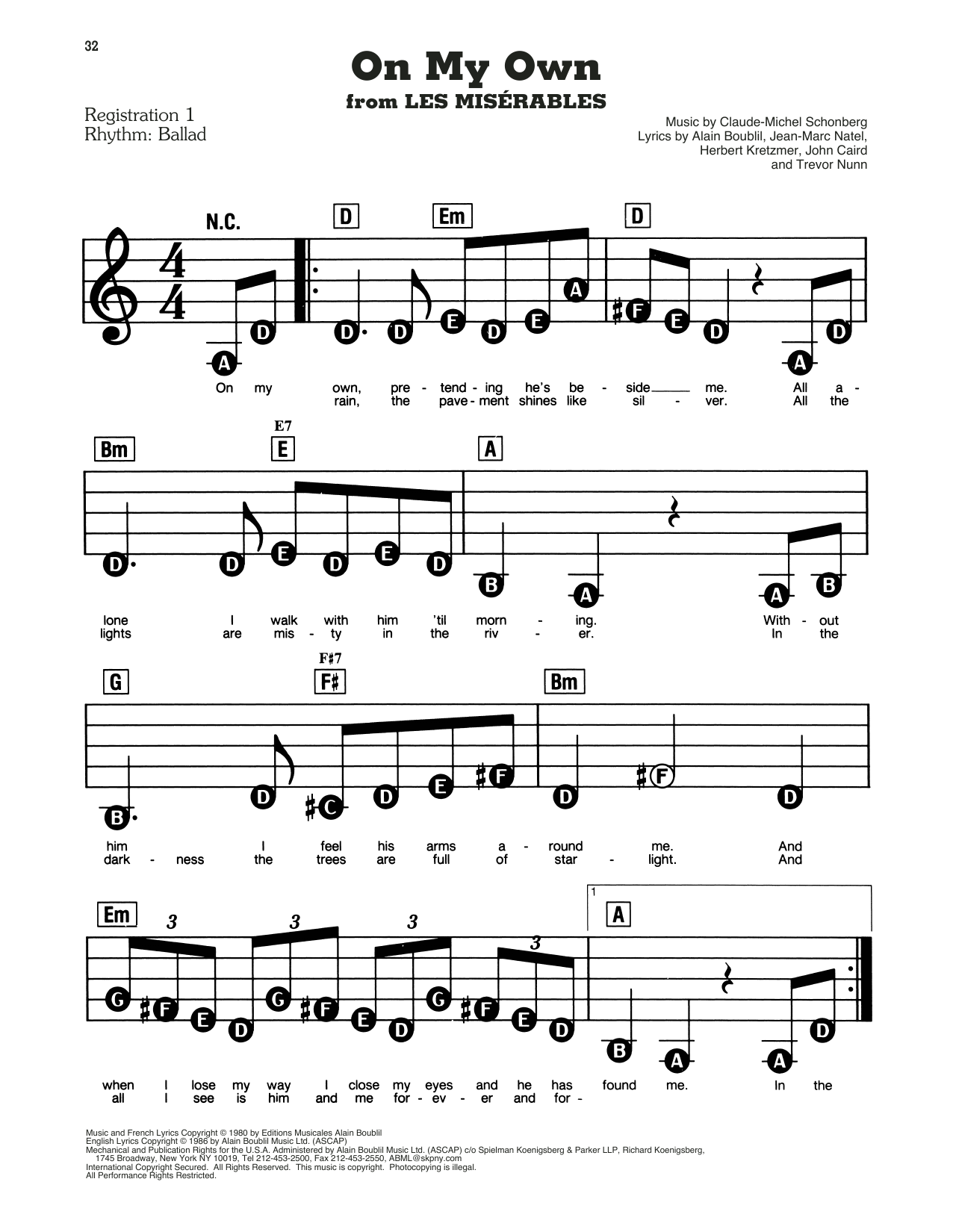
On My Own (from Les Miserables) Sheet Music Preview

On My Own (from Les Miserables): E-Z Play Today

By Alain Boublil

Item: 35-DS00459756

Digital Download
$4.99
Description

On My Own (from Les Miserables): E-Z Play Today isn't in MakeMusic Cloud just yet...but it could be. Let us know you'd like to see it, and you'll help shape what comes next. In the meantime, start a free trial and dive into thousands of interactive titles your students can play along with today.

Sample Audio
No sample audio found.
Sample Video
Additional Details
Publisher: Hal Leonard
Page Count: 4
SKU: 35-DS00459756

More about this title

About the Composer: Alain Boublil

Alain Boublil is a French musical theatre composer and lyricist whose work defined the modern megamusical. His collaboration with Claude Michel Schönberg produced some of the most performed stage scores in history, with Les Misérables becoming a cultural phenomenon that has shaped musical theatre globally for four decades. Boublil's gift for melody and emotional directness makes his songs exceptionally singable and instantly memorable, which explains why his work appears consistently in music education settings.

Why we love this

This solo captures the raw vulnerability that makes Les Misérables endure in classrooms and concert halls. The melody is sturdy enough for developing pianists to shape with confidence, yet it demands genuine musical maturity to convey the character's isolation and longing without becoming sentimental.

What to expect

Quiet desperation wrapped in a melody that refuses to look away. The harmonic language is direct and emotionally unguarded, creating an atmosphere of isolation lit by a single point of hope. This is music about longing that never tips into melodrama.

Who it's for

Piano students and teachers exploring Broadway repertoire at the intermediate level, vocalists building a contemporary musical theatre audition book, and programs seeking accessible material that develops interpretive maturity without requiring advanced technical facility.

How to get the most out of it

  • Shape the phrases to breathe; resist rushing through the emotional peaks. Let silence work for you.
  • Pay attention to dynamic contrast between the verse and the chorus. The shift signals a change in the character's internal landscape.
  • Balance accompaniment texture so it supports rather than overwhelms the vocal line if performed with a singer.

How to use it

Slot this into a Broadway showcase or an interdisciplinary program pairing music with literature and theatre. It also works beautifully as a recital piece for a pianist ready to develop interpretive confidence, or as a bridge between classical technique and contemporary musical theatre performance.

Skills your students will build

  • Sustained legato playing and long-phrase phrasing
  • Dynamic control and emotional subtlety
  • Reading Broadway vocal writing and harmonic language
  • Balancing accompaniment texture with clear melody
  • Shaping rubato and tempo flexibility expressively

You May Also Like