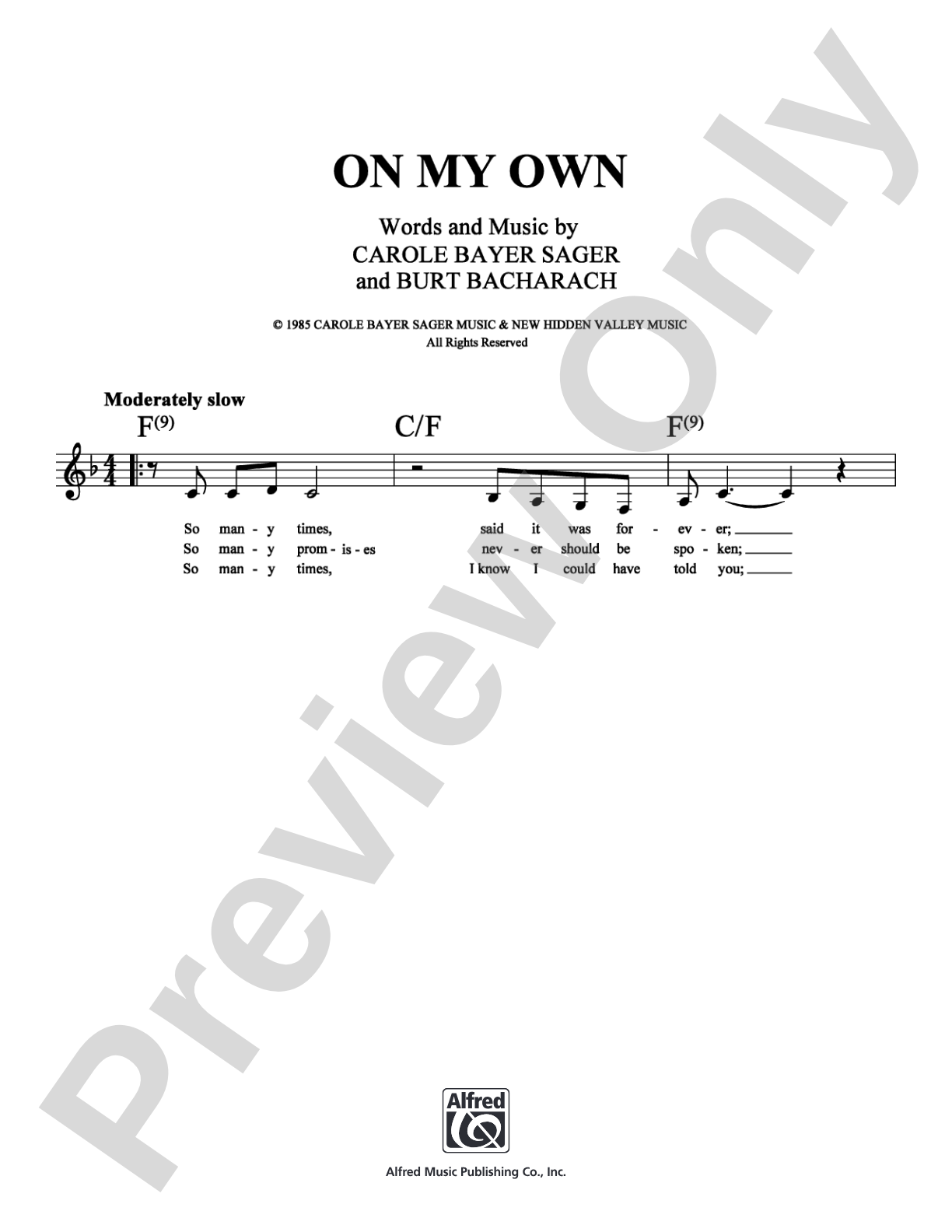
On My Own: Lead Sheet Digital Sheet Music

On My Own: Lead Sheet Digital Sheet Music

Carole Bayer Sager, Burt Bacharach, Michael Mcdonald, Patti LaBelle

Item: 00-PS-0009202

Digital Download
$1.99
Description

On My Own: Lead Sheet Digital Sheet Music isn't in MakeMusic Cloud just yet...but it could be. Let us know you'd like to see it, and you'll help shape what comes next. In the meantime, start a free trial and dive into thousands of interactive titles your students can play along with today.

Sample Audio
No sample audio found.
Sample Video
Additional Details
SKU: 00-PS-0009202

More about this title

About the Artist: Michael McDonald

Michael McDonald is a legendary session keyboardist, vocalist, and songwriter who shaped the sound of 1970s and 1980s rock and soul music. As a member of Steely Dan and later The Doobie Brothers, he brought sophisticated harmonic sensibility and warm, expressive vocals to some of the era's most enduring recordings. His solo work and collaborations demonstrate mastery of pop-rock composition and arrangement.

Why we love this

This lead sheet captures a song with genuine emotional weight and sophisticated harmonic movement that rewards careful interpretation. The melody sits naturally for vocalists while remaining interesting enough to hold an audience's attention, and the underlying chord changes offer plenty of room for keyboard and instrumental improvisation.

What to expect

Warm and introspective, with a gentle groove that never rushes. The melody unfolds with restraint, inviting singers to find intimacy within a sophisticated harmonic landscape that feels both familiar and nuanced.

Who it's for

Vocalists preparing standards for jazz or pop recitals will find this useful for both performance and transposition practice. Keyboardists and guitarists can use the lead sheet for accompanying singers in rehearsal or performance, or as a foundation for improvisation in an ensemble setting.

How to get the most out of it

  • Study the phrasing of the original recording to understand where McDonald and LaBelle shape the melody through timing and dynamics rather than just hitting the notes on the page.
  • Pay attention to the harmonic rhythm; the chord changes often move more slowly than the melody might suggest, so lock into the groove rather than rushing.
  • Use the lead sheet as a starting point for reharmonization if you're accompanying with piano or guitar; this tune responds well to subtle color changes in the chord voicings.

How to use it

This works well in a cabaret-style set or as part of a program exploring adult contemporary songwriting. It pairs naturally with other Michael McDonald material or with songs that emphasize vocal storytelling over technical display.

Skills your students will build

  • Reading and interpreting lead sheet notation with chord symbols
  • Shaping melodic phrasing for emotional communication rather than mechanical accuracy
  • Understanding harmonic function and voice leading in popular song forms
  • Transposing melodies to suit a vocalist's range

You May Also Like