
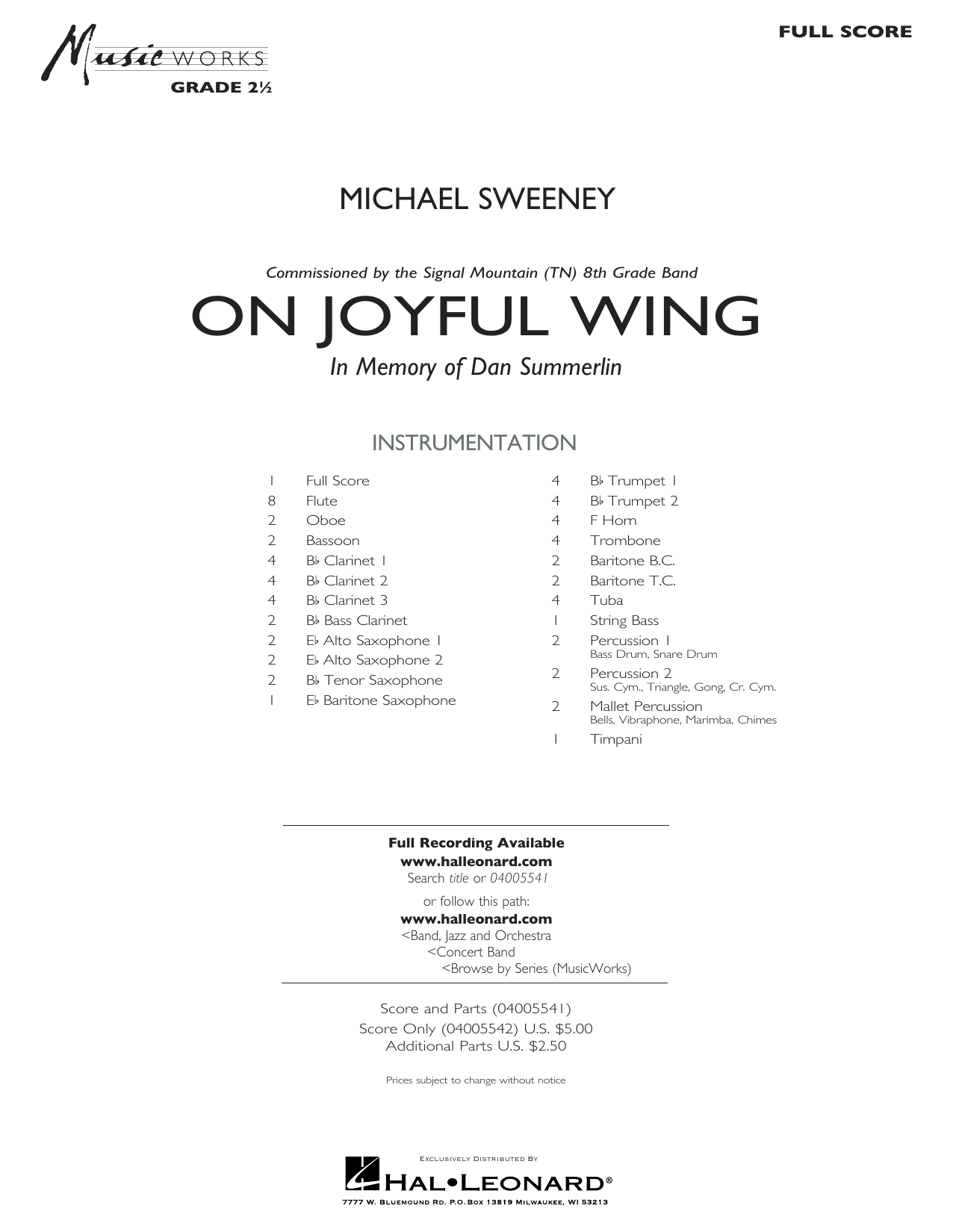

On Joyful Wing: Concert Band Conductor Score & Parts
Arranged by Michael Sweeney
Grade: 2
Item: 35-PK00412932
$55.00
Pickup currently not available
Buy Extra Parts (Digital PDF Download)
| Product | Price | Quantity |
|---|---|---|
| On Joyful Wing - Full Score | $7.50 | |
| On Joyful Wing - Flute | $6.00 | |
| On Joyful Wing - Oboe | $6.00 | |
| On Joyful Wing - Bassoon | $6.00 | |
| On Joyful Wing - Bb Clarinet 1 | $6.00 | |
| On Joyful Wing - Bb Clarinet 2 | $6.00 | |
| On Joyful Wing - Bb Clarinet 3 | $6.00 | |
| On Joyful Wing - Bb Bass Clarinet | $6.00 | |
| On Joyful Wing - Eb Alto Saxophone 1 | $6.00 | |
| On Joyful Wing - Eb Alto Saxophone 2 | $6.00 | |
| On Joyful Wing - Bb Tenor Saxophone | $6.00 | |
| On Joyful Wing - Eb Baritone Saxophone | $6.00 | |
| On Joyful Wing - Bb Trumpet 1 | $6.00 | |
| On Joyful Wing - Bb Trumpet 2 | $6.00 | |
| On Joyful Wing - F Horn | $6.00 | |
| On Joyful Wing - Trombone | $6.00 | |
| On Joyful Wing - Baritone B.C. | $6.00 | |
| On Joyful Wing - Baritone T.C. | $6.00 | |
| On Joyful Wing - Tuba | $6.00 | |
| On Joyful Wing - Bass | $6.00 | |
| On Joyful Wing - Percussion 1 | $6.00 | |
| On Joyful Wing - Percussion 2 | $6.00 | |
| On Joyful Wing - Mallet Percussion | $6.00 | |
| On Joyful Wing - Timpani | $6.00 |
Parts Added to Cart!
Description
Drawing on two early American hymn tunes, here is a beautifully paced lyric piece with moments of calm reflection as well as emotional high points. The opening uses the lesser known "Vermont" composed by William Billings, and this is followed by a poignant adpatation of the familiar hymn "Nearer, My God, To Thee".
Dur: 3:45


On Joyful Wing: Concert Band Conductor Score & Parts isn't in MakeMusic Cloud just yet...but it could be. Let us know you'd like to see it, and you'll help shape what comes next. In the meantime, start a free trial and dive into thousands of interactive titles your students can play along with today.
Request This Title
Tell us you want it.
Start Your Free Trial
Explore everything that's ready to play right now.
Sample Audio
No sample audio found.
Sample Video
No sample videos found.
Additional Details
Publisher:
Hal Leonard
SKU:
35-PK00412932
More about this title
About the Arranger: Michael Sweeney
Michael Sweeney is a prolific composer and arranger whose work spans concert band, jazz ensemble, and educational settings. His arrangements thoughtfully balance accessibility with musical substance, making standard repertoire and original works approachable for developing ensembles while maintaining artistic integrity.
Why we love this
Sweeney's treatment of these hymn tunes respects their spiritual weight while building something fresh through skillful orchestration and pacing. The piece moves naturally between introspective and expressive moments, giving your band genuine interpretive choices without demanding virtuosic technique.
What to expect
Reverent and unhurried, with genuine emotional weight beneath its modest technical demands. The piece unfolds with the intimacy of a congregational setting, then swells into moments of collective affirmation without losing its reflective core.
Who it's for
Grade 2 bands with solid fundamentals and players ready to work with sustained lyricism. This arrangement suits programs seeking accessible literature that doesn't sacrifice musical depth or bands preparing for contests and formal concerts.
How to get the most out of it
- Balance the opening Vermont tune so it emerges with quiet authority; the simplicity of Billings' melody deserves clarity, not backing.
- Let the transition into Nearer, My God, To Thee breathe slightly; this shift from lesser-known to familiar material marks an emotional pivot.
- Shape the dynamic arc across the full 3:45 duration so peaks don't arrive too early; resist pushing climactic moments until they're structurally earned.
- Encourage phrase singing from all sections, particularly through the hymn setting, so harmonic support doesn't feel mechanical.
How to use it
This works beautifully as a concert anchor piece, particularly on programs exploring American musical roots or devotional themes. Its length and character make it an ideal counterweight to faster, technically showy selections, and it pairs naturally with other hymn-based or Americana repertoire.
Skills your students will build
- Sustained phrase shaping and breath management across longer lyrical lines
- Balance and blend within hymn-style four-part harmony
- Dynamic control at softer dynamic levels (pp to mp)
- Awareness of harmonic function and how supporting voices anchor a melody
- Stylistic interpretation of early American musical idioms