
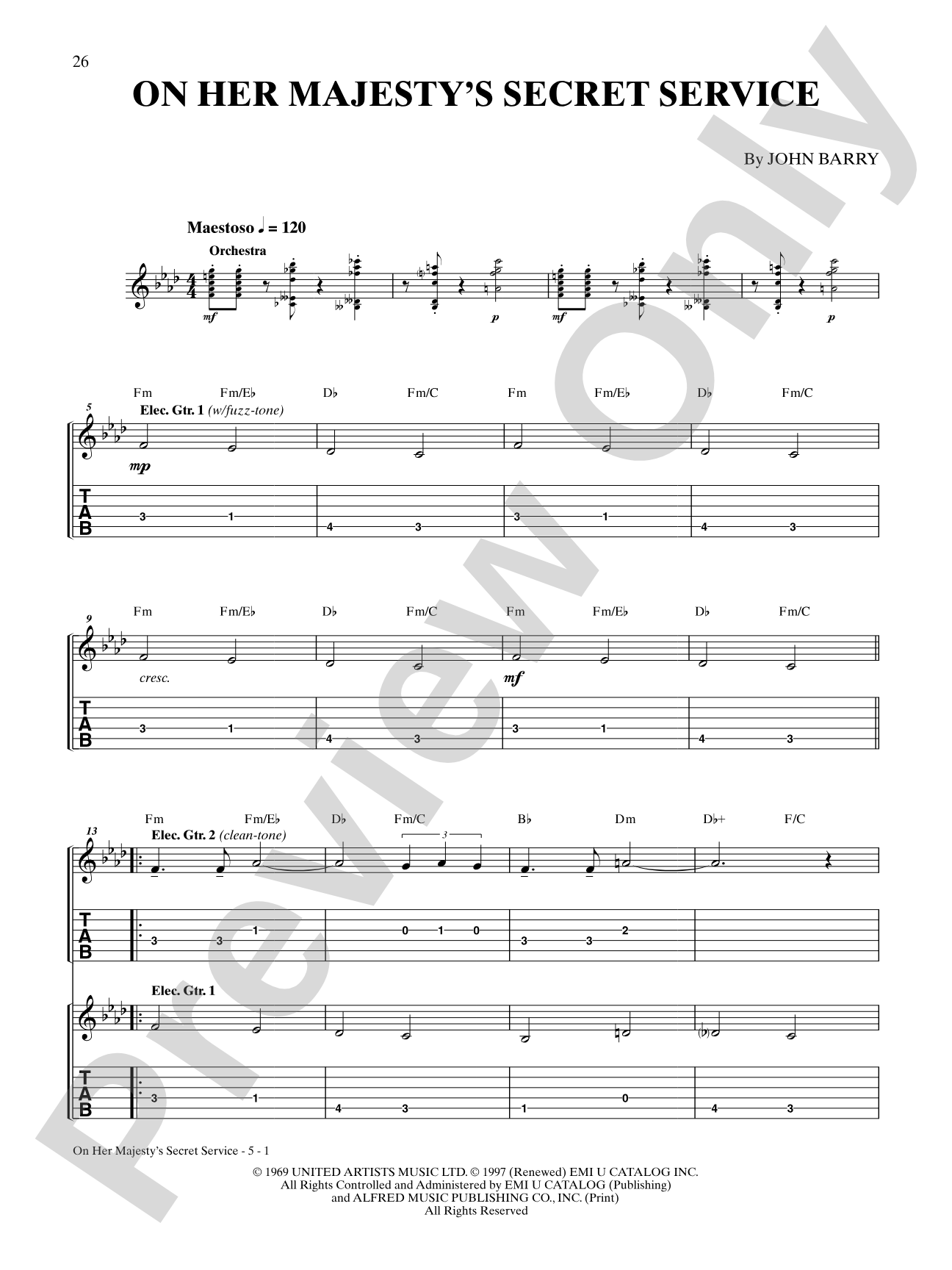

On Her Majesty's Secret Service (from "On Her Majesty's Secret Service"): Guitar TAB
Item: 00-PS-0013924
$4.99
One moment…
Related Items
James Bond Theme: Guitar TAB |
$4.99
|
View | |
Diamonds Are Forever (from "Diamonds Are Forever"): Guitar TAB |
$4.99
|
View | |
A View to a Kill (from "A View to a Kill"): Guitar TAB |
$4.99
|
View | |
Live and Let Die: Guitar TAB |
$4.99
|
View | |
Goldfinger (from "Goldfinger"): Guitar TAB |
$4.99
|
View | |
Thunderball (Main Theme): Guitar TAB |
$4.99
|
View | |
You Only Live Twice: Guitar TAB |
$4.99
|
View | |
Nobody Does It Better (from "The Spy Who Loved Me"): Guitar TAB |
$4.99
|
View | |
For Your Eyes Only (from "For Your Eyes Only"): Guitar TAB |
$4.99
|
View | |
From Russia with Love (from "From Russia with Love"): Guitar TAB |
$4.99
|
View | |
Tomorrow Never Dies (from "Tomorrow Never Dies"): Guitar TAB |
$5.99
|
View | |
James Bond 007: Collection for Guitar: Easy Guitar TAB Book & DVD-ROM |
$16.99
|
View |
Description
In 1962, the staccato attack of Vic Flick's guitar shot out from the film Dr. No as if from the barrel of Bond's own Walther PPK, and it's been the signature sound of Bond ever since. This book features 12 classic James Bond themes in easy-to-play melody and guitar arrangements. The included DVD-ROM contains sound-alike and play-along MP3s with full orchestration, and our exclusive TNT 2 Custom Mix software, which allows you to alter the instrument mixes, loop sections, and change tempos and keys. Titles: Diamonds Are Forever * For Your Eyes Only * From Russia with Love * Goldfinger * James Bond Theme * Live and Let Die * Nobody Does It Better * On Her Majesty's Secret Service * Thunderball * Tomorrow Never Dies * A View to a Kill * You Only Live Twice.


On Her Majesty's Secret Service (from "On Her Majesty's Secret Service"): Guitar TAB isn't in MakeMusic Cloud just yet...but it could be. Let us know you'd like to see it, and you'll help shape what comes next. In the meantime, start a free trial and dive into thousands of interactive titles your students can play along with today.
Request This Title
Tell us you want it.
Start Your Free Trial
Explore everything that's ready to play right now.
Sample Audio
1
James Bond Theme minus guitar
--:--
2
James Bond Theme
--:--
3
Live and Let Die minus guitar
--:--
4
Live and Let Die
--:--
James Bond Theme minus guitar
0:00
0:00
Sample Video
No sample videos found.
Additional Details
Publisher:
Alfred Music
Page Count:
48
SKU:
00-PS-0013924
More about this title
About the Composer: John Barry
John Barry shaped the sound of spy cinema for over five decades. His orchestral arrangements for the James Bond franchise became instantly recognizable, establishing a musical language that defined the genre and influenced film scoring worldwide. Beyond Bond, Barry composed for some of cinema's most celebrated dramas and adventures, earning four Academy Awards and a legacy as one of the most prolific film composers of the 20th century.
Why we love this
These arrangements capture the cinematic drama of Bond's world without requiring a full orchestra. The mix of melody and accompaniment parts lets guitarists experience how Barry's themes drive narrative tension, and the play-along tracks with customizable mixes transform practice into something that sounds like a professional recording.
What to expect
Suave, propulsive, and cinematic. These themes carry the intrigue and elegance of their films; playing them alongside orchestral backing creates the sensation of performing alongside a full ensemble, even in a practice room or small venue.
Who it's for
Intermediate guitarists who want to play recognizable, stylish melodies without transcribing by ear. This collection works well for guitarists building confidence with play-along recordings or preparing for recitals that call for popular film music.
How to get the most out of it
- Use the TNT 2 software to isolate the orchestration while you learn each melody; gradually remove layers as your confidence grows.
- Pay attention to the staccato articulation that defines the Bond theme and similar tracks; crisp attack matters more than speed.
- Loop sections where your timing feels loose rather than running full play-alongs; the software makes this easy and keeps focus sharp.
- Experiment with different tempos on familiar themes first; slowing "Goldfinger" or "Thunderball" by 10-15 percent reveals harmonic details you'll miss at tempo.
How to use it
String together 3-4 themes from this collection for a Bond-themed recital segment that appeals to audiences who know these films. The variety of moods (the intensity of the main theme, the sophistication of "For Your Eyes Only", the swagger of "Live and Let Die") lets you program a cohesive set that never feels repetitive.
Skills your students will build
- Reading TAB and standard notation simultaneously
- Interpreting staccato articulation for guitar attack and clarity
- Balancing melody tone against rhythmic accompaniment figures
- Synchronizing with click tracks and orchestral backing at varying tempos
- Adapting phrasing and dynamics to match recorded arrangements