On Green Dolphin Street: Guitar TAB Digital Sheet Music

On Green Dolphin Street: Guitar TAB Digital Sheet Music

Bronislau Kaper, Joe Pass

Item: 00-PS-0000681

Digital Download
$2.99
Description

On Green Dolphin Street: Guitar TAB Digital Sheet Music isn't in MakeMusic Cloud just yet...but it could be. Let us know you'd like to see it, and you'll help shape what comes next. In the meantime, start a free trial and dive into thousands of interactive titles your students can play along with today.

Sample Audio
No sample audio found.
Sample Video
Additional Details
SKU: 00-PS-0000681

More about this title

About the Artist: Joe Pass

Joe Pass (1929-1994) was a virtuoso guitarist whose command of jazz harmony and single-note soloing set the standard for generations of players. Self-taught and prolific, he performed with the Oscar Peterson Trio, led his own ensembles, and recorded extensively as both leader and sideman, becoming one of the most recorded guitarists in jazz history.

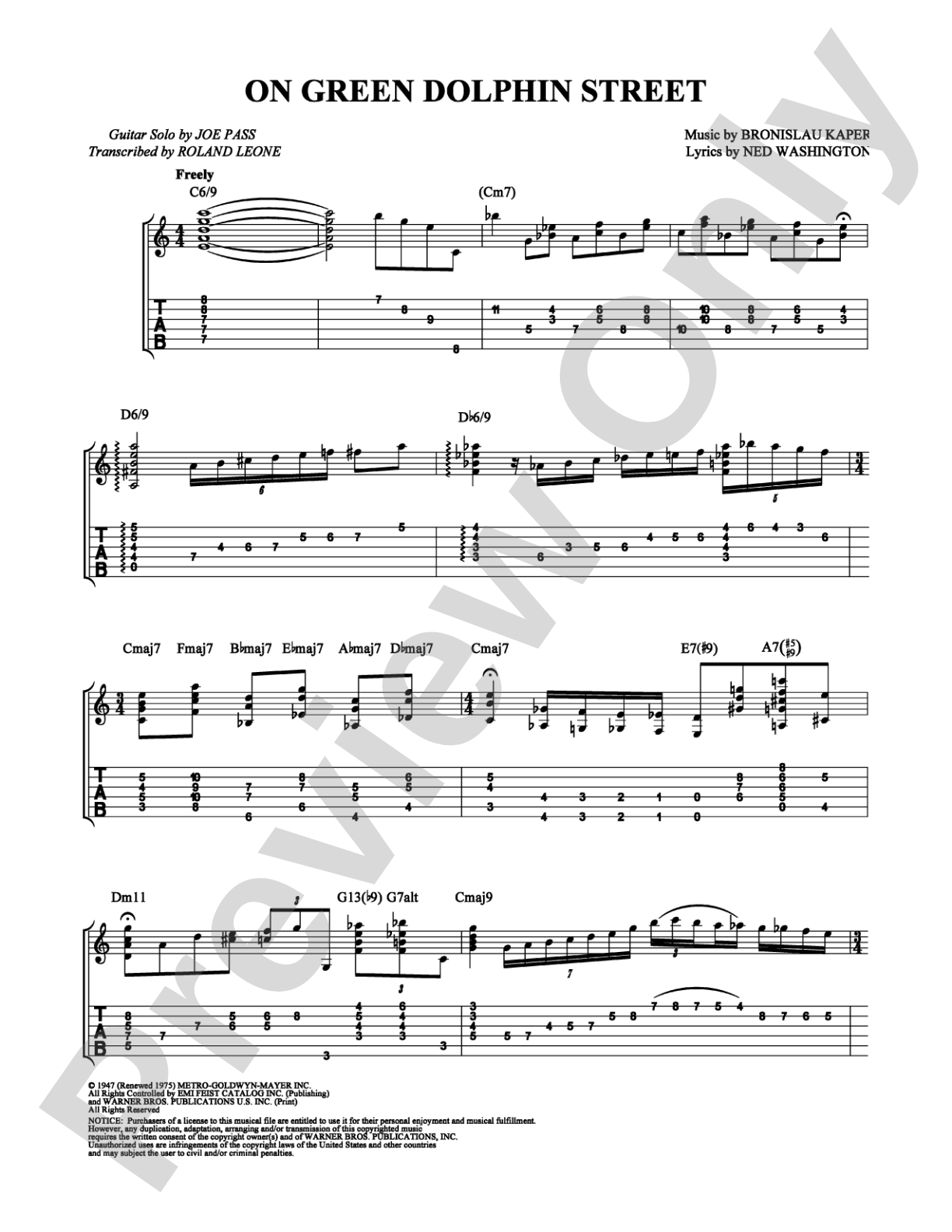
Pass's playing combined melodic sophistication with technical precision. His approach to standards like "On Green Dolphin Street" showcases his ability to reharmonize changes, execute fluid improvisation, and accompany himself through comping and walking bass lines on a single instrument—a skill that defined his artistry.

Why we love this

This transcription captures Pass's distinctive approach to a jazz standard, revealing how he navigates chord changes with voice leading that's both economical and harmonically adventurous. Guitar students benefit enormously from studying his note choices and phrasing; the TAB format makes his single-note lines and comping patterns learnable without requiring students to read treble clef exclusively. It's the kind of piece that teaches jazz vocabulary directly through imitation.

What to expect

Sophisticated and conversational. Pass transforms this lush ballad into something intimate and introspective, moving between moments of sparse, elegantly voiced statements and fluid single-note passages that dance over the changes. The guitar becomes both soloist and ensemble, creating a complete musical statement within its own melodic and harmonic world.

Who it's for

Jazz guitarists at the intermediate to advanced level who are building their jazz vocabulary through transcription and reharmonization study. Students learning to comp and solo simultaneously will find this piece especially valuable for understanding how a single guitarist manages harmonic responsibility and melodic development.

How to get the most out of it

  • Study the comping rhythms and voicings Pass uses during the melody statement; they're as important as the solo lines and show how jazz guitarists accompany themselves.
  • Pay attention to his use of chromatic approach notes and enclosures—these are not random; they land intentionally to create tension and resolution within the changes.
  • Work the solo section slowly at first to internalize the harmonic logic behind his note choices rather than treating it as a mechanical sequence.
  • Listen closely to Pass's original recording to absorb the swing feel, space between phrases, and dynamic shaping that the TAB notation alone cannot fully convey.

How to use it

Feature this in a jazz guitar recital or ensemble context where a soloist performs a prepared piece or in a jazz history unit exploring how standards sound through the lens of individual artists. It also serves as a study score for jazz combos planning to feature guitar in a stripped-down setting where the guitarist must handle both accompaniment and solo responsibility.

Skills your students will build

  • Reading and interpreting jazz guitar TAB with chord symbols
  • Analyzing and executing Pass's reharmonization and voice-leading choices
  • Comping over jazz changes with appropriate rhythm and voicing density
  • Executing chromatic approach notes, enclosures, and jazz phrasing techniques
  • Transcribing and internalizing jazz vocabulary through a master player's example

You May Also Like