
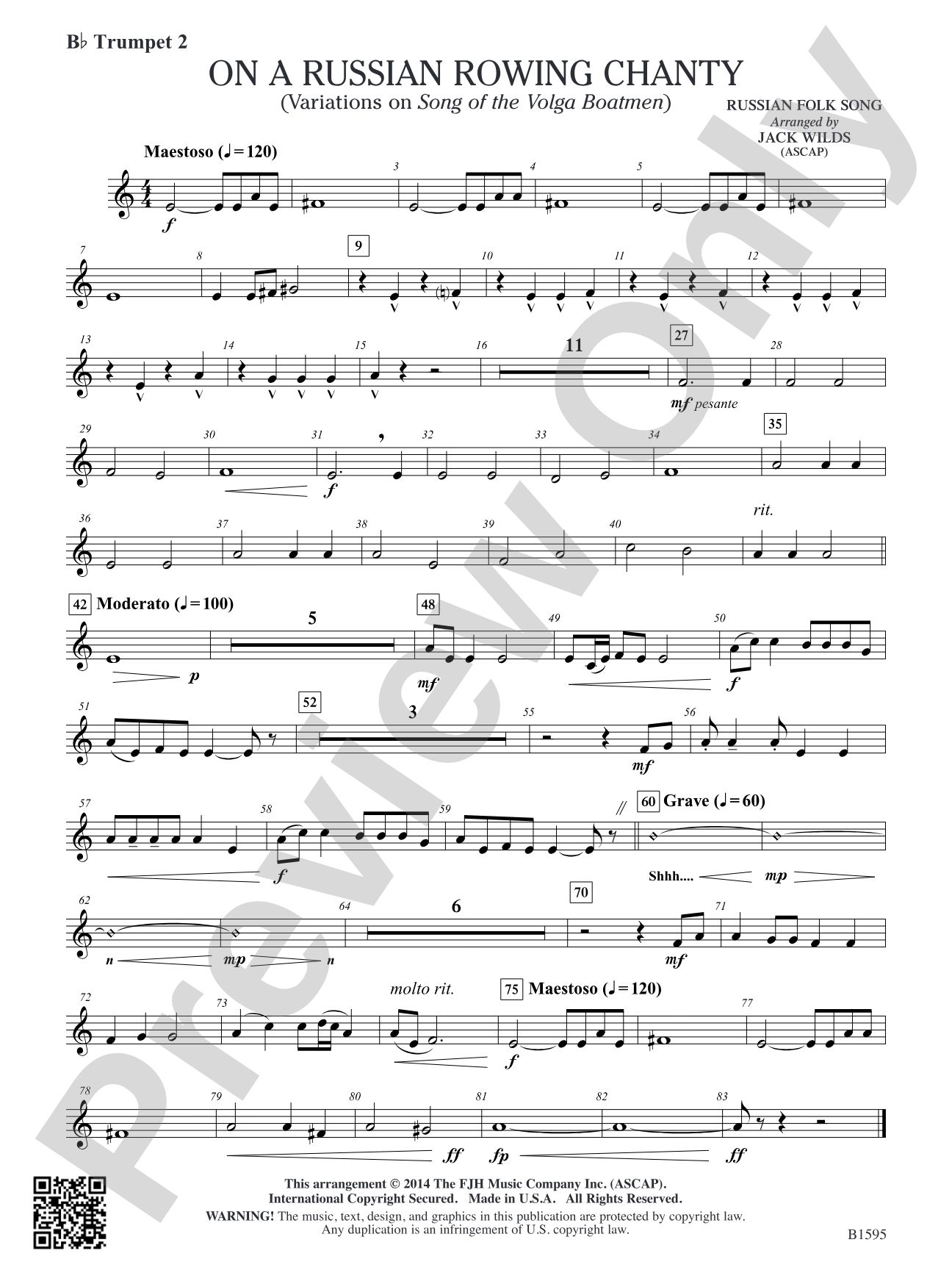

On a Russian Rowing Chanty: B-flat Trumpet 2
Arranged by Jack Wilds
Grade: 2
Item: 98-PC-DB1595_T2
$7.00
Pickup currently not available
Description
Based on the Russian folk tune Song of the Volga Boatmen, this piece is an eclectic and engaging set of variations. The familiar melody takes on a variety of forms and tonalities as it weaves through the composition, including a lively dance and an eerie statement accompanied by slithering chromatic lines. Don't miss this opportunity to discuss theme and variations with your students using a piece they will love!


Don't just read it, hear it, play along with it, and watch your students grow with it. In MakeMusic Cloud, On a Russian Rowing Chanty: B-flat Trumpet 2 comes alive with professional accompaniment, adjustable tempo, and built-in practice tools that turn solo practice into real progress.
Open in the Player
Jump straight in and assign it today.
Start Your Free Trial
Open this title and explore the full library in minutes.
Sample Audio
1
Audio File
--:--
0:00
0:00
Sample Video
No sample videos found.
Additional Details
Series:
FJH Young Band
Publisher:
The FJH Music Company, Inc.
SKU:
98-PC-DB1595_T2
More about this title
About the Composer: Jack Wilds

Jack Wilds composes for ensembles across the full spectrum of musical life, from elementary choirs through professional orchestras. His catalog spans chamber works performed by ensembles like the Attacca Quartet and members of the New York Philharmonic, alongside over 40 publications for developing musicians. Drawing inspiration from visual art, literature, and philosophical texts, his writing consistently balances accessibility with artistic depth.
A former public school band director, Wilds brings classroom experience to every score he writes for young musicians. His wind band works appear on festival repertoire lists across multiple continents and have been heard at the Midwest Clinic and regional music educator conferences. He serves as a lecturer in composition, theory, and music technology at Texas State University and as Co-Director of Music at First Presbyterian Church in San Marcos, while maintaining an active schedule as a clinician and adjudicator.
Why we love this
This arrangement transforms a globally recognized folk melody into a showcase for compositional craft that your students will immediately recognize and enjoy. The structural clarity of theme and variations makes this an ideal teaching score for introducing students to how composers develop and reimagine a single musical idea, while the range of moods and timbral colors keeps players engaged throughout.
What to expect
A musical journey through contrasting moods and landscapes, anchored by a melody that feels both timeless and instantly recognizable. One moment you're in a bustling, energetic folk dance; the next, chromatic swirls create an unsettling, atmospheric turn before the familiar tune reasserts itself in a new guise.
Who it's for
Grade 2 concert bands seeking accessible yet musically substantive repertoire that connects to world music and compositional technique. This work is ideal for groups ready to explore thematic development without navigating complex rhythmic or harmonic language.
How to get the most out of it
- Isolate the chromatic accompaniment figures that appear in the eerie section; have the relevant sections rehearse these patterns separately so the slithering effect lands clearly without drowning the melody.
- Emphasize the rhythmic precision needed in the lively dance variation, which relies on crisp articulation and rhythmic lock to create momentum.
- Balance the familiar melody across different instrumental families as it rotates through its variations; mark who has the tune at each key moment during score study.
How to use it
Program this alongside other multicultural selections to highlight how folk melodies inspire concert music at every skill level. The moderate difficulty makes it suitable for mid-concert placement, where it can anchor a thematic set on world music or serve as a bridge between opening selections and more substantial works.
Skills your students will build
- Recognizing theme and variations form
- Playing the same melody across different tonalities and orchestrations
- Accompanying a primary melody with contrasting rhythmic and harmonic material
- Shifting articulation and tone color between dance-like and atmospheric musical sections
- Following a familiar folk tune through compositional transformation