
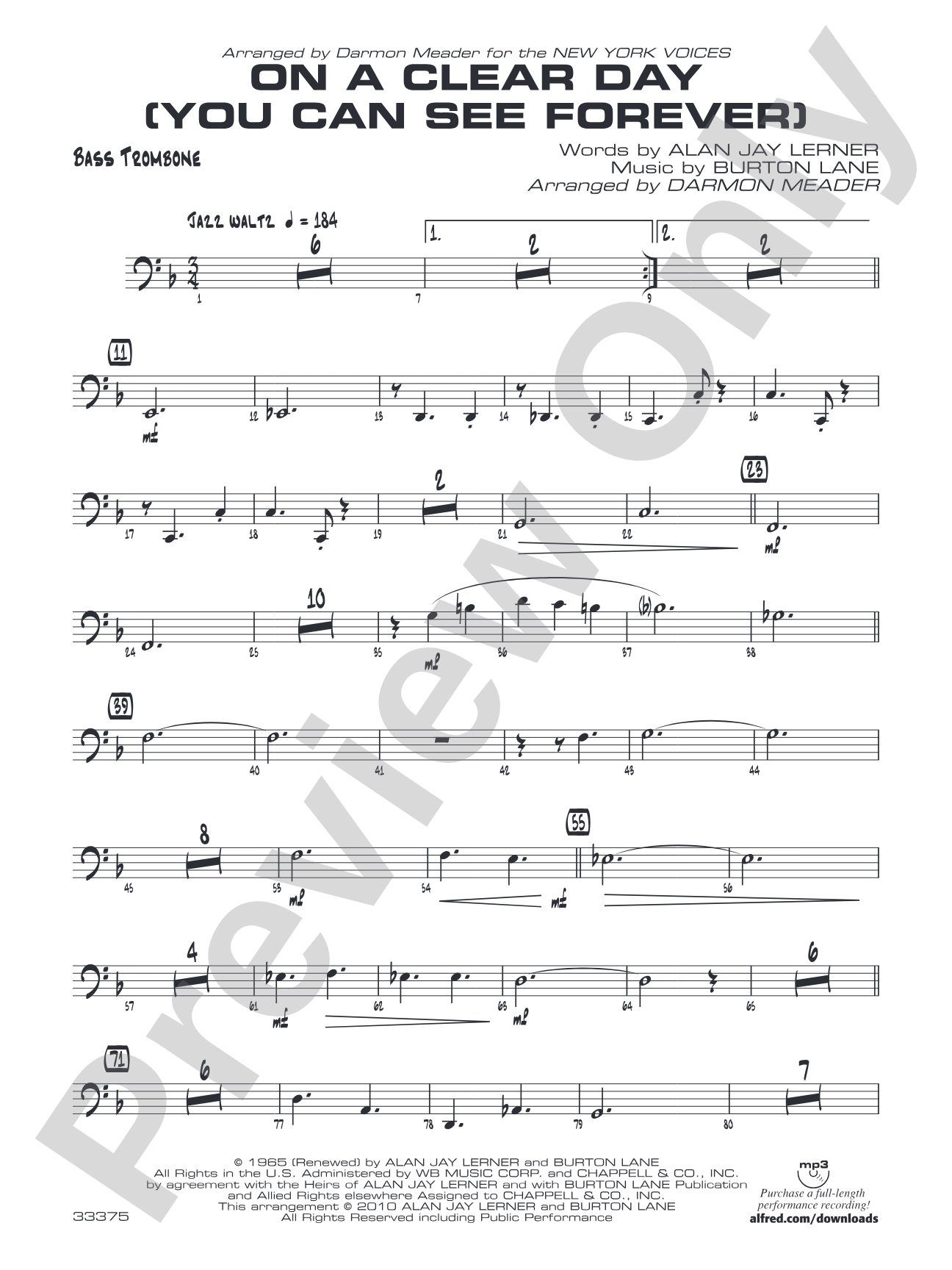

On a Clear Day (You Can See Forever): Bass Trombone
Words by Alan Jay Lerner, music by Burton Lane / arr. Darmon Meader
Grade: 4 (Medium Advanced / Difficult)
Item: 00-PC-0017184_BTN
$5.99
Pickup currently not available
Description
On a Clear Day (You Can See Forever) from the Jazz Vocal Series is designed for high school and college bands, and features vocal solos with some SATB arrangements. Full instrumentation includes 5 saxophones, 8 brass, 4 rhythm parts, a vocal solo part, and an optional B-flat tenor sax part that can be used as a substitute for the vocal solo. Guitar chord frames are provided and the rhythm section parts suggest chord voicings and rhythms.


Don't just read it, hear it, play along with it, and watch your students grow with it. In MakeMusic Cloud, On a Clear Day (You Can See Forever): Bass Trombone comes alive with professional accompaniment, adjustable tempo, and built-in practice tools that turn solo practice into real progress.
Open in the Player
Jump straight in and assign it today.
Start Your Free Trial
Open this title and explore the full library in minutes.
Sample Audio
1
Audio File
--:--
0:00
0:00
Sample Video
No sample videos found.
Additional Details
Series:
Jazz Vocal Series
Publisher:
Alfred Music
Page Count:
146
SKU:
00-PC-0017184_BTN
More about this title
About the Composer: Burton Lane
Burton Lane (1912-1997) composed some of Broadway's most enduring melodies, with a gift for writing singable, memorable lines that sit perfectly for voices. His scores for Finian's Rainbow and On a Clear Day You Can See Forever established him as a master of the jazz-inflected Broadway sound, blending sophisticated harmonies with accessibility. His work remains a cornerstone of the Great American Songbook and a frequent choice for jazz educators seeking material that challenges musicians while maintaining audience appeal.
Why we love this
Darmon Meader's arrangement captures the sophisticated sophistication of Lane's original without overwhelming a high school ensemble; the optional tenor sax substitution for vocal solo gives you flexibility when you don't have a strong singer available, and the inclusion of guitar chord frames makes the rhythm section feel genuinely connected to the jazz tradition. Programming a vocal feature with full jazz ensemble requires material that's both singable and musically substantial, and this delivers on both counts.
What to expect
Optimistic and soaring, with the kind of open, bright quality that made the original song a standard; Lane's melody unfolds naturally over jazz changes, and the ensemble parts create a lush harmonic backdrop that feels both polished and swinging. There's a buoyant confidence in the writing, an invitation for the vocalist or soloist to sing with freedom and joy.
Who it's for
Jazz ensemble directors working with Grade 4 musicians who want to feature a vocalist or skilled tenor saxophonist and need a Broadway standard that sits comfortably at the medium-advanced level. This works equally well for college jazz ensembles looking to build a vocal-feature program or high school groups ready to tackle sophisticated harmonic language and ensemble voicings.
How to get the most out of it
- Balance the vocal line so it sits slightly forward of the ensemble; the saxophone and brass voicings are rich enough to cover a singer who doesn't project with confidence.
- Use the guitar chord frames as a teaching tool with your rhythm section; understanding the voicings suggested in those frames will sharpen the ensemble's harmonic precision and collective sound.
- If you substitute the B-flat tenor sax for the vocal solo, adjust your rehearsal mindset from accompanying a singer to featuring an instrumental soloist, and give that player the freedom to interpret the melody with rubato.
- Mark the suggested rhythms and voicings in the rhythm section parts; they're not merely suggestions but crucial to maintaining the arrangement's intended groove and texture.
How to use it
Feature this in a concert that celebrates the intersection of Broadway and jazz, pairing it with other Jazz Vocal Series selections or standalone jazz standards arranged for ensemble. It's particularly effective as a showcase piece mid-concert, where the vocal or saxophone solo can capture audience attention before returning to full ensemble work.
Skills your students will build
- Balancing soloists with ensemble accompaniment in a jazz context
- Reading and interpreting guitar chord frames and suggested voicings
- Performing jazz style with appropriate articulation and swing feel
- Managing instrumentation flexibility (vocal solo vs. tenor sax substitution)
- Executing complex harmonic progressions common to Broadway jazz standards