
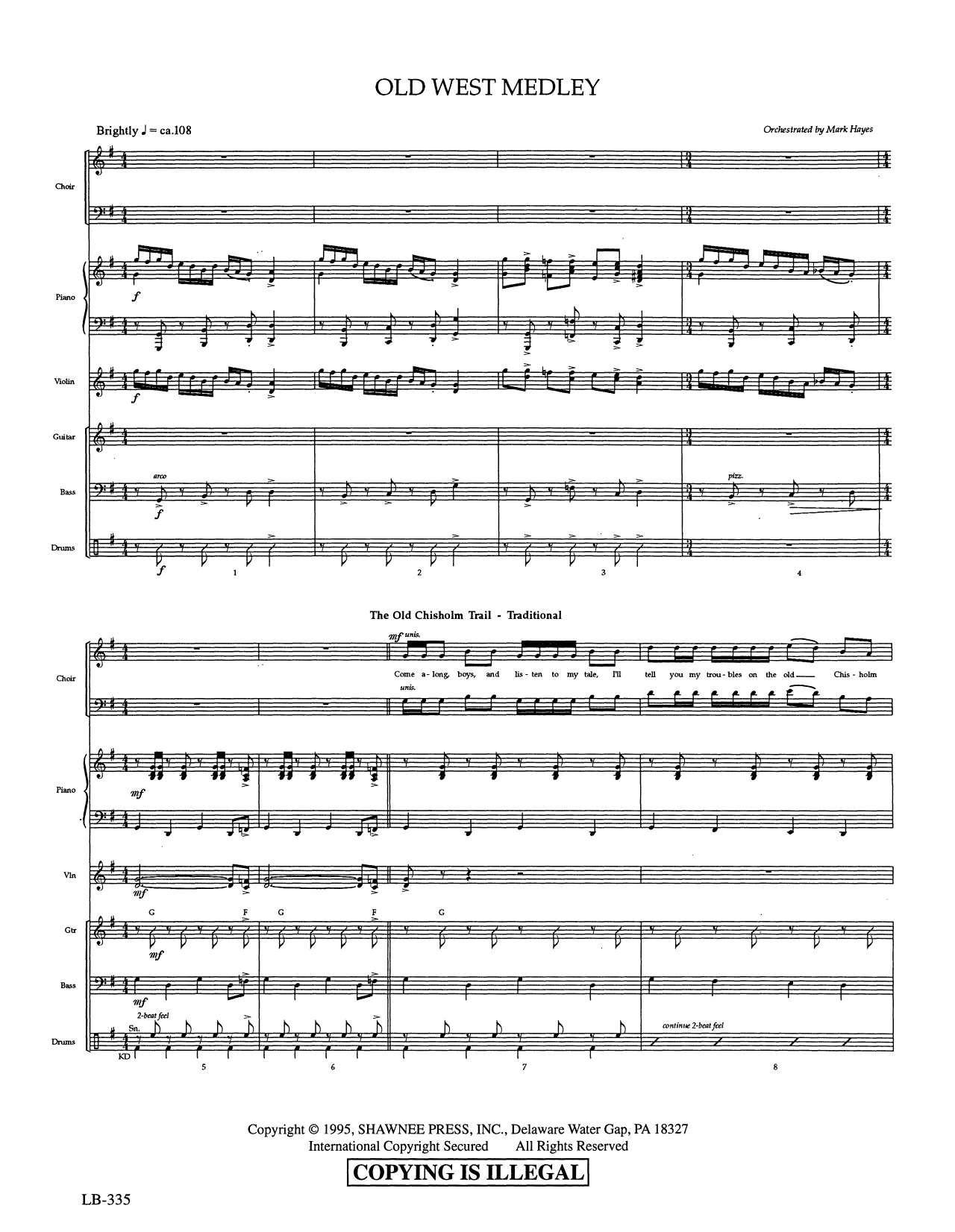

Old West Medley (arr. Mark Hayes): Choral Instrumental Pak
Arranged by Mark Hayes
Item: 35-PK00453320
$30.00
Pickup currently not available
Buy Extra Parts (Digital PDF Download)
Parts Added to Cart!
Description
Old West Medley (arr. Mark Hayes)


Old West Medley (arr. Mark Hayes): Choral Instrumental Pak isn't in MakeMusic Cloud just yet...but it could be. Let us know you'd like to see it, and you'll help shape what comes next. In the meantime, start a free trial and dive into thousands of interactive titles your students can play along with today.
Request This Title
Tell us you want it.
Start Your Free Trial
Explore everything that's ready to play right now.
Sample Audio
No sample audio found.
Sample Video
No sample videos found.
Additional Details
Publisher:
Hal Leonard
SKU:
35-PK00453320
More about this title
About the Arranger: Mark Hayes
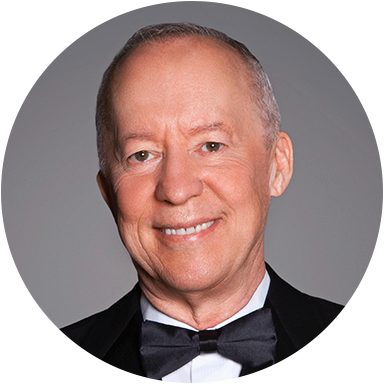
Mark Hayes has established himself as one of the most prolific voices in choral and piano music, with more than 1,750 published works spanning concert, sacred, and musical theater repertoire. A summa cum laude graduate of Baylor University's piano performance program, Hayes has conducted at Lincoln Center, Carnegie Hall, and the National Cathedral, premiered major works including his Requiem at Lincoln Center and in Rome, and received the 2010 Award for Exemplary Leadership in Christian Music from Baylor University.
Beyond the choral realm, Hayes is an accomplished orchestrator, record producer, and passionate composer for solo piano, with over 100 piano publications ranging from gospel and jazz to classical and Broadway arrangements. His film and theater work includes the musical score for Civil War Voices (which won 6 awards at the Midtown International Theatre Festival) and orchestrations for stage productions. Based in Kansas City, Missouri, Hayes continues to compose music across genres while conducting guest appearances around the world.
Why we love this
Hayes brings orchestrator's sophistication to a familiar Americana subject, creating instrumental and choral parts that feel substantial rather than novelty. The medley format gives you flexibility to program a concert piece that lands with energy and familiar material without requiring specialized programming knowledge to make it work.
What to expect
Warmth and Americana charm mixed with the harmonic sophistication of a seasoned arranger. The orchestral foundation gives the voices room to breathe while the melodies themselves carry the storytelling weight that makes Old West imagery resonate across generations.
Who it's for
Choirs with access to an instrumental ensemble or pit musicians looking for concert repertoire that engages audiences with recognizable material. Directors seeking a choral arrangement that doesn't require soloists or extended rehearsal time for complex modern techniques will find this format straightforward to prepare.
How to get the most out of it
- Treat the rhythmic swagger of these tunes as a stylistic anchor; slight liberties with tempo rubato between medley sections can heighten the narrative arc and prevent the piece from feeling like a medley at all.
- Balance the choir and instruments so neither dominates the orchestration; Hayes typically layers these elements to create dialogue rather than doubling, which means clear ensemble balance in rehearsal will pay dividends in performance.
- Pay attention to the character shifts between selections within the medley; each theme carries different energy and harmonic color, so mark those transitions clearly for ensemble awareness.
How to use it
This works as a standalone concert centerpiece or as a thematic anchor for a program exploring American musical roots. If you're building a spring concert around regional heritage or planning a lighter set that appeals to broader audiences, this medley creates a satisfying anchor without requiring context or lengthy program notes.
Skills your students will build
- Singing through harmonic progressions that move beyond diatonic movement
- Coordinating ensemble releases with instrumental accompaniment
- Maintaining rhythmic independence between choir and accompanying parts
- Stylistic awareness of Americana idioms (tempo, articulation, phrasing)
- Sectional independence when medley themes distribute across voice parts differently