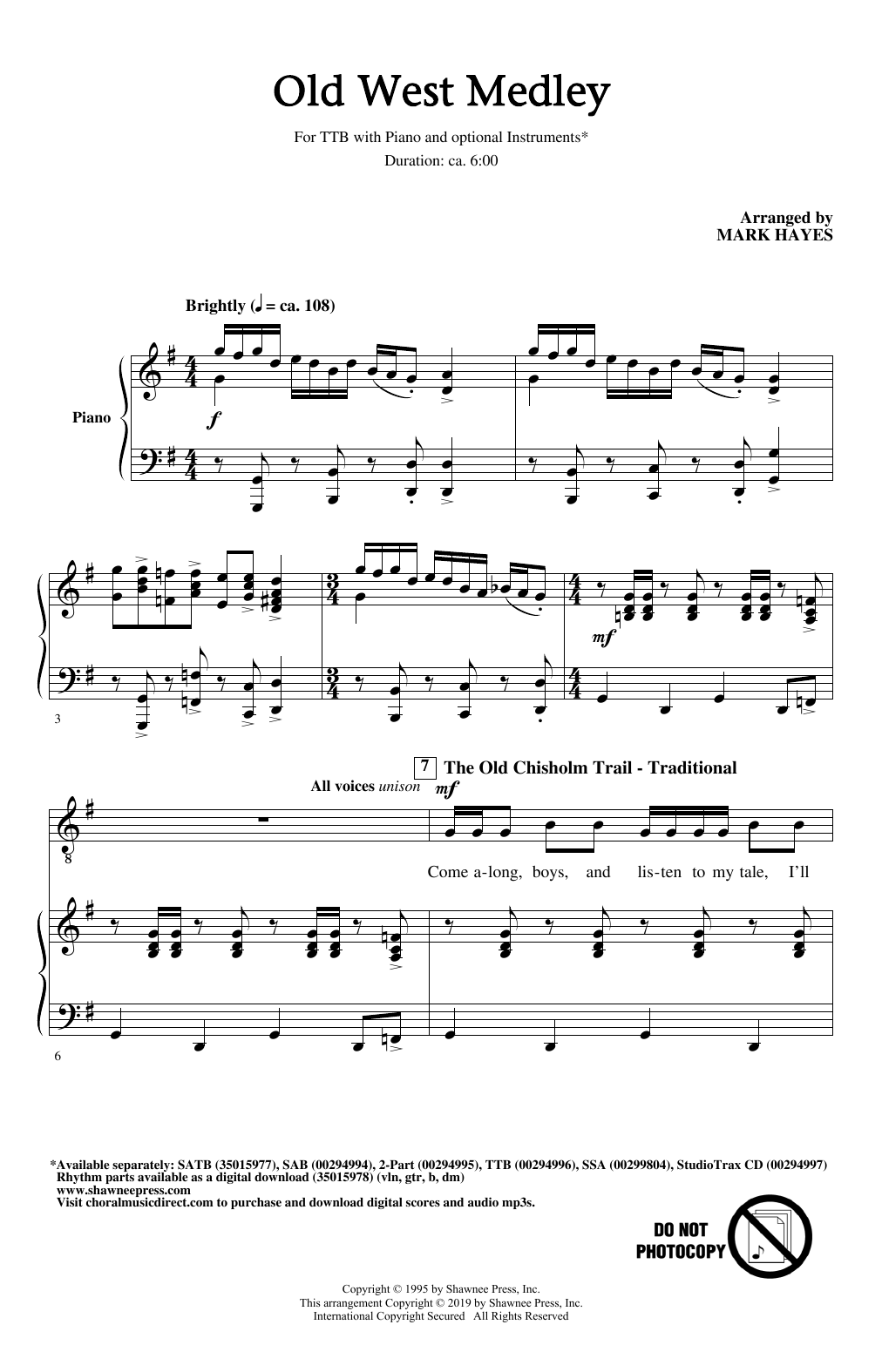
Old West Medley (arr. Mark Hayes) Sheet Music Preview

Old West Medley (arr. Mark Hayes): TTB Choral Octavo

Arranged by Mark Hayes

Item: 35-DS00453264

Digital Download
$2.99
Description

Old West Medley (arr. Mark Hayes): TTB Choral Octavo isn't in MakeMusic Cloud just yet...but it could be. Let us know you'd like to see it, and you'll help shape what comes next. In the meantime, start a free trial and dive into thousands of interactive titles your students can play along with today.

Sample Audio
No sample audio found.
Sample Video
Additional Details
Publisher: Hal Leonard
Page Count: 23
SKU: 35-DS00453264

More about this title

About the Arranger: Mark Hayes

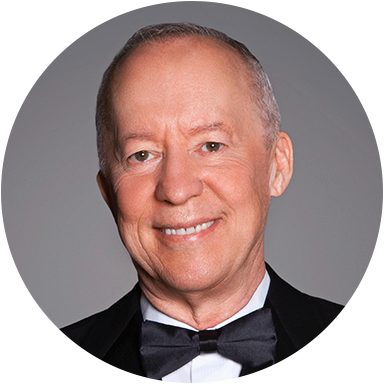
Mark Hayes

Mark Hayes brings nearly five decades of compositional and arranging experience to every project he undertakes. A summa cum laude graduate of Baylor University's piano program, he has established himself as a prolific voice in American choral and concert music, with more than 1,750 published works spanning sacred and secular idioms. His orchestrations and arrangements have graced stages from Carnegie Hall to Lincoln Center, and his conducting appearances at the National Cathedral and international venues reflect his standing as a musician of considerable scope.

Beyond the concert hall, Hayes has demonstrated versatility across musical theater, orchestration, and record production. He composed the score for Civil War Voices, which earned six awards at the Midtown International Theatre Festival, and has orchestrated commercial musicals while maintaining an extraordinary output of piano works and choral compositions. His 2010 recognition from Baylor University's Center for Christian Music Studies acknowledged his sustained leadership in the field. Based in Kansas City, Missouri, Hayes continues to create music informed by classical rigor, accessibility, and craftsmanship.

Why we love this

Hayes knows how to construct a medley that doesn't feel like a greatest-hits collection tossed together. The Old West Medley unfolds with genuine structural thought, weaving familiar melodies into a coherent arc rather than allowing each tune to stop the forward motion. For a men's ensemble seeking something that plays equally well in a concert setting or a lighter program slot, this delivers the authenticity of folk source material without sacrificing musical substance.

What to expect

Dust, campfire light, and the broad horizons of frontier life materialize through Hayes's treatment of traditional melodies. The Old West Medley captures the sweeping romanticism of the American frontier without sliding into sentimentality; there is genuine storytelling happening in the voices. Expect both lyrical passages and moments of rugged energy, layered with the kind of harmonic sophistication that rewards close listening.

Who it's for

Men's choirs of intermediate to advanced capability who want a substantial work beyond the typical ballad or part song. Directors programming concerts that benefit from Americana flavor will find this more musically ambitious than standard novelty fare. This also suits college and community ensembles looking for repertoire with popular appeal that doesn't compromise musicianship.

How to get the most out of it

  • Establish clarity between sections by adjusting vowel colors slightly as melodic material shifts; this helps the audience recognize where one tune yields to the next.
  • Work the rhythm section (if using accompaniment) with precision during the transitions; loose ensemble timekeeping exposes every seam in a medley format.
  • Balance the baritone line when it carries thematic material; Hayes often gives significant melodic responsibility to lower voices, and these moments need the same projection as any soprano entrance.
  • Experiment with slight tempo variations between medley sections to reflect stylistic differences in the source material without losing overall cohesion.

How to use it

Position this as a concert centerpiece within a program of American choral music, or pair it with other folk-based arrangements to create thematic coherence across a set. At 23 pages, it functions as substantial repertoire suitable for either a fall concert or spring finale. The work also provides excellent material for showcasing ensemble maturity to an audience that appreciates both accessibility and musical craft.

Skills your students will build

  • Stylistic interpretation within familiar melodic material
  • Ensemble balance across shifting textural roles
  • Transition negotiation in multi-section forms
  • Phrasing that respects both folk idiom and Hayes's harmonic language
  • Dynamic contrast without sacrificing blend

You May Also Like