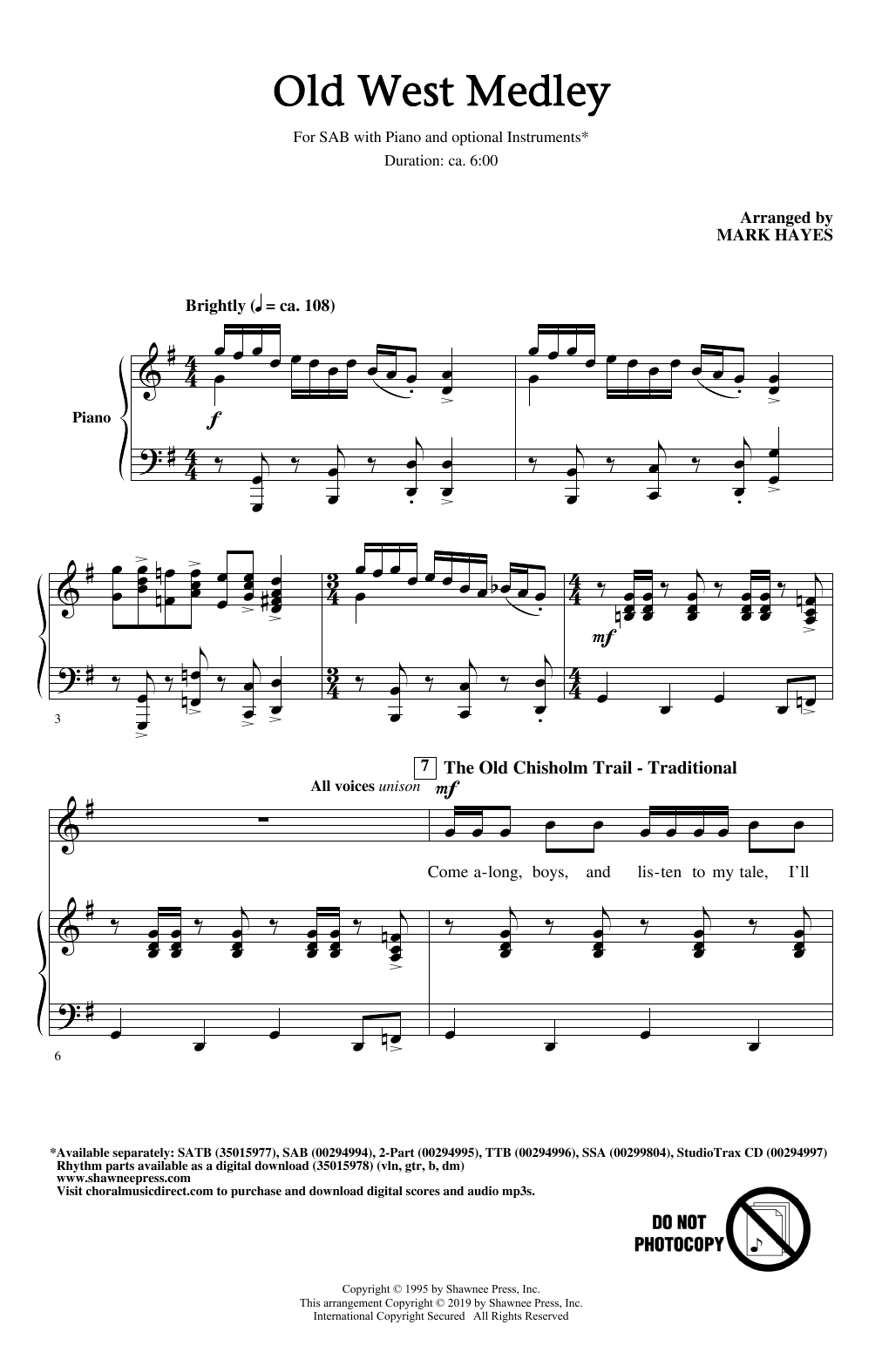
Old West Medley (arr. Mark Hayes) Sheet Music Preview

Old West Medley (arr. Mark Hayes): SAB Choral Octavo

Arranged by Mark Hayes

Item: 35-DS00453262

Digital Download
$2.99
Description

Old West Medley (arr. Mark Hayes): SAB Choral Octavo isn't in MakeMusic Cloud just yet...but it could be. Let us know you'd like to see it, and you'll help shape what comes next. In the meantime, start a free trial and dive into thousands of interactive titles your students can play along with today.

Sample Audio
No sample audio found.
Sample Video
Additional Details
Publisher: Hal Leonard
Page Count: 22
SKU: 35-DS00453262

More about this title

About the Arranger: Mark Hayes

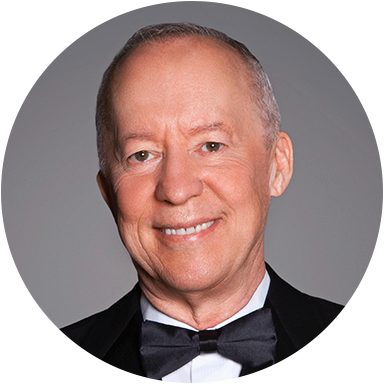
Mark Hayes

Mark Hayes has composed and arranged over 1,750 published works across virtually every musical genre, establishing himself as one of the most prolific voices in contemporary music. A summa cum laude graduate of Baylor University's piano program, he has conducted at major venues including Lincoln Center, Carnegie Hall, and the National Cathedral, and received the Baylor University Award for Exemplary Leadership in Christian Music in 2010. His catalog spans sacred choral music, orchestral works, musicals, and an extensive library of piano compositions ranging from gospel and jazz to classical and Broadway arrangements.

Beyond his work as a composer and conductor, Hayes has shaped musical theater and entertainment through orchestration and arrangement; his credits include the orchestration of the musical Madame Buttermilk and the musical score for Civil War Voices, which earned six awards at the Midtown International Theatre Festival. Whether creating new works commissioned for international institutions or arranging repertoire that brings beloved melodies to new audiences, Hayes demonstrates a gift for writing that serves performers and audiences alike.

Why we love this

Hayes brings the ear of a seasoned orchestrator to this medley, crafting three-part writing that sounds fuller and more sophisticated than typical SAB fare without sacrificing accessibility. The arrangement sits comfortably for mixed choirs and opens up genuine musical moments within what could easily become a novelty number; directors will find themselves actually looking forward to rehearsing it.

What to expect

Dust, open skies, and the narrative arc of American frontier mythology collide with the crafted sophistication of a professional arranger's hand. The writing honors the sturdy melodies at its core while adding harmonic color and textural surprises that keep the medley from feeling quaint or one-dimensional.

Who it's for

This medley suits mixed choirs with solid sight-reading skills and some experience with block harmonies. It works equally well for community ensembles, church choirs stepping into secular repertoire, and educational groups looking for concert material with genuine character.

How to get the most out of it

  • Build the energy incrementally across individual selections rather than treating the medley as one sustained climax; each tune deserves its own arc, and the pacing will feel more refined.
  • Let the piano accompaniment lead the character work. Hayes's voicings and harmonic choices create personality that your choir can follow into phrase shapes and articulation choices.
  • Balance the three parts carefully in the SAB voicing so no single line dominates; the arrangement works because all three voices carry musical material, not just the melody.

How to use it

Position this as a crowd-pleasing mid-program selection that gives your audience permission to smile without undermining your credibility as musicians. It pairs naturally with other American repertoire or thematic concert programs exploring identity and landscape, and the twenty-two pages suggest a final medley placement that leaves the hall in an upbeat mood.

Skills your students will build

  • Singing through key changes within a continuous piece
  • Balancing three independent melodic lines in SAB texture
  • Executing rhythmic precision when multiple tunes shift meter or tempo
  • Responding to harmonic context to shape phrasing and dynamics across sectional boundaries
  • Coordinating with piano accompaniment that carries structural weight

You May Also Like