
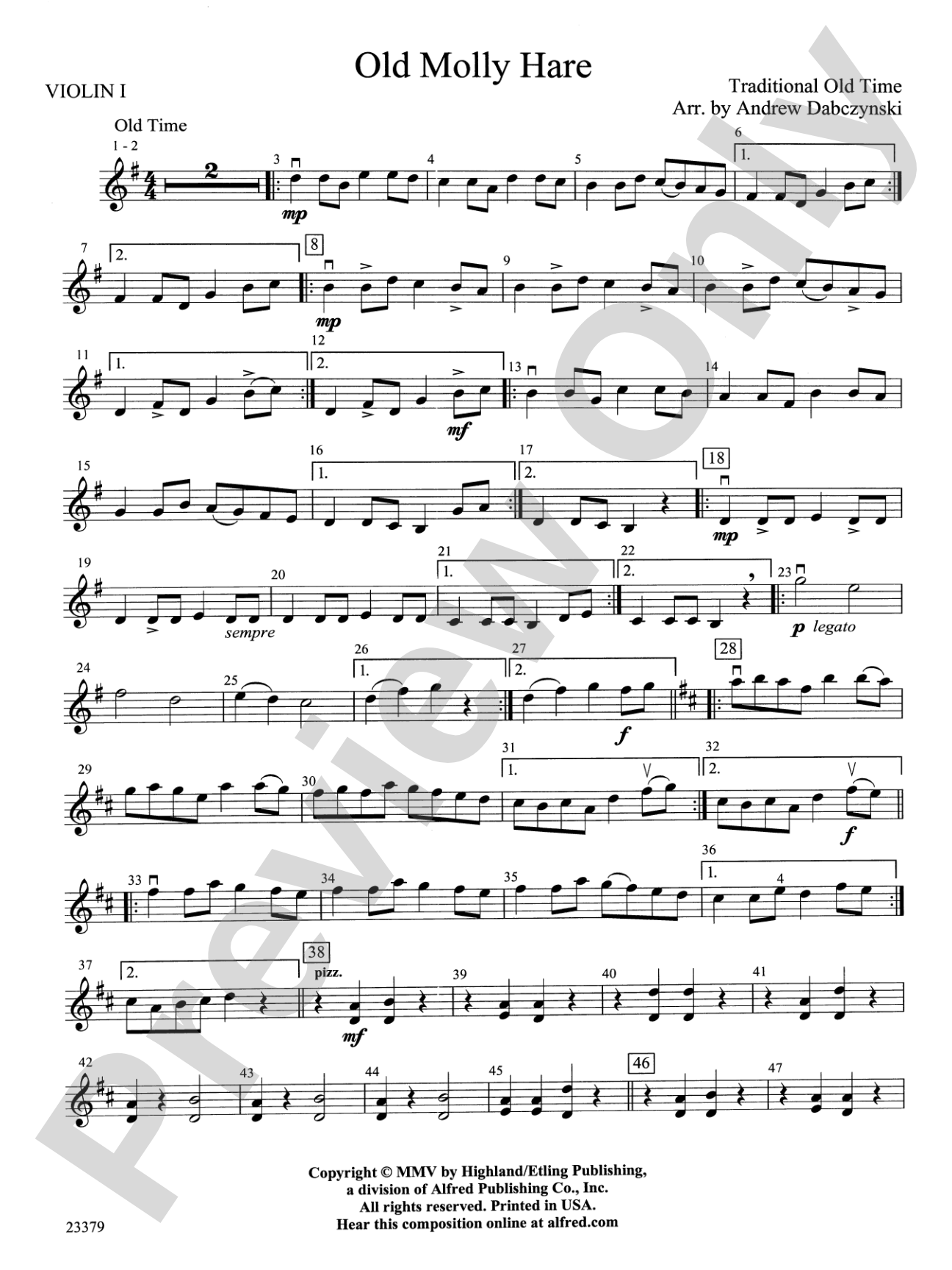

Old Molly Hare: 1st Violin
Traditional / arr. Andrew H. Dabczynski
Grade: 2.5
Item: 00-PC-0000720_VN1
$5.99
Pickup currently not available
Description
In this fresh arrangement of a traditional, old-time fiddle favorite, every member of the orchestra gets lots of chances to play the up-beat tune. The straight-forward melody is approachable by all, and the authentic-sounding variations and key changes will challenge even advanced players. A series of soloistic "breaks" can be performed by individuals or entire sections, and the inclusion of optional chord symbols provide opportunities for improvisation. This creative setting of Old Molly Hare will provide motivating learning experiences for students, and will add invigorating old-time style and drive to any concert program.


Don't just read it, hear it, play along with it, and watch your students grow with it. In MakeMusic Cloud, Old Molly Hare: 1st Violin comes alive with professional accompaniment, adjustable tempo, and built-in practice tools that turn solo practice into real progress.
Open in the Player
Jump straight in and assign it today.
Start Your Free Trial
Open this title and explore the full library in minutes.
Sample Audio
1
Audio File
--:--
0:00
0:00
Sample Video
No sample videos found.
Additional Details
Series:
Highland/Etling String Alternatives
Publisher:
Alfred Music
Page Count:
128
SKU:
00-PC-0000720_VN1
More about this title
About the Composer: Andrew H. Dabczynski

Andrew H. Dabczynski has shaped string education across multiple institutions and roles. He founded the BYU "New Horizons Orchestra," a beginning string ensemble for adult learners that also serves as a training ground for string teachers, and was honored with BYU's Joseph E. White Fellowship for this work. His career has included faculty positions at the Eastman School of Music and in public school systems across New York and Michigan, as well as supervisory roles in fine arts education. Utah ASTA recognized him as "Higher Education Teacher of the Year" in 2005 and later honored his "Outstanding Contributions to Music Education."
As a performer, Dabczynski has played viola in regional orchestras including the Rochester Philharmonic and Hartford Symphony, and was a founding member of the Colden String Quartet during its residency at Western Michigan University. He holds degrees from Eastman (B.M. in viola performance), the University of Connecticut (M.A.), and the University of Michigan (Ph.D. in Music Education). Beyond his pedagogical work, Dabczynski has sustained a deep commitment to folk music and ethnomusicology, with particular focus on fiddling traditions and how folk music transmits across generations. He co-authored the String Explorer method series with Alfred Music and has contributed to the American String Teachers Association at the national level.
Why we love this
Every player gets to carry the tune through multiple sections and soloistic breaks, which builds confidence and keeps rehearsals energized across all ability levels. The optional chord symbols invite improvisation and give students room to engage creatively while the authentic variations and key changes maintain enough musical sophistication to hold advanced players' attention. This is the kind of arrangement that makes traditional music feel alive in rehearsal rather than historical.
What to expect
Old Molly Hare bounces with the infectious energy of a traditional fiddle tune, inviting players and listeners into an upbeat, folk-rooted world. The straightforward melody feels familiar and approachable, while the authentic variations and key changes add surprise and musical depth. The result is joyful and driving, the kind of music that makes rehearsal feel less like work and more like celebration.
Who it's for
String orchestras at the intermediate level (2.5 grade) looking for repertoire that balances accessibility with genuine musical substance. Directors want material that keeps every player invested, whether they are building solid fundamentals or ready for more interpretive responsibility. This arrangement is equally at home in a concert setting or festival competition.
How to get the most out of it
- Balance the fiddle-style character by letting the melody soar without drowning in accompaniment; the forward momentum depends on a clear, singing line even in unison passages.
- Prepare soloistic breaks in advance by assigning them to specific players or sections so performers know whether they're carrying a passage alone or with others.
- Use the optional chord symbols to invite improvisation during rehearsal before finalizing parts; this connects students to the improvisational spirit of traditional fiddling.
- Emphasize the energy shift at each key change as a musical event, not just a technical adjustment; these moments should feel fresh and keep the audience engaged throughout.
How to use it
Program this as a concert finale or opening number to set an energetic, accessible tone that welcomes audiences into the concert. It also works well as a festival selection where its blend of straightforward playing and interpretive opportunity appeals to adjudicators. The old-time style and crowd-friendly character make it an excellent pairing with other folk-based or Americana arrangements if you're building a thematic set.
Skills your students will build
- Reading and executing key changes within a single piece
- Balancing melody and accompaniment in unison and harmonic textures
- Interpreting soloistic passages with confidence and musicality
- Responding to optional chord symbols for improvisation and stylistic awareness
- Sustaining rhythmic drive and forward motion in a folk-music idiom