
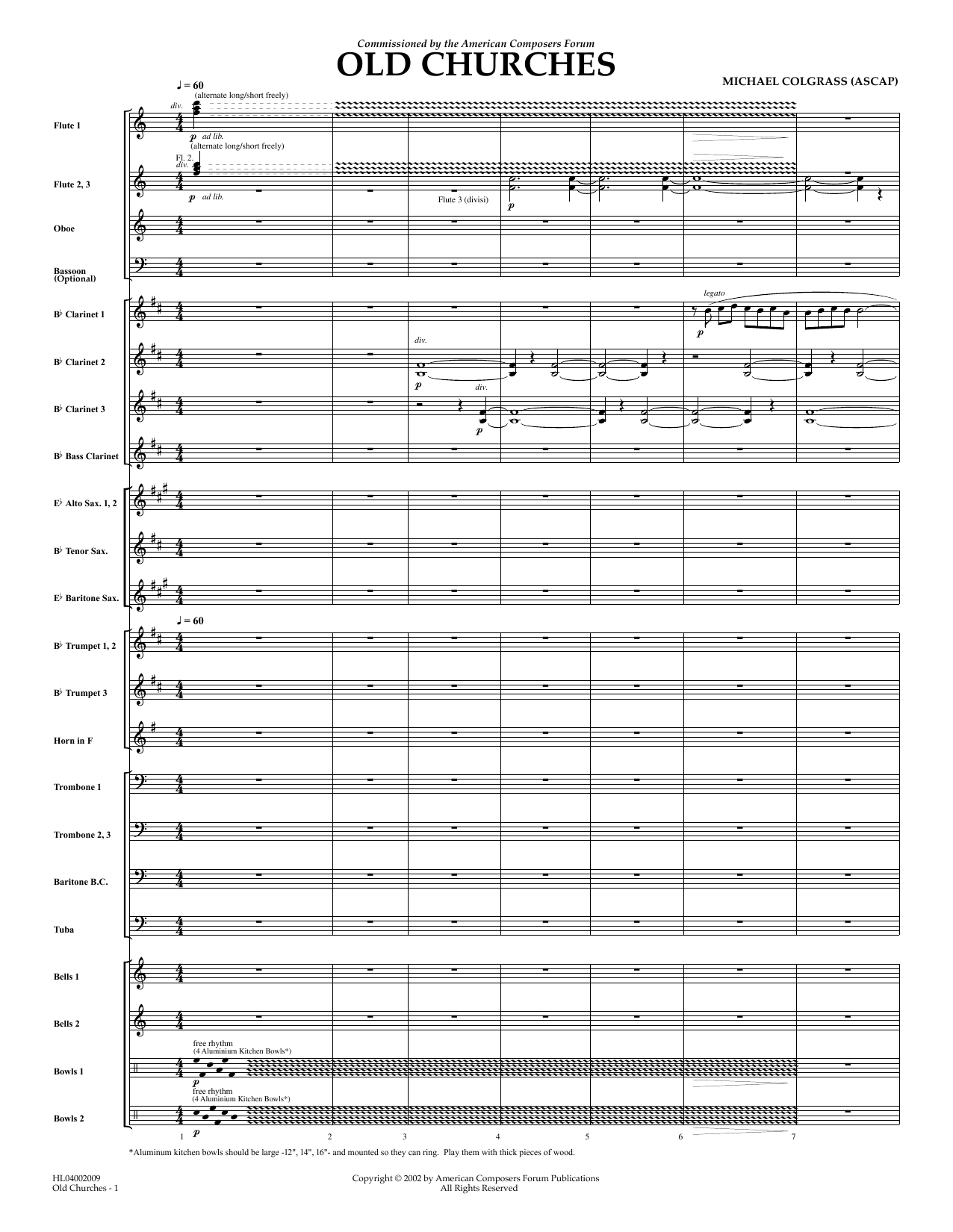

Old Churches: Concert Band Conductor Score & Parts
By Michael Colgrass
Grade: 3
Item: 35-PK00444405
$10.00
Pickup currently not available
Parts Added to Cart!
Description
Gregorian chant is one of the earliest forms of notated music, using free flowing rhythms and simple melody. In "Old Churches", composer Michael Colgrass uses these elements to create an aura of voices echoing in the monastery. Using easy graphic notation, students have a fun and creative way to explore sound production along with the compositional process. (Includes score and parts.)
Learn more at Youtube: https://www.youtube.com/user/ComposersForum/search?query=michael+colgrass+
BandQuest, an exciting series of new music and accompanying curricula for band, is a program published by the American Composers Forum. The series was started as a response to feedback from music educators that there is a pressing need for new, fresh band music. The heart of this program is new works written by a diverse group of leading American composers who have created challenging pieces that are a true departure from standard middle school repertoire. Every BandQuest project includes a residency component in which the composer works collaboratively with a middle school as they create their new piece. Many BandQuest pieces are accompanied by an interdisciplinary curriculum designed to assist students as they learn the music and to integrate each piece with non-music studies. Visit www.bandquest.org to learn more about this innovative series, and email bandquest@composersforum.org to request a free downloadable audio catalog.


Discover MakeMusic Cloud: thousands of interactive titles your students can play along with today.
Sample Audio
No sample audio found.
Sample Video
No sample videos found.
Additional Details
Publisher:
Hal Leonard
SKU:
35-PK00444405
More about this title
About the Composer: Michael Colgrass
Michael Colgrass is an American composer and conductor whose catalog spans orchestral works, chamber music, and educational pieces for young ensembles. His approach to composition consistently emphasizes accessibility without sacrificing artistic substance, making him a natural fit for the BandQuest series and other educational commissions.
Colgrass has built a career on creating works that invite students into the compositional process itself. Rather than presenting finished products, his pieces often reveal the building blocks of music making, encouraging performers to think like creators rather than mere interpreters.
Why we love this
Colgrass taps into something genuinely instructive here: the connection between ancient music and contemporary sound exploration. Students aren't just playing a piece about monasteries; they're discovering how limited materials (free rhythm, simple melody, graphic notation) can evoke powerful atmosphere. The creative entry point through graphic notation gives reluctant readers and kinesthetic learners a real stake in the performance.
What to expect
Ethereal and contemplative. The piece conjures the particular silence of old stone spaces, where voices seem to hang and resonate. There's a meditative quality underneath, balanced by the quiet energy of discovery as students realize they're shaping the sound themselves.
Who it's for
Grade 3 bands looking for a departure from standard repertoire while maintaining accessibility. This works especially well for ensembles ready to think critically about sound and composition, and for programs that want to pair music study with history or religion curriculum.
How to get the most out of it
- Establish the spatial concept early. Talk through how voices would echo in a stone chamber, and let that image guide your ensemble's balance and tone production throughout rehearsal.
- Approach the graphic notation as a permission structure, not a constraint. Give students agency to shape their own rhythmic choices within the framework, which deepens their ownership of the piece.
- Shape longer lines by thinking about breath and phrasing rather than measure lines. The free rhythm mirrors how chant actually breathes, so rehearse with attention to musical punctuation rather than metronomic precision.
- Record a rehearsal and play it back. Hearing their collective sound choices reflected back helps students grasp how much their interpretive choices matter in graphic notation.
How to use it
Consider programming this early in the school year as an ensemble-building exercise that doubles as a concert piece. Its contemplative character makes it an effective opener or closer on a diverse program. You might also pair it with a humanities unit on medieval history or religious music traditions.
Skills your students will build
- Reading and interpreting graphic notation
- Free rhythm interpretation and ensemble coordination without steady pulse
- Tone production and resonance awareness
- Understanding compositional process and creative decision making
- Phrasing and breath control in the context of chant-inspired melody