
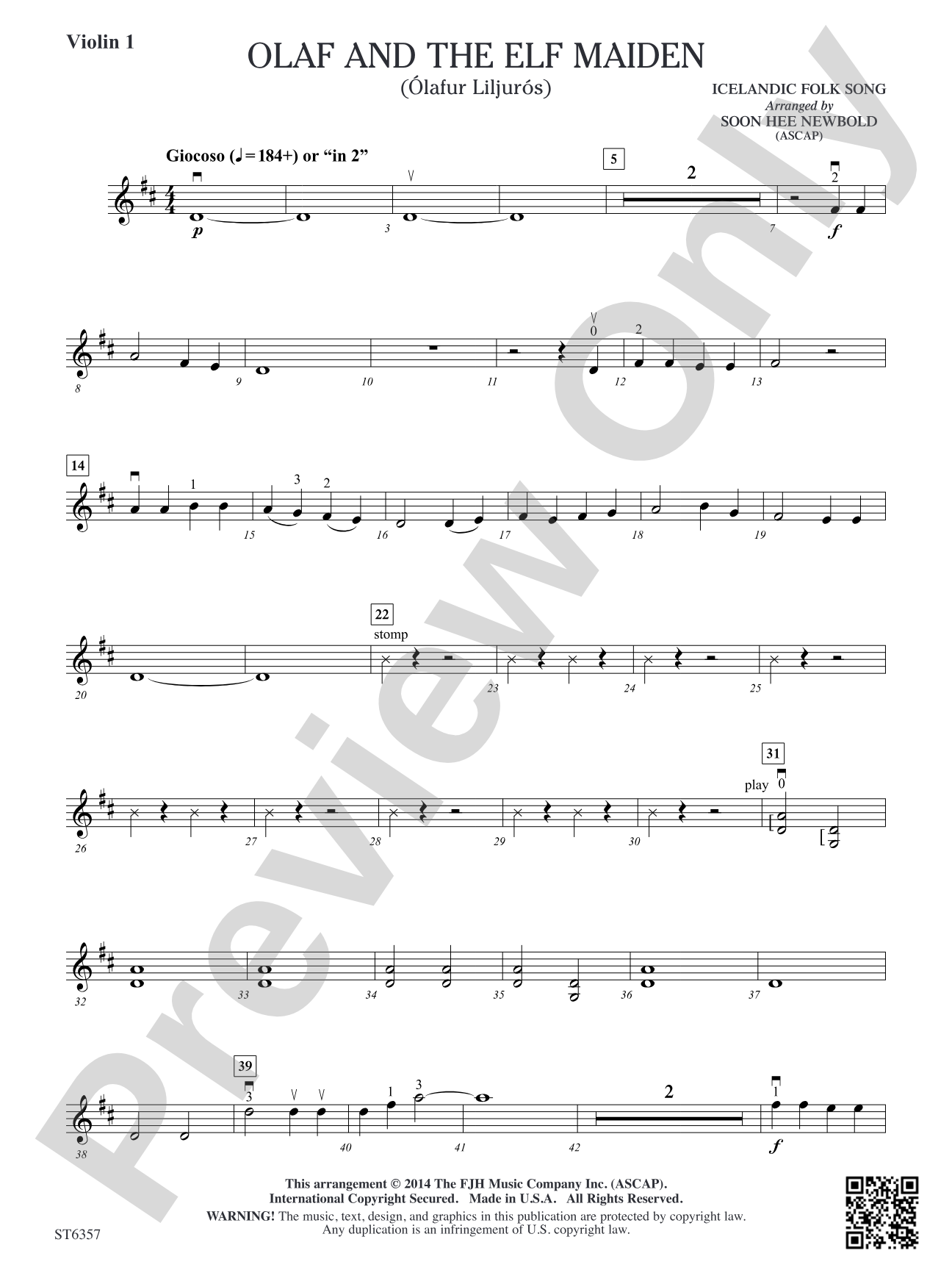

Olaf and the Elf Maiden: Violin 1
Arranged by Soon Hee Newbold
Grade: 1.5
Item: 98-PC-DST6357_VN1
$7.00
Pickup currently not available
Description
This lively Icelandic vikivaki folk song makes a great opener or closer and calls for stomping by the orchestra members. Telling the tragic tale of Olaf and his deadly encounter with an elf maiden, the music includes open drones that support the melody as it is passed around the different instruments in the ensemble. Fantastic!


Don't just read it, hear it, play along with it, and watch your students grow with it. In MakeMusic Cloud, Olaf and the Elf Maiden: Violin 1 comes alive with professional accompaniment, adjustable tempo, and built-in practice tools that turn solo practice into real progress.
Open in the Player
Jump straight in and assign it today.
Start Your Free Trial
Open this title and explore the full library in minutes.
Sample Audio
1
Audio File
--:--
0:00
0:00
Sample Video
No sample videos found.
Additional Details
Series:
FJH Beginning Strings
Publisher:
The FJH Music Company, Inc.
SKU:
98-PC-DST6357_VN1
More about this title
About the Arranger: Soon Hee Newbold

Soon Hee Newbold has built a career around bringing world music traditions into contemporary concert settings. Her work as a composer and conductor spans five decades and multiple continents, shaped by her own performance experiences as a pianist and violinist alongside her deep engagement with global musical cultures. She has premiered works at major American venues including Carnegie Hall, the Kennedy Center, and Lincoln Center, and has conducted ensembles on every continent.
Newbold's arrangements and compositions are performed regularly by orchestras and bands at all levels, from professional symphonies to beginning student ensembles. She maintains an active schedule as a guest clinician and keynote speaker at regional and national conferences. Her work as a film composer in Hollywood has expanded her reach beyond the concert hall into screen and recording media.
Why we love this
This arrangement captures the raw storytelling power of a traditional Icelandic vikivaki while staying completely accessible for young orchestras. The drone-based harmonic texture and melodic passing technique teach transparent orchestration without sacrificing musical maturity. The invitation to stomp transforms a listening experience into a physical, embodied one that young musicians genuinely enjoy.
What to expect
There is something primal and hypnotic about this piece: the insistent stomp grounds the ensemble while the open drones create a windswept, modal quality that feels both ancient and immediate. The melody unfolds like a voice telling a story around a fire, shifting from one storyteller to the next, with a tragic inevitability that young musicians can genuinely feel.
Who it's for
String orchestras in grades 1-2 who are ready for something beyond basic unison playing but need clear harmonic structure to stay organized. Directors seeking an opener or closer that energizes the room and feels culturally substantive without excessive technical demands.
How to get the most out of it
- Establish the stomp as a unified rhythmic anchor before the first rehearsal with parts. Have the full orchestra practice the stomp pattern without instruments to lock in the ensemble pulse.
- Shape the melody as it travels between instruments by asking the section holding the drone to listen actively and provide support rather than background. This prevents the drone from flattening the phrase.
- Balance the open string drones carefully in early rehearsals; young players often play these louder than the melody because they feel exposed on a single note. Work toward transparency so the melody always sits on top.
- Encourage natural phrasing even within the simple melodic line. The legend being told deserves breadth and intention, not a mechanical reading.
How to use it
This works beautifully as a concert opener, especially if your program includes other folk-based or world music selections that explore different cultural traditions. Its rhythmic directness and compact form also make it an ideal closer when you want to leave the audience with energy and a sense of participatory connection.
Skills your students will build
- Listening to sustained harmonic drones while maintaining independent melodic lines
- Passing a melody between instrumental sections with continuity and direction
- Coordinating rhythmic ensemble elements (stomp, melody, drone) into unified texture
- Understanding open strings and sympathetic resonance in string writing
- Performing with cultural awareness of Nordic folk traditions