
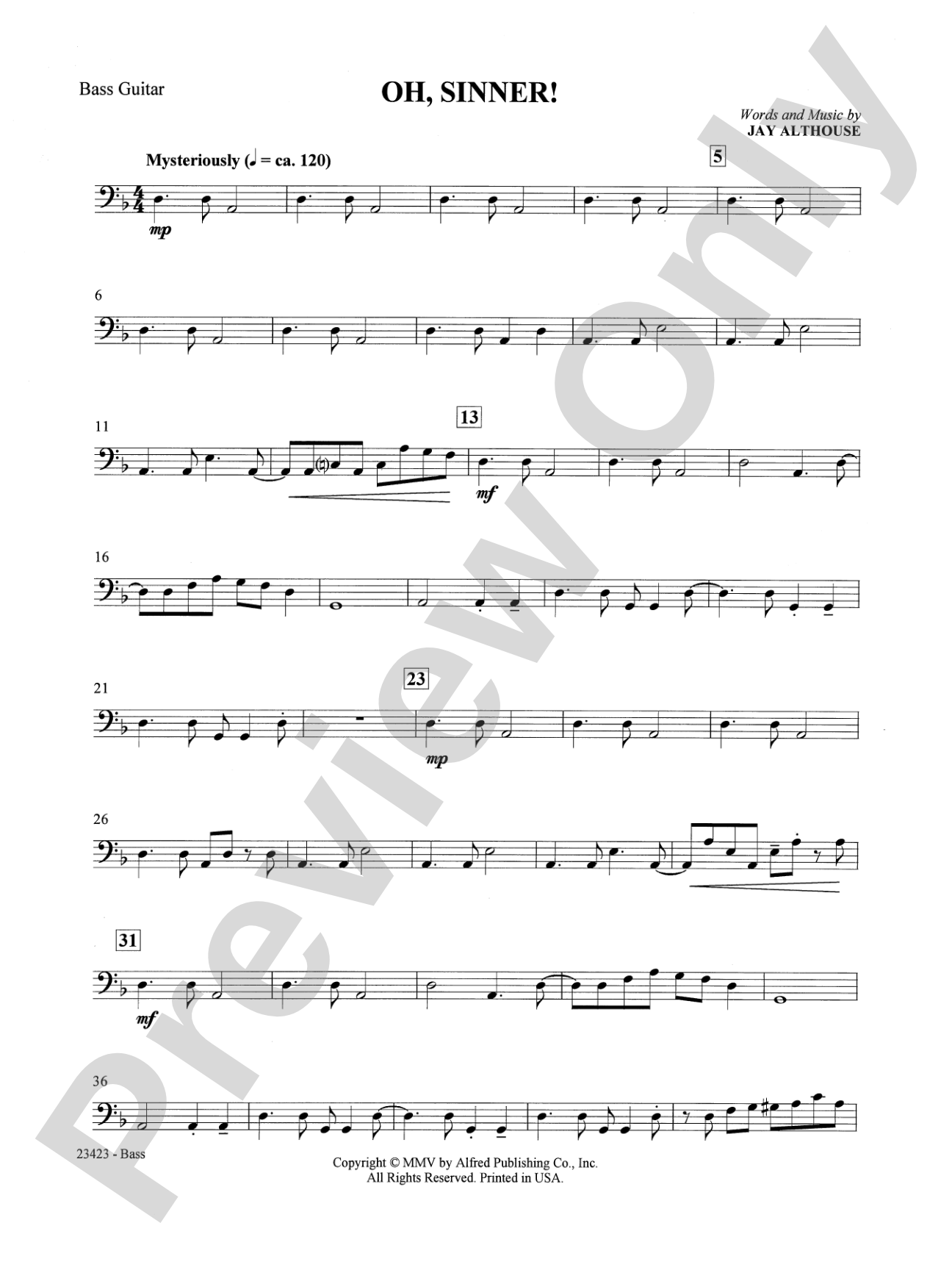

Oh, Sinner!: String Bass: Choral SoundPax
Music by Jay Althouse
Item: 00-PC-0000722_SB
$4.00
Pickup currently not available
Description
A soul-styled original with a funky choral groove, bluesy modal melody, and several dig-in solos for your most stylized singers. Jay's mysterious opening builds to an intense verse, repeats with greater emphasis, and finally brings it on home as the voices slide down from one inversion to the next, accompanied by a descending piano motive. (Sure to make even your biggest transgressors repent!) Awesome SoundTrax and Pax. SoundPax includes parts for a. sax., t. sax., tpt., tbn., rhy.


Don't just read it, hear it, play along with it, and watch your students grow with it. In MakeMusic Cloud, Oh, Sinner!: String Bass: Choral SoundPax comes alive with professional accompaniment, adjustable tempo, and built-in practice tools that turn solo practice into real progress.
Open in the Player
Jump straight in and assign it today.
Start Your Free Trial
Open this title and explore the full library in minutes.
Sample Audio
1
Audio File
--:--
0:00
0:00
Sample Video
No sample videos found.
Additional Details
Series:
Alfred Choral Designs
Publisher:
Alfred Music
SKU:
00-PC-0000722_SB
Instrumentation:
SoundPax
More about this title
About the Composer: Jay Althouse

Jay Althouse holds degrees in Music Education and Music from Indiana University of Pennsylvania, where he was later honored with the Distinguished Alumni award. His eight-year tenure in rights and licensing at a major educational publisher included service on the Executive Board of the Music Publishers Association of America, giving him deep insight into what choirs need and how music reaches them.
With more than 800 choral works in print across all levels, Althouse has established himself as a prolific voice in sacred and secular choral writing. An ASCAP writer member and regular recipient of the Special Award for composition, he has collaborated with his wife Sally K. Albrecht on children's musicals, co-authored The Complete Choral Warm-up Book and Accent on Composers, and contributed to Folk Art Messenger as a member of the National Advisory Board of the Folk Art Society of America. He is based in Wake Forest, North Carolina.
Why we love this
Althouse builds genuine swagger here. The funky choral groove paired with bluesy modal melody gives your ensemble permission to commit to a completely different performance style, while the solo features let your strongest stylized singers shine in ways that traditional sacred music rarely demands. The descending piano inversions and mysterious opening create architectural interest that justifies programming this alongside more conservative repertoire.
What to expect
A mysterious invitation that unfolds into confident stride. The bluesy modal melody feels slightly off-kilter in the best way, creating tension that the funky groove resolves with each repeat. By the end, descending inversions feel inevitable, like the voices know exactly where they're meant to land.
Who it's for
Choirs with strong soloists and the maturity to embrace contemporary sacred styles will connect most fully with this piece. Directors looking to program something that acknowledges soul and R&B without abandoning the choral tradition will find eager performers here.
How to get the most out of it
- Study the recorded accompaniment first to lock in the groove's pocket. The rhythm section drives everything; if your singers sit behind the beat even slightly, the funk dissipates.
- Cast your soloists early and give them rehearsal time separate from the full choir. These aren't small ornamental moments; they anchor the song's personality.
- Emphasize the modal melody's slight dissonance during the verse repeats. As intensity builds, singers should lean into that bluesy color rather than smoothing it away.
- Shape the descending voice inversions in the final section deliberately. Think of it as a collective vocal slide rather than individual part movement; the effect depends on unified intention.
How to use it
Pair this with a traditional spiritual or hymn arrangement earlier in the concert to show the range of sacred music your choir commands. Its contemporary soul aesthetic works equally well as a closing number (leaving audiences energized) or as a mid-program pivot that signals permission to take risks.
Skills your students will build
- Singing in modal harmonic language and recognizing bluesy inflection
- Executing rhythmic precision in funk and groove-based styles
- Balancing solo spotlight with ensemble cohesion
- Interpreting descending harmonic progressions with unified voice leading
- Performing contemporary sacred music with stylistic authenticity