
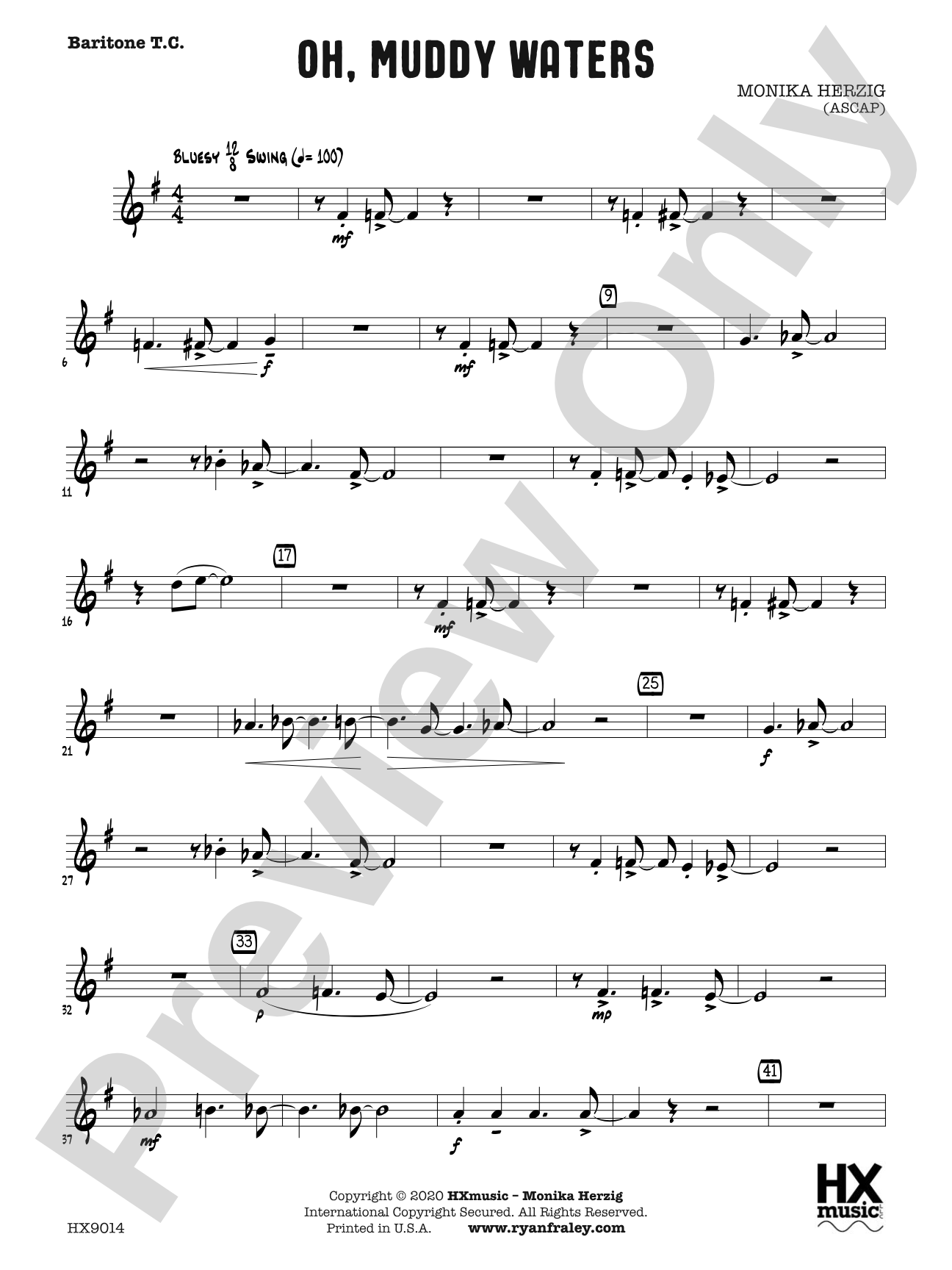

Oh, Muddy Waters: B-flat Baritone T.C.
By Monika Herzig
Grade: 3
Item: 98-PC-DHX9014_BTC1
$3.99
Pickup currently not available
Description
Originally recorded by Monika Herzig and a cast of musical collaborators from around the globe on her 2016 album, "The Whole World in Her Hands," Oh, Muddy Waters is a bluesy call-and-response between bass instruments and the whole ensemble. Monika has arranged the small group version for big band, with modest brass ranges, suggested piano voicings, and solo space for tenor sax and guitar (or piano). Solo transcriptions are provided that match the recording note-for-note. Laid-back, soft syncopations and a rich harmonic language bring to life a composition that builds on that initial bass riff. Top trumpet note: G5


Discover MakeMusic Cloud: thousands of interactive titles your students can play along with today.
Sample Audio
1
Audio File
--:--
0:00
0:00
Sample Video
Additional Details
Series:
HXmusic
Publisher:
HXmusic
SKU:
98-PC-DHX9014_BTC1
More about this title
About the Composer: Monika Herzig

Monika Herzig arrived in the United States from Germany in 1988 with minimal possessions but maximum ambition, beginning a career that would span three decades of jazz performance, education, and advocacy. She earned her doctorate in Music Education at Indiana University, where she now serves on the faculty in Arts Administration, while simultaneously building an impressive discography on her own ACME Records label and touring extensively throughout North America and Europe. Her scholarly work includes two books examining the legacies of David Baker and Chick Corea, and her honors include a Down Beat Magazine Award, a Jazz Journalist Association Hero Award, and grants from the NEA and Indiana Arts Commission.
Beyond her solo work as a pianist and bandleader, Herzig has become known for lifting up other voices in jazz, most visibly through her "SHEroes" project, which assembles some of the world's finest female instrumentalists for collaborative performances and recordings. Her arrangements and compositions consistently reflect her belief that jazz is a global language, drawing collaborators from around the world and creating music that reaches across geographical and stylistic boundaries.
Why we love this
Herzig's arrangement transforms a soulful, intimate composition into an engaging big band vehicle without sacrificing its laid-back character. The inclusion of solo transcriptions that match the original recording gives your students a direct connection to how the music breathes in practice, while the modest brass ranges and flexible voicings make it accessible to mixed-ability ensembles. This is the kind of writing that sounds sophisticated but actually wants your group to succeed.
What to expect
The piece settles into a rich, bluesy pocket that feels both contemporary and rooted in jazz tradition. A bass riff locks everything in place while the ensemble weaves sophisticated harmonies overhead, creating a texture that's simultaneously relaxed and intricately layered. There's a warmth here that comes from the world-music influences Herzig brought to the original recording, making it feel like an invitation rather than a demonstration of technical prowess.
Who it's for
Jazz ensembles at the high school or early college level looking for material that respects their musical intelligence while building foundational swing and section balance skills. This arrangement works equally well for concert programming or festival competition, offering enough musical substance to satisfy judges without requiring virtuosic individual soloists.
How to get the most out of it
- Let the bass riff establish the groove before the full ensemble enters; this isn't about rushing into the thick harmonies but letting the foundation breathe.
- Balance the call-and-response between bass and ensemble so the lower voices don't get buried under brass. The dramatic tension lives in the conversation, not in volume.
- Study the transcribed solos not as "must play it exactly" but as a roadmap for phrasing and tone color. Your tenor saxophonist and guitarist will find genuine permission to interpret within that framework.
- The soft syncopations in the ensemble writing demand attention to articulation and subtractive dynamics. Resist the urge to make this groove heavier than it needs to be.
How to use it
Pair this with other blues-based or global-influenced jazz charts to create a thematic set that explores how jazz absorbs and reinterprets musical traditions from beyond America. It's substantial enough for a festival competition set but also functions beautifully in a casual concert setting where you want to showcase your ensemble's musicality over flashiness. Consider programming it mid-set where your group can settle into the pocket after warming up.
Skills your students will build
- Reading and executing soft, syncopated ensemble figures
- Balancing call-and-response textures between bass line and full ensemble
- Listening to and locking into an established groove
- Understanding the relationship between solo transcriptions and personal interpretation
- Managing modest but idiomatic brass ranges in a jazz context