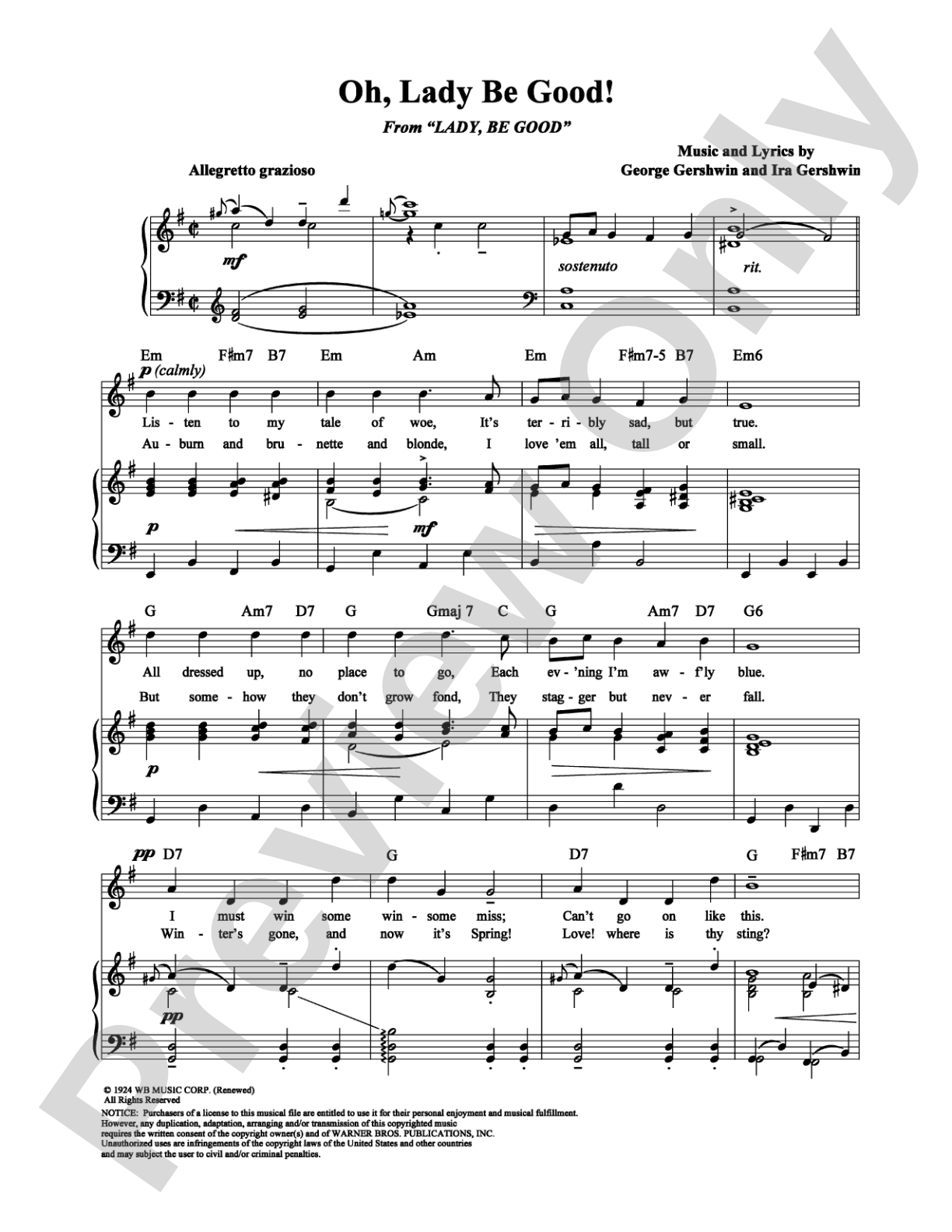
Oh, Lady Be Good!: Piano/Vocal/Chords Digital Sheet Music

Oh, Lady Be Good!: Piano/Vocal/Chords Digital Sheet Music

George Gershwin, Paul Whiteman

Item: 00-PS-0005398

Digital Download
$3.99
Description

Oh, Lady Be Good!: Piano/Vocal/Chords Digital Sheet Music isn't in MakeMusic Cloud just yet...but it could be. Let us know you'd like to see it, and you'll help shape what comes next. In the meantime, start a free trial and dive into thousands of interactive titles your students can play along with today.

Sample Audio
No sample audio found.
Sample Video
Additional Details
SKU: 00-PS-0005398

More about this title

About the Artist: Paul Whiteman

Paul Whiteman (1890, 1967) was a bandleader and orchestral arranger who shaped American popular music in the 1920s and 1930s. Known as the "King of Jazz," Whiteman elevated dance band music and popular song to concert hall legitimacy, commissioning works and recording arrangements that became the blueprint for American swing and standards.

Whiteman's influence on music education extends beyond his recordings. His approach to arranging taught generations of musicians how to balance accessibility with harmonic sophistication, making him essential listening for anyone studying the evolution of American popular music and orchestration.

Why we love this

This is a timeless jazz standard with melodic sophistication and harmonic interest that rewards careful interpretation. Singers and pianists working with this tune gain exposure to authentic period style while developing flexibility with swing rhythm and blues-influenced phrasing.

What to expect

Charming and sophisticated, with a melody that dances rather than soars. The tune balances straightforward accessibility with harmonic surprises that keep both singer and accompanist engaged throughout.

Who it's for

This digital sheet music suits singers preparing recital repertoire from the Great American Songbook, pianists building jazz standards fluency, or music students studying early 20th-century popular song conventions. It's also valuable for ensemble singers working through classic jazz vocal literature.

How to get the most out of it

  • Listen to Whiteman's original recording to internalize the rhythmic feel and articulation style characteristic of 1920s-30s jazz interpretation.
  • Shape the melody with conversational phrasing rather than strict metronomic evenness; allow space for breath and subtle timing variations that suggest swing.
  • Explore the harmonic movement carefully at the piano; the chord changes reward intelligent voice leading and allow for subtle comping variations between verse and chorus.

How to use it

Include this alongside other Gershwin-era standards in a jazz or musical theatre recital context. It pairs naturally with similar-period repertoire and offers a lighter, more playful contrast to heavier ballad material.

Skills your students will build

  • Swing rhythm interpretation and stylistic phrasing from the 1920s-30s era
  • Harmonic navigation through jazz chord changes
  • Balancing vocal line independence with sensitivity to pianistic comping and support
  • Period-appropriate articulation and rhythmic flexibility in popular song

You May Also Like