
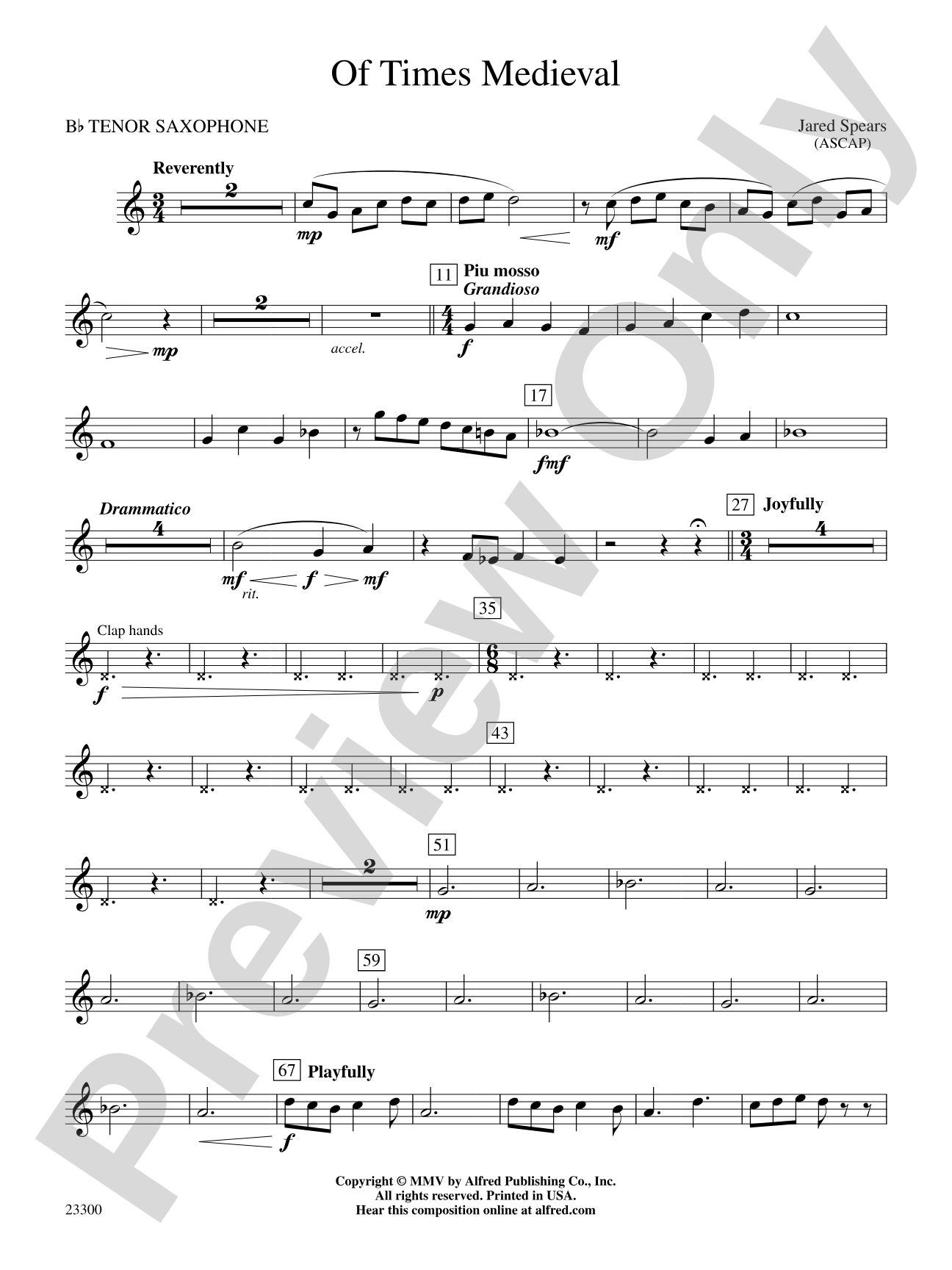

Of Times Medieval: B-flat Tenor Saxophone
Music by Jared Spears
Item: 00-PC-0000650_TX1
$3.00
Pickup currently not available
Description
Based on the chant Veni Creator Spiritus, Of Times Medieval takes your audience on a journey through Medieval Europe. Your audience will experience an ancient monastery, a celebration in the streets, and a clash of swords and shields. This bold and expressive piece is a must for any program.


Don't just read it, hear it, play along with it, and watch your students grow with it. In MakeMusic Cloud, Of Times Medieval: B-flat Tenor Saxophone comes alive with professional accompaniment, adjustable tempo, and built-in practice tools that turn solo practice into real progress.
Open in the Player
Jump straight in and assign it today.
Start Your Free Trial
Open this title and explore the full library in minutes.
Sample Audio
1
Audio File
--:--
0:00
0:00
Sample Video
No sample videos found.
Additional Details
Series:
Young Symphonic
Publisher:
Alfred Music
Page Count:
284
SKU:
00-PC-0000650_TX1
More about this title
About the Composer: Jared Spears

Jared Spears holds the title of Professor of Music Emeritus at Arkansas State University, where he spent 32 years teaching theory, history, composition, percussion, and band across all educational levels. A native of Chicago, he earned degrees from Northern Illinois University, the Cosmopolitan School of Music, and Northwestern University, studying composition under respected mentors including Alan Stout and Anthony Donato.
Since retiring in 1999, Spears has maintained an prolific composing and conducting schedule, creating over 250 works for band, choir, orchestra, and chamber ensembles published by American and European publishers. His honors include the Faricy Award for Creative Music from Northwestern University, Citations of Excellence from the National Band Association, multiple ASCAP awards, and recognition in international music directories. His music has been performed worldwide, and he has led festivals, camps, and clinics across Canada, Europe, and the United States.
Why we love this
Spears builds narrative depth into the concert band format without sacrificing musical sophistication. The scaffolding of scenes (monastery, street celebration, battle) gives your ensemble clear dramatic anchors, making the interpretive work visceral rather than abstract. Programming a piece that lands this hard emotionally and musically rewards both your musicians and your audience.
What to expect
Of Times Medieval evokes candlelit stone arches, then spills into bustling streets alive with celebration, before clashing into conflict. The harmonic language honors the ancient chant while the orchestration brings medieval color into sharp modern focus, creating a soundscape that feels both timeless and immediate.
Who it's for
Conductors programming at intermediate to advanced concert band levels who want music that engages audiences through storytelling and medieval atmosphere. Your ensemble needs solid fundamentals in dynamic contrast and phrasing, but the piece rewards focused preparation with memorable performances.
How to get the most out of it
- Shape the opening chant material with careful breath placement and dynamic control so the ancient melody emerges clearly; the audience needs to hear what anchors the entire work.
- Bring textural contrast into sharp relief at section transitions, especially moving from the monastery into street celebration. Clarity here heightens the dramatic journey.
- Balance the battle section's percussion and lower brass so the clash feels visceral without drowning out the harmonic progression; restraint amplifies impact.
- Use the full page count strategically in rehearsal. Mark passages that require precision ensemble playing versus those where expressive liberty serves the program.
How to use it
Feature this as a centerpiece work in a concert exploring historical themes or as the dramatic anchor in a program mixing classical and contemporary pieces. Its narrative arc and orchestral ambition make it a strong closer or a powerful first-half finale that resets audience attention.
Skills your students will build
- Sustaining long dynamic arcs and expressive phrasing across extended melodic lines
- Balancing textural layers when multiple thematic elements sound simultaneously
- Responding to programmatic cues and dramatic intent through sectional interpretation
- Precision ensemble rhythm in sections requiring rhythmic precision within flowing musical lines
- Understanding how harmonic language evolves from historical sources into contemporary arrangement